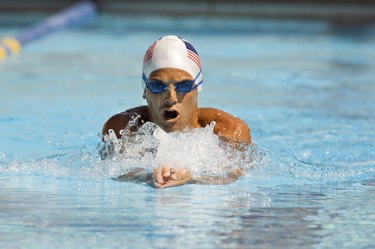
Aside from the water component, swimming is a pretty unique cardiovascular sport. When you run or cycle, there's really only one way to do the sport. Sure, you can shift your form, pace or cadence but generally, the mechanics of running and cycling stay consistent.
Swimming, however, involves different strokes, giving you way more options with your workout. And while the butterfly or freestyle may be among the most intense strokes, don't discount the breastwork from your pool workout.
Video of the Day
Video of the Day
Learn about all the benefits this stroke has to offer and consider mixing in a few breaststroke laps during your next workout.
3 Benefits of the Breaststroke
1. It Helps Preserve Energy
Although it may look simple, the breaststroke isn't the easiest to learn, according to U.S. Masters Swimming. The timing can be challenging to master and it can be hard to reduce drag during this stroke. In the breaststroke, you need your body to stay especially horizontal to prevent extra resistance, which makes it more difficult to swim.
With that said, you can also use the breaststroke as a recovery stroke during your workouts. Often, swimmers use this stroke over longer distances, as it doesn't require as much energy as, say, the butterfly. Compared to other strokes, the recovery phase of the breaststroke (aka the glide) lasts longer and your legs don't stay in constant motion (like with a flutter kick), giving them more time to rest.
2. It's a Full-Body Workout
Swimming, as a whole, is an amazing cardiovascular, total-body workout — the breaststroke is no exception, according to Swim England. Thanks to the water resistance pushing against your body, you also get muscle-building benefits.
And for those looking to lose weight, it's also an excellent way to burn extra calories. Swimming the breaststroke burns about 200 calories per half hour, per Swim England. That means, you can burn anywhere upwards of 400 calories an hour in the pool.
Although the calories you burn doing a breaststroke aren't as high as other swims, you can up the intensity of your workout. For instance, adding a pair of webbed hand paddles can make your workout more challenging, as these add extra resistance in the water, according to the Mayo Clinic. Plus, this can help build your muscular strength and endurance.
Or, instead of the standard breaststroke, you can use a flutter kick with breaststroke arms for an added challenge.
Calories Burned When Swimming the Breaststroke
Swimming the breaststroke burns about 200 calories per half-hour. While there are higher calorie-burning strokes, you can add hand paddles or switch to a flutter kick to make this more challenging.
3. It's Low Impact
Whereas running or walking can put extra stress on your joints, swimming is a great low-impact form of cardio, according to the Mayo Clinic. It may even be able to help improve joint use for people living with osteoarthritis.
But for those with pre-existing knee injuries, modifying the breaststroke is best. The leg motion of this stroke can put extra strain on your knees. So, if you wish to keep using the breaststroke arm motion, while protecting your knees, switch to dolphin kicking with your legs. Slow down the dolphin kick motion to sync with your arms and you can mimic the pace of the breaststroke without harming your knees.
Warning
Before you try the breaststroke (or any new type of swim stroke), always double check with a medical professional. Not all strokes are safe for all swimmers, so it's best to find what works with your body.