
What Does the Stopper Position in Soccer Do?
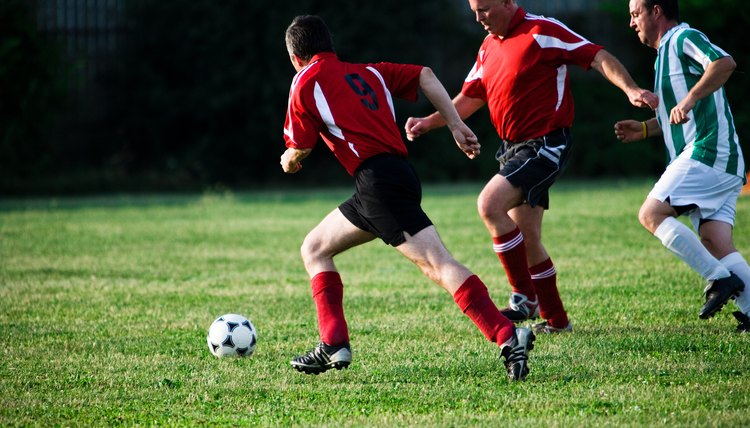
The fullbacks of a soccer team monitor the attacking players on the opposing team, attempting to stop them from dribbling or passing the ball downfield. All fullbacks must be confident, aggressive and unafraid of charging oncoming attackers. Stoppers are a special type of fullback that aggressively pursue opponents to stymie offensive maneuvers.
One Sweeps, One Stops
Some teams have two central fullbacks that perform the same basic functions, while other teams divide up the central fullbacks and give them separate responsibilities. The sweeper is the last line of defense. Her job is to clear the ball quickly if attackers attempt to pass it into the goal area. The stopper occupies the space slightly in front of the sweeper. Her job is to mark the most threatening offensive players to ensure they can’t send or receive passes. When the ball is in the opposing team’s half of the field, the stopper may move forward slightly to help support the midfielders, who are the players who occupy the central portion of the field.
Top Skills Needed
Stoppers must be fiercely competitive and willing to engage the other team’s best players. If an attacker attempts to dribble the ball through the defensive line, a stopper attempts to halt the advance. Many times attackers will attempt to launch a high pass toward the goal area, so stoppers must have excellent heading skills. When the other team’s goalie punts the ball, stoppers often are the players who have first contact, so they must have superior ball-handling skills to win possession.
Anticipation Is Key
A major function of stoppers is to limit the movement of attackers by anticipating and intercepting their passes. This requires the ability to read the opponents’ strategy and predict their likely movements. A stopper also relies heavily on the guidance of the sweeper, who generally occupies the space slightly behind him and so might have a better view. A sweeper calls out commands to the stopper, such as ordering him to move forward to fill a gap in the defense.
Time to Tackle
A key defensive strategy is tackling. A stopper executes a block tackle by placing her foot on the ball as the attacker attempts to dribble past. A sliding tackle consists of launching forward so that the foot makes contact with the ball, knocking it from the opponent’s control. Stoppers must be aggressive enough to perform hard tackles but also must be disciplined enough to avoid recklessly attacking an opponent, which puts the whole team at risk of a penalty.
References
- Coaching Soccer Successfully; Roy Rees, et al.
- BBC Sport: Football: Tackling and Defending; September 2005
Writer Bio
Stan Mack is a business writer specializing in finance, business ethics and human resources. His work has appeared in the online editions of the "Houston Chronicle" and "USA Today," among other outlets. Mack studied philosophy and economics at the University of Memphis.