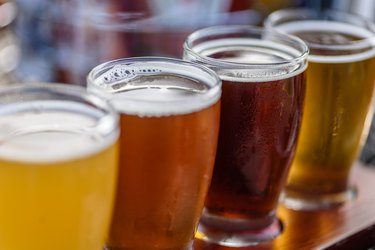
You've probably heard the urban legend that drinking a lot of beer gives you a "beer belly." The truth is that beer is not solely responsible for widening the waistline. It's the extra calories in beer and other alcoholic drinks that can cause an increase in body fat.
Tip
Drinking beer adds extra calories to your diet, which can cause you to gain weight. It can also increase your appetite and calorie intake.
Video of the Day
What Causes Fat Gain
Sometimes it seems as if fat appears for no reason. You think you eat pretty healthfully, and you even exercise sometimes, but you still pack on the pounds. Although there are many factors involved in fat gain, including gender, age and genetics, it's typically the result of consuming more calories than you expend each day.
Video of the Day
"Empty calories" are often to blame. These are calories from foods and beverages that offer little nutrition but add to your daily total. Alcoholic drinks are a prime example.
One can of beer has 153 calories, according to the USDA. On a 2,000-calorie diet, a can of beer would make up almost 8 percent of your daily intake. A pint of beer, with 204 calories, would take up 10 percent of your daily calorie needs. And if, like many people, you have two or three, you could be spending 20 to more than 30 percent of your calorie budget on beer, which doesn't contribute any nutrients to your diet.
But beer and other alcoholic drinks aren't usually included in people's daily calorie needs; rather, they are consumed on top of them, as a calorie surplus. According to Mayo Clinic, there are 3,500 calories in one pound of fat. If you exceed your daily calorie needs by drinking two pints of beer each day, you could gain nearly a pound of fat every eight days.
It's Not Just the Beer
Most people don't pour a beer and sit down to eat a nice, fresh salad. Beer goes with pizza, burgers and barbecue — all fatty, highly caloric foods. Although you might normally be able to resist these tempting foods, it gets more difficult after a couple of pints.
A handful of small studies have examined this effect. In one study published in Appetite in June 2015, participants were provided with either vodka and orange juice or just orange juice before a lunch meal. Results showed that those who drank alcohol had a stronger preference for high-fat, savory foods and consumed 11 percent more calories than those who did not drink alcohol.
Another study published in Science Translational Medicine in July 2015 used functional magnetic resonance imaging (MRI) to assess alcohol's effects on brain regions involved in reward and feeding behavior. During two lunch sessions, participants received either an infusion of alcohol or a saline solution and were exposed to a meat aroma.
Researchers measured the brain's blood oxygen level-dependent response (BOLD), and then participants were served a standardized lunch. Researchers found that those who received the alcohol infusion had a greater BOLD response to the meat aroma and subsequently consumed more food at the lunch meal.
Everything in Moderation
According to a research review published in Current Obesity Reports in January 2015, light to moderate drinking is not likely to cause fat gain. The Dietary Guidelines for Americans defines moderate drinking as no more than one alcoholic drink per day for women and no more than two for men. For beer, one drink is considered to be 12 ounces at 5 percent alcohol. Higher alcohol beers may count for as many as two drinks.
However, light to moderate alcohol consumption could benefit your health, including providing reduced risk of heart attack, stroke, death from heart disease, diabetes and gallstones, according to Harvard Health Publishing. But exceeding these limits on a regular basis can have deleterious effects. Heavy drinking, categorized as four or more drinks in a day or eight or more drinks in a week for women, and five or more drinks per day or 15 or more drinks in a week for men, can not only cause weight gain but can also shorten your lifespan.
- NIH: "Factors Affecting Weight & Health"
- University of Michigan: "Empty Calories"
- USDA: "Basic Report: 14003, Alcoholic Beverage, Beer, Regular, All"
- Mayo Clinic: "Counting Calories: Get Back to Weight-Loss Basics"
- Science Translational Medicine: "Alcohol’s BOLD Effect on Food Intake"
- Current Obesity Reports: "Alcohol Consumption and Obesity: An Update"
- Appetite: "Moderate Alcohol Consumption Stimulates Food Intake and Food Reward of Savoury Foods"
- Dietary Guidelines for Americans: "Appendix 9. Alcohol"
- Harvard Health Publishing: "Sorting out the Health Effects of Alcohol"