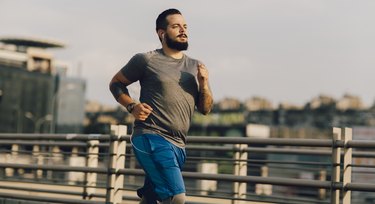
Fat deposits around the waistline — often called "love handles" — are a common point of struggle for people. But the truth is excess body fat can crop up anywhere. Although you can't target your hips and belly fat specifically, if you lose total body fat, you'll also slim down your midsection.
Tip
The best exercises to get rid of "love handles" include aerobic activities and strength training. But you also need to make sure that you address your diet as well.
Video of the Day
Prime Your Body for Fat Loss
First thing's first: You're going to need more than exercise to get rid of love handles. Reducing your calorie intake and eating healthy foods is also key. The combination of exercise and diet will help you create a calorie deficit, which is crucial for fat loss.
Although losing weight depends on many factors, including genetics, your body type, sex, age, medical conditions and what medications you take, it's largely a matter of keeping your calorie intake lower than your calorie output. Both aerobic exercise and strength training will contribute a good amount to your total daily calorie expenditure (TDEE). Reducing your calorie intake will widen the gap.
While there's no way to predict fat loss, you can get a general idea of the concept of a calorie deficit with the 3,500-calorie rule, which is, according to Nutrition.gov., a pound of fat equals 3,500 calories. Therefore, for every 3,500-calorie deficit you create, you lose a pound of fat.
Tip
If you create a daily 500-calorie deficit, theoretically, you'll lose a pound of fat a week. If you create a 1,000-calorie daily deficit, you'll shed two pounds a week, some of which may come from your love handles.
Dial Up the Intensity on Your Cardio Sessions
Any type of aerobic exercise will help you burn fat around your waistline — again, as long as you do it regularly. When choosing activities, the most important thing isn't just how many calories it burns, but whether you enjoy doing it and will do it often.
That said, there's one thing you should strive for: intensity. Doing any activity with more intensity will increase the calorie burn. For example, running burns a lot more calories than walking.
According to Harvard Health Publishing, a 155-pound person will burn around 149 calories walking at a pace of 3.5 miles per hour. But if that same person runs for 30 minutes at a pace of 6 miles per hour, she'll burn 372 calories.
That is a huge difference that will affect how quickly you can shed body fat. Of course, you may not be able to run that fast right now, but the idea is to set it as a goal to work toward.
Tip
If you bike, swim, dance or kickbox for your cardio, aim to increase the intensity. Gradually increasing workout intensity will ensure that your body stays challenged and is working hard enough to torch fat.
Try These Love Handle Exercises With Weights
It's a common misconception that doing lots of ab exercises will help you burn fat around your waist. In fact, it will only strengthen your abdominals. While that's still an important part of any strength-training program, the only way to lose love handles is to burn the fat off with a calorie deficit.
You already know that cardio exercise burns calories, but so does strength training because building lean muscle mass revs your metabolism. Muscle is metabolically active. Your body expends energy to build and maintain it, much more so than fat.
Having a lot of muscle expends a lot of energy — up to 20 percent of your total daily energy expenditure, according to Paige Kinucan and Len Kravitz, PhD, of the University of New Mexico. You're going to get a lot more bang for your buck if you include strength training in your exercise program.
The best exercises for love handles in the gym are compound exercises. These use more than one muscle group at a time, which activates more muscle fibers and leads to greater calorie expenditure while you are doing them. Examples include:
Move 1: Squat
- Hold a heavy dumbbell by one end at chest-height.
- Begin with your feet just wider than hip-distance apart. (Toes can face forward or turn out slightly.)
- Keeping your chest tall and core tight, hinge your hips back and down to sink into a squat so your upper legs are parallel with the floor (or as low as you can comfortably go with good form).
- Press through all four corners of your feet to return to standing.
Move 2: Lunge
- Start standing, holding a dumbbell in each hand. The weights can hang at your sides or you can lift them up to your shoulders.
- Step a few feet forward with your left foot.
- Lower into a lunge until both knees are bent to 90 degrees. Your back knee should hover just above the ground, and your front knee should be stacked over your ankle.
- Hold for a beat before pushing through your front foot to return to standing.
- Repeat on the other leg.
Move 3: Deadlift
- Fix the weight plates on your barbell and position it on the floor in front of you. If needed, position it on an elevated platform to allow for a reduced range of motion.
- Step up to the bar, shins almost against it, feet planted firmly hip-width apart. Keep your spine straight, chest up and shoulders back and down.
- Hinge from the hips, softening your knees as your hips sink low enough to let you grasp the bar with your hands shoulder-width apart.
- Check your posture: Your spine should be straight and long, chest up and open, shoulders back.
- Engage all the muscles of your core to maintain this position as you push your feet into the floor, as if you were trying to push the floor away from you, and lift the bar.
- Finish the motion by lifting your chest and engaging your lats to stabilize the bar in front of your hips.
- Return the bar by reversing the motion, pushing your weight back into your hips and softening your knees, letting the bar travel in a controlled path back down to the floor along your body.
Move 4: Push-Up
- Begin in a high plank with your core and glutes engaged. Your shoulders should be stacked over your wrists and your hips should be in line with your head and heels.
- Bend at the elbows at about a 45-degree angle from your torso and lower your body toward the ground.
- On the way down, squeeze your shoulder blades together.
- When your chest hovers just above the ground (or however far down you can go), press into the ground and push your shoulder blades apart to return to the starting position.
Move 5: Bent-Over Row
- Stand with your feet hip-width apart and hold a dumbbell in each hand in front of your thighs.
- Shoot your hips back and hinge forward at least 45 degrees (as much as 90 degrees), keeping your back flat. Start with your arms extended toward the ground, palms facing each other.
- Draw your elbows up toward your ribs and pull the weights up alongside your lower abdomen.
- As you lift the weights, focus on squeezing the shoulder blades together.
- Lower back down to the start with control.
Move 6: Dumbbell Thruster
- Start standing with your feet just wider than hip-distance apart, core engaged, with a dumbbell in each hand at your shoulders, palms facing in.
- Keeping your chest tall and core tight, hinge your hips back and down to sink into a squat. Lower until your thighs are parallel with the ground — or as low as you can comfortably squat while maintaining good form.
- Press through all four corners of your feet to return to standing.
- As you straighten your legs, press the dumbbells up over your head. Your upper arms should stay close to your ears.
- Slowly bend your elbows to lower the dumbbells back down to your shoulders with control.
Move 7: Burpee
- Stand with your feet shoulder-width apart and your arms by your sides.
- Bend your knees, keeping your back straight and letting your butt drop down into a squat.
- Reach your hands forward, placing them on the floor shoulder-width apart.
- Kick your feet back to come into a high plank.
- Lower your chest and belly down to the floor.
- Press through your hands to quickly push your body back up.
- Jump your feet back in, making sure they land wider than your hands.
- Lift your hands, and press through your heels to stand.
- Jump straight up, reaching your arms overhead.
- Land gently and immediately lower into your next rep.
In addition, doing compound exercises at a high intensity — whether by lifting heavy loads or by taking minimal rest breaks in between sets — encourages something called excess post-exercise oxygen consumption (EPOC).
According to the American Council on Exercise, the body expends energy to repair, recover and return to a state of homeostasis after intense exercise. This means you continue to burn calories long after finishing your workout.
The other benefit is that many of these compound exercises, especially if you are doing them with free weights, also challenge your abdominal muscles. Once you've burned the love handles, you'll see the fruits of your labor in your tight, toned midsection.
But Remember: Consistency Is Key
Exercises to get rid of love handles are only as good as the regularity with which you do them. Stick to a consistent exercise program, and you'll see results.
So how much exercise do you really need? The answer is: as much as you can fit into your lifestyle. Some people are able to make time for daily two-hour gym sessions, while other people can only sneak in 45 minutes on their lunch break. It's important to make exercise work for you rather than the other way around (although you will need to work).
As a starting point, you can aim for the U.S Department of Health and Human Services' (HHS) recommended daily minimum, which is 150 minutes of moderate-intensity aerobic exercise or 75 minutes of vigorous exercise.
Once you're able to make that a habit, the HHS says you can reap many more benefits by getting 300 minutes of moderate-intensity or 150 minutes of vigorous aerobic exercise weekly. The HHS also recommends doing strength training exercise for all the major muscle groups twice weekly.
- Nutrition.gov: "Frequently Asked Questions (FAQs)"
- U.S Department of Health and Human Services: "Physical Activity Guidelines, 2nd Edition"
- Harvard Health Publishing: "Calories Burned in 30 Minutes for People of Three Different Weights"
- University of New Mexico: "Controversies in Metabolism"
- ACE: "7 Things to Know About Excess Post-Exercise Oxygen Consumption (EPOC)"
- ACE: "5 Benefits of Compound Exercises"