
Whether you stretch before or after your workout, how you should stretch depends on what you want your stretching to accomplish.
Generally, there are two popular approaches to choose from: static stretching and dynamic stretching. While static stretching may be familiar from middle-school gym class, dynamic stretching might have only entered your workout routine more recently.
Video of the Day
Video of the Day
Here's the breakdown of each type of stretching, when to use one over the other and a few sample stretches of each style for you to try.
What Is Dynamic Stretching?
Dynamic stretching is active, which pretty much means you stretch your muscles while moving around.
"Dynamic stretching is lengthening a connective tissue — including muscles, tendons and fascia — by actively moving your muscles and joints through their full range of motion," says physical therapist and certified strength and conditioning specialist Grayson Wickham, PT, DPT, CSCS, founder of the digital mobility platform Movement Vault.
You might briefly hold the position in which your joints and muscles are the most stretched, but movement is the name of the game.
The Pros and Cons of Dynamic Stretching
"The biggest benefit of dynamic stretching is that you strengthen your muscles while you stretch them out," Wickham says. "You essentially increase your muscle strength throughout a full range of motion." As a result, you increase joint stability, which then helps you move properly and avoid pain and injury.
Another perk of dynamic stretching: improved proprioception, aka coordination. "By actively moving your joints through their full range of motion, you stimulate your nervous system receptors in and around the joint," Wickham explains.
Since dynamic stretching involves activating and contracting specific muscles, it's also a great way to prepare your body for a workout, Wickham says. In addition to firing up your nervous system, it also increases blood flow to your muscles and ups your body temperature. Jumping jacks, anyone?
Dynamic stretching works wonders for performance, too: According to a February 2012 report in the International Journal of Sports Physical Therapy, dynamic stretching supports running and jumping performance during sports competitions, such as basketball.
"Dynamic stretching actively moves your joints through their full range of motion and stimulates your nervous system receptors in and around the joint."
As long as you perform dynamic stretches correctly, this type of movement doesn't come with many risks, says certified athletic trainer Austin Martinez, CSCS, ATC, director of education for Stretch Lab.
However, "if you were just in the car on a road trip for 12 hours and immediately jump into an intense dynamic stretching routine, your body may not be ready for it, which could lead to pain and injury," Wickham says.
As with any movement routine, it's important to start slow, listen to your body and increase your speed or intensity accordingly.
When to Opt for Dynamic Stretching
Because of its body-activating abilities, dynamic stretching is an ideal part of any warm-up before working out, Wickham says.
Otherwise, you can use dynamic stretching any time you want to get moving. Just avoid doing it late at night, since it may increase your alertness and make falling asleep difficult, he adds.
Related Reading
3 Dynamic Stretches to Try Pre-Workout
Perform each dynamic stretch for 30 to 60 seconds and repeat for 5 minutes total.
Move 1: Lunge Rotation
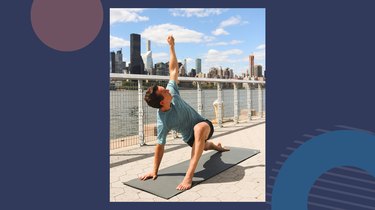
- Start in a half-kneeling position, with your left leg forward and your right knee on the ground.
- Move your right knee as far back as possible, and then place your right hand opposite your left leg on the ground.
- Press the top of your right foot into the ground and straighten your right knee and leg.
- Extend your left arm straight out to the side as you push your right hand into the ground and rotate your chest up toward the ceiling as far as possible. Hold for five seconds.
- Next, rotate your chest to the opposite side, down toward your planted hand. Hold for five seconds.
- Repeat on the other side.
Move 2: Around the World
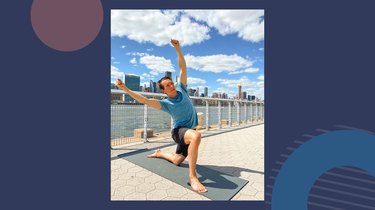
- Start in a half-kneeling position, with your front leg extended in front of you and your back knee on the ground.
- Punch both arms up to the ceiling as far as possible and then bend your torso backwards.
- Reach your arms and upper body to one side as far as possible and push your hips back to rotate toward your front leg, reaching as far forward as your balance will allow. Use your core muscles to create the movement.
- Reach toward the opposite side and rotate to come back up into the upright position.
- Repeat in the opposite direction and then switch legs.
Move 3: Inchworm
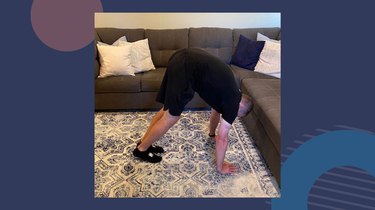
- Start in a high plank position with your shoulders stacked over your wrists and your glutes tight.
- Slowly walk your feet in toward your hands, keeping your core engaged and your legs as straight as possible.
- Once you've reached a standing hamstring stretch position, walk your hands out in front of you until you reach a high plank position again.
What Is Static Stretching?
If you've ever played a team sport, attended a workout class or have simply lived through P.E., chances are you've done your fair share of static stretching.
Simply put, static stretching is just stretching in which you stay still and hold a position for an extended period of time, Martinez explains. When you (try to) touch your toes and hold that position? Yep, that's a static stretch.
During static stretching, you don't contract or engage your muscles but instead try to relax so that you can lengthen your muscles and connective tissues (like tendons), Wickham says. For this reason, static stretching is considered a type of passive stretching.
The Pros and Cons of Static Stretching
The goal of static stretching is to lengthen and relax your muscles, which can ultimately improve your muscle flexibility, joint range of motion and joint mobility, Martinez says. Basically, over time, you can progress from being able to only reach your hands down to your shins to being able to touch your toes.
According to a May 2018 review in the Journal of Sports Rehabilitation, static stretching is effective in increasing joint range of motion and muscle extensibility (aka ability to lengthen).
To Wickham, though, one of the biggest benefits of static stretching is that it helps you relax and begin to recover. He recommends that clients interested in static stretching pair it with deep breathing, which signals the body to calm down via the parasympathetic nervous system.
That said, there are some disadvantages of practicing static stretching. In fact, stretching can increase injury risk when done before a workout or athletic event, like a race or soccer match, Wickham says.
Plus, it might hurt muscular performance, a March 2013 review in the Scandinavian Journal of Medicine and Science in Sports suggests. This is probably due to the fact that static stretching doesn't warm up your joints and nervous system the same way that dynamic stretching does.
When to Opt for Static Stretching
Given the fact that static stretching can potentially spell trouble for your exercise efforts, it's best to avoid doing it before a workout, Wickham says.
Instead, static stretching is best used during a cooldown after a workout, game or race. "Static stretching can also be an effective tool to use on recovery days, again incorporating deep breathing techniques," Wickham says.
3 Static Stretches to Try Post-Workout
Move 1: Seated Hamstring Stretch
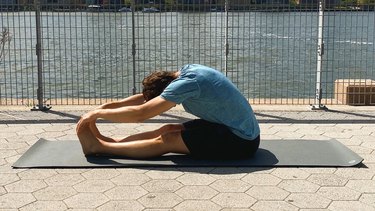
- Sit on the floor with your legs extended straight out in front of you.
- Reach both of your arms forward as close to your toes as possible.
- Hold this position for at least 20 seconds and relax, allowing yourself to slowly reach your hands farther.
Move 2: Pigeon Pose
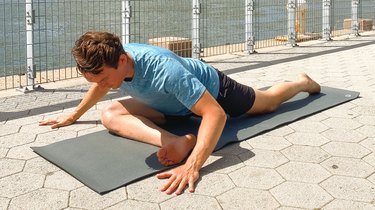
- Sit on the floor with your front knee bent and position your knee and ankle so that your front shin rests on the floor perpendicular to your torso.
- Extend your other leg straight back behind you.
- Keep your hands on the floor in front of your shin, or slowly walk them out in front of you so that your torso lowers down toward your front leg.
- Hold this position for at least 20 seconds and relax as much as possible into your hips.
- Repeat on the other leg.
Move 3: Lateral Neck Stretch

- Sit up tall on the floor with your legs crossed.
- Place your right hand over the top of your head to rest it just above your left ear.
- Gently use your hand to tilt your head toward your right shoulder.
- Hold this position for at least 20 seconds and feel the left side of your neck relax.
- Repeat on the other side.
The Bottom Line on Dynamic vs. Static Stretching
Dynamic stretching is active; stretching your muscles while moving strengthens them at the same time and is best used as a warm-up. Static stretching is stationary and helps lengthen and relax your muscles, making it ideal for a cooldown.
- International Journal of Sports Physical Therapy: "Current Concepts in Muscle Stretching for Exercise and Rehabilitation"
- Journal of Sports Rehabilitation: "The Effectiveness of PNF Versus Static Stretching on Increasing Hip-Flexion Range of Motion"
- Scandinavian Journal of Medicine and Science in Sports: "Does Pre-Exercise Static Stretching Inhibit Maximal Muscular Performance? A Meta-Analytical Review"