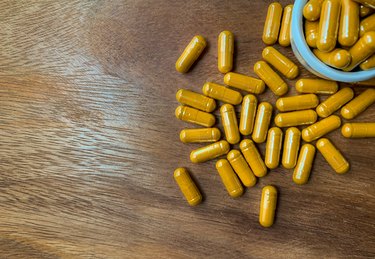
Turmeric capsules have captured the attention of the science and medical community for the past few years. Because of its anti-inflammatory properties, turmeric is said to help with everything from minimizing joint pain to reducing heart disease risk.
Tip
This is one supplement with a good deal of research behind it. Turmeric supplement benefits may include reducing inflammation associated with arthritis, inflammatory bowel disease and non-alcoholic fatty liver disease.
Video of the Day
What is Turmeric?
Turmeric, or Curcuma longa, is a plant that grows throughout India and Asia. It's known mainly for its underground stem or rhizome that looks a bit like ginger root. In fact, the two plants are related. Turmeric root is used as a dried or fresh spice or seasoning in many Indian and Asian foods. It's also the main ingredient in curry powder.
Video of the Day
You can recognize turmeric by its bright yellow color and distinctive taste and aroma. It gets its color from compounds called curcuminoids, which also happen to be responsible for turmeric's health benefits.
Turmeric has been used medicinally for thousands of years. According to the National Institutes of Health's National Center for Complementary and Integrative Health, turmeric has traditionally been used in Ayurvedic medicine to treat conditions like breathing problems, fatigue, rheumatism and pain.
If you want to try turmeric, you can use the fresh root and grate it to make tea. You can also use the dried powdered spice in cooking, or you can take turmeric capsules.
Turmeric Benefits for Inflammatory Diseases
Much of the research on turmeric, and its active ingredient curcumin, has focused on its antioxidant properties and its ability to reduce inflammation in various conditions like osteoarthritis, rheumatoid arthritis, inflammatory bowel disease and cardiovascular disease.
Scientists aren't quite sure how turmeric reduces inflammation, but it appears to somehow inhibit the production of cytokines, which are pro-inflammatory compounds.
A review published in August 2016 in the Journal of Medicinal Food analyzed the results of eight studies on people with both osteoarthritis and rheumatoid arthritis. Researchers found turmeric supplement benefits included a reduction in joint pain, stiffness, swelling and improved movement.
Some people also reported they were able to use less pain medication while using turmeric capsules. The turmeric dosage used in the individual studies varied, but the average turmeric dosage used was 1,000 milligrams per day for eight to twelve weeks.
Turmeric and curcumin have also been tested on inflammatory bowel diseases (IBD) like ulcerative colitis and Crohn's disease. A few studies suggest that it might be helpful.
A review on herbal therapies for IBD published in Annals of Gastroenterology in April 2015 found that turmeric capsules helped extend the length of disease remission in those with ulcerative colitis when it was taken along with their standard medication.
Those who took their standard medication alone had more frequent disease relapse. The turmeric dosage used in this study was 1,000 milligrams twice per day.
Turmeric Reduces Cardiovascular Disease Risk
Turmeric supplement benefits might also extend to reducing cardiovascular disease risk, but the findings are somewhat mixed. Turmeric supplements seem to decrease total and LDL (bad) cholesterol but several studies found only a minimal reduction, and no effect on HDL (good) cholesterol or triglycerides.
One condition that they do seem to have some benefit for is non-alcoholic fatty liver disease (NAFLD), which is a major risk factor for cardiovascular disease.
Read more: How to Repair a Fatty Liver
In a small study of people with NAFLD published in Phytotherapy Research in September 2016, those who took a daily 500-milligram curcumin supplement for eight weeks had a 78.9 percent reduction in their liver fat content, compared to 27.5 percent in the placebo group.
While this study only included 80 participants, it was a well-designed randomized controlled trial. Interestingly, those who received the supplement had significant improvements not only in their liver fat, but also a reduction in body mass index, cholesterol, triglycerides, glucose levels and measures of inflammation, compared to those who took a placebo.
Turmeric Safety, Side Effects and Absorption
Most of the studies reviewed found turmeric capsules are safe to take, and they have minimal side effects. The National Institutes of Health's National Center for Complementary and Integrative Health states that gastrointestinal upset might occur if you take high doses of the supplement, or for a long time.
One thing to know about turmeric capsules is that they often have poor bioavailability. That means they're not well absorbed, and they're very quickly metabolized and eliminated from your body, so they're often ineffective.
According to the Linus Pauling Institute at Oregon State University, taking a turmeric supplement that has piperine (the compound in black pepper) added to it can enhance the bioavailability by preventing it from being metabolized too quickly. When turmeric is metabolized more slowly, it has more time to work.
If you take turmeric supplements along with other medications, make sure you discuss it with your doctor, because there's a chance they can interact.
- National Institutes of Health National Center for Complementary and Integrative Health: “Turmeric”
- Journal of Medicinal Food: “Efficacy of Turmeric Extracts and Curcumin for Alleviating the Symptoms of Joint Arthritis: A Systematic Review and Meta-Analysis of Randomized Clinical Trials”
- Annals of Gastroenterology: “Herbal and Plant Therapy in Patients with Inflammatory Bowel Disease”
- Phytotherapy Research: “Treatment of Non-alcoholic Fatty Liver Disease with Curcumin: A Randomized Placebo-controlled Trial”
- Oregon State University Linus Pauling Institute: “Curcumin”
- Foods:"Curcumin: A Review of Its’ Effects on Human Health"