Azurita/iStock/Getty Images
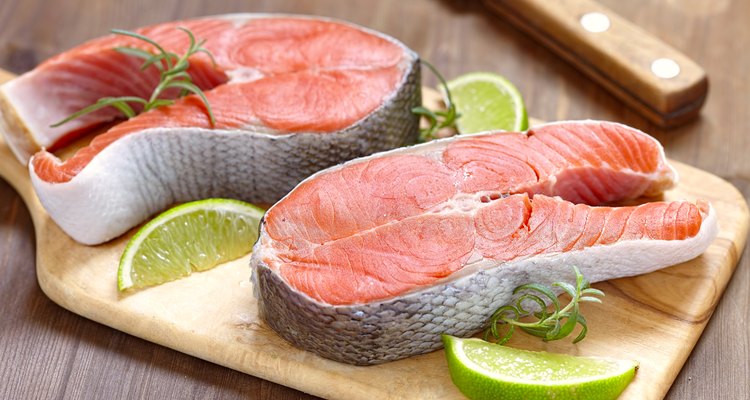
Fishmongers and markets commonly sell salmon fillets with the skin remaining on one side. You might be tempted to remove the skin, but don't. Heart-healthy omega-3 fats are just under the skin, and leaving the skin on helps keep the fish from falling apart ... and it tastes good! A common method for cooking salmon at home is simply to bake it. This method will retain the fish's natural flavor and much of its nutritional value. Serve baked salmon with sauteed asparagus, roasted red potatoes and a rich Chardonnay for a simple, yet elegant, meal.
Preheat the oven to 450 degrees Fahrenheit.
Rinse 1 lb. salmon fillet under cold water and allow it to drain in a colander for five minutes. Pat with paper towels until it is completely dry.
Brush the skin side of the fish with extra virgin olive oil and place, skin side down, in a baking dish or roasting pan. Then, brush the other side with olive oil and season with sea salt or kosher salt and coarse ground black pepper to taste.
Bake for until desired doneness -- 11 minutes for rare, 12 to 14 minutes for medium, and 14 to 17 minutes for more well done fish with a crisp, lightly browned outside.
Transfer the fish to a large serving platter or individual serving plates. Allow it to rest for 5 minutes before serving, so the internal juices can redistribute, making the meat moist and tender.
Related Articles

How to Bake Lingcod
How to Marinate and Pan-Sear Salmon
How to Cook Trevally

How to Cook Parrotfish
How to Cook Prawns in a Oven
How to Cook Mackerel in an Oven

How to Remove the Smell of Cologne From ...

How to Pluck Your Upper Lip With ...
How to Bake Boneless Skinless Tilapia
How to Cook Saba Fish

How to Bake Breaded Mahi Mahi
How to Pan Sear Sea Bass
How to Cook Panfish in the Oven
Cooking Frozen Swai Fillets
Do You Cook Fish Skin-Side Down?

How to Cook Blue Eye Cod
How to Cook Salmon Fillets on the Stove ...
How to Cook Six-Ounce Swai Fillets

How to Get Nail Glue Off of Your Skin

Yogurt Face Mask for Acne
References
- "Fish: The Complete Guide to Buying and Cooking"; Mark Bittman; 1999
- "Fish and Shellfish"; James Peterson; 1996
Resources
Writer Bio
Christopher Godwin is a freelance writer from Los Angeles. He spent his formative years as a chef and bartender crafting signature dishes and cocktails as the head of an upscale catering firm. He has since ventured into sharing original creations and expertise with the public. Godwin has published poetry, fiction and nonfiction in publications like "Spork Magazine," "Cold Mountain Review" and "From Abalone To Zest."
Photo Credits
Azurita/iStock/Getty Images