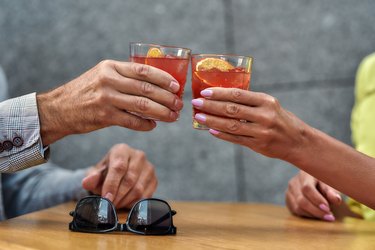
When you're ordering at a bar or restaurant, it's helpful to know about the calories in mixed drinks that catch your eye. Because drinks feature many different types of alcohol and mixers, the calories a standard drink contains can vary widely — and some may even put you over your sugar limit for the day.
It's also important to know exactly what ingredients are in your go-to libation. For instance, you may know you love Hurricane cocktails, but you might not know the many different fruit juices and types of alcohol that go into them (and what those mean for the calories in the mixed drink).
Video of the Day
Video of the Day
Here's everything you need to know about mixed drink calories, carbohydrates and sugar, and how to opt for lighter versions when possible.
Related Reading
Margaritas
Served over ice in a salt-rimmed glass with a wide brim, a margarita is a Mexican-inspired beverage that's often enjoyed alongside nachos, tacos or burritos. This drink has ingredients including tequila and lime juice.
There are 275 calories in a margarita. More specifically, a standard margarita drink (225 grams or about 8 fluid ounces) has the following nutrition profile, per the USDA:
- Calories: 275
- Carbs: 36.1 grams, 12% Daily Value (DV)
- Sugar: 36.1 grams
Note that the FDA calculates its Daily Value (DV) percentages based on eating 275 grams of carbs on a 2,000-calorie daily diet.
1800 Ultimate Margarita
1800's Ultimate Margarita comes premixed, so there's no need to add your own tequila. The brand suggests pouring it over ice or blending it with ice to enjoy.
A 4-ounce serving has:
- Calories: 130
- Carbs: 33 grams (10% DV)
- Sugar: 30 grams
Cadillac Margarita
The Cadillac margarita is a version of the classic margarita cocktail. It's known as the "Cadillac" of margaritas because it contains only high-quality ingredients and sometimes a little extra triple sec or any orange-flavored liqueur.
A standard recipe for the Cadillac margarita includes 1 1/2 ounces of tequila, 1 ounce of Grand Marnier orange liqueur and 1/4 ounce of fresh lime juice, per DrinksMixer.
There are 96 calories in 1 1/2 ounces of 80-proof tequila. Meanwhile, there are 76 calories in 1 ounce of 80-proof Grand Marnier and 2 calories in 1/4 ounce of lime juice.
Overall, there are 174 calories in a Cadillac margarita when all of its ingredients below are combined:
Calories | Carbohydrates | Sugar | |
|---|---|---|---|
1 ½ oz. of tequila | 96 | 0 g | 0 g |
1 oz. of Grand Marnier orange liqueur | 76 | 6.5 g | 6.3 g |
1/4 oz. of lime juice | 2 | 0.6 g | 0.1 g |
Total in Cadillac Margarita | 174 | 7.1 g | 6.4 g |
Some recipes suggest adding 1/2 ounce of triple sec to the drink alongside 1/2 ounce of Grand Marnier. Triple sec contains 52 calories per 1/2 ounce. There are 188 calories in a Cadillac margarita with both triple sec and Grand Marnier.
The salt commonly added to the rim of margarita glasses contains zero calories. Triple sec and Grand Marnier contain more calories than tequila because they are liqueurs, deriving added calories from sugar.
Frozen Strawberry Margarita
The frozen margarita machine was invented by a restaurant owner in Dallas on May 11, 1971, and was crafted from a soft-serve ice cream machine, according to the National Museum of American History.
A traditional margarita is made with tequila, triple sec and lime juice. A frozen strawberry margarita is made by combining these ingredients — plus 1/4 cup of strawberries — with ice cubes and blending until smooth. A margarita glass often has a double bowl with a narrow bowl on the bottom topped by a wide bowl, as well as a wide upper rim to allow for salting.
There are 169 calories in a frozen strawberry margarita. It also contains 11.3 grams of carbohydrates and 7.9 grams of sugar, when all of the ingredients below are combined:
Calories | Carbohydrates | Sugar | |
|---|---|---|---|
1 ½ oz. of tequila | 96 | 0 g | 0 g |
1/2 oz. triple sec | 52 | 5.5 g | 5.4 g |
1/4 cup strawberries | 13 | 3.2 g | 2 g |
1 oz. lime juice | 8 | 2.6 g | 0.5 g |
Total in Frozen Strawberry Margarita | 169 | 11.3 g | 7.9 g |
Some recipes also call for the addition of 1 teaspoon of sugar, which adds 16 calories and 4.2 grams of sugar.
Jumbo Frozen Margarita
What constitutes a jumbo frozen margarita will vary from restaurant to restaurant. Overall, a jumbo 16-ounce frozen margarita quickly adds up in calories, carbohydrates and sugars:
- Calories: 586
- Carbs: 77.1 g (26% DV)
- Sugars: 77.1 g
A jumbo frozen margarita may have more or fewer calories depending on size and added flavorings and ingredients, but the calories in a frozen margarita mostly come from alcohol and sugar.
Tip
You can make a lighter margarita at home by replacing sugar with stevia. Squeeze ripe limes for a bright, fresh flavor and use just 1 ounce of tequila. Pour the drink over ice or blend it with crushed ice cubes to cut down on your frozen margarita calories.
Wine, light beer or sparkling water are smarter choices if you're watching your calorie intake and want to cut down on jumbo margarita calories when sipping.
Jose Cuervo Margarita Mix
Jose Cuervo margarita mix is a non-alcoholic blend that you mix with tequila and ice. Although the margarita mix tastes like limes, it offers none of the citrus fruit's nutritional benefits.
A 4-ounce serving of Jose Cuervo Classic Margarita Mix has 110 calories, no fat and no cholesterol. The mix alone contains 3 percent of your DV of sodium, but if you serve it in a salt-rimmed glass, the total sodium content will rise.
The calories in Jose Cuervo Margarita Mix come from carbohydrates. Each 4-ounce serving contains 28 grams of carbohydrates, 24 of which are sugars. Jose Cuervo Margarita Mix includes high-fructose corn syrup, natural flavors, preservatives, yellow no. 5 and other ingredients. The mix has no fiber or protein.
Here's the nutritional breakdown of a 4-ounce serving of Jose Cuervo Classic Margarita Mix:
- Calories: 110
- Carbohydrates: 28 g (9% DV)
- Sugars: 24 g
You'll add 96 calories by pouring in 1 1/2 ounces of tequila to this margarita mix.
Vodka and Mixers
Vodka can be made from wheat, barley or potatoes, and sometimes it's flavored. Regardless of the type of vodka, it is often mixed with soda or other drinks.
A 1 1/2-ounce serving of vodka has 97 calories, according to the NIH. The calories may vary — though not by much — depending on the brand and the ingredients used as a base for the vodka.
The number of calories in a serving will also depend on the alcohol-proof percentage of the vodka, according to the U.S. National Library of Medicine. While 1 1/2 ounces of 80-proof vodka has 97 calories, the same amount of 94-proof vodka has 116 calories.
Tip
The calories in alcohol can add up quickly. The mixed drinks that are lowest in calories are those that use water or sugar-free tonic water mixers.
Vodka and Diet 7Up
The diet version of 7UP is called 7Up Zero Sugar, and it contains the following ingredients: filtered carbonated water, citric acid, potassium citrate, potassium benzoate (a preservative), aspartame, acesulfame potassium, natural flavors and calcium disodium EDTA (to protect flavor).
Aspartame may catch your eye in that list — it's an artificial sweetener that can help cut the calories in your drink. Some research on rodents has called into question the link between aspartame and potential cancer risk, but as of now, both the U.S. Food and Drug Administration (FDA) and the European Food Safety Authority (EFSA) have stated that there is no known link between aspartame and cancer, per the American Cancer Society. Aspartame is much sweeter than sugar, so just a little bit can give foods and beverages the same level of sweetness.
Considering diet 7Up contains no calories, carbohydrates or sugar, a vodka and diet 7Up will have just 97 calories when the ingredients below are combined:
Calories | Carbohydrates | Sugar | |
|---|---|---|---|
1 ½ oz. of vodka | 97 | 0 g | 0 g |
12-oz. can of diet 7Up | 0 | 0 g | 0 g |
Total in Vodka Diet 7Up | 97 | 0 g | 0 g |
Vodka and Sprite
Sprite is a citrus-flavored soda that is often used in vodka cocktails. A 12-ounce can of the soda is made with carbonated water, high-fructose corn syrup, citric acid, natural flavors, sodium citrate and sodium benzoate (to protect taste), per manufacturer The Coca-Cola Company.
Because it's not made with artificial sweeteners, Sprite does add calories to your mixed drink. There are 237 calories in a vodka Sprite, plus 38 grams of carbohydrates and 38 grams of sugar, when all of its ingredients below are combined:
Calories | Carbohydrates | Sugar | |
|---|---|---|---|
1 ½ oz. of vodka | 97 | 0 g | 0 g |
12 oz. can of Sprite | 140 | 38 g | 38 g |
Total in Vodka Sprite | 237 | 38 g | 38 g |
With this drink, you need to keep an eye out for the added sugar: It contains 76 percent of your DV.
If you are looking to cut vodka Sprite calories, using Sprite Zero Sugar is another option. Like 7Up Zero Sugar, it's sweetened with aspartame and contains 0 calories per serving. Its full ingredient list is: carbonated water, citric acid, potassium citrate, natural flavors, potassium benzoate (to protect taste), aspartame and acesulfame potassium.
Vodka and Tonic
Vodka and tonic is an alcoholic drink that is usually served in a tall highball-style glass. Proportions of vodka and tonic vary according to taste, and the total calorie content of the drink will fluctuate accordingly. Typically, a vodka and tonic is served over ice with a slice of lemon.
One 8-ounce serving of tonic water has 83 calories. On the other hand, diet tonic water does not contain sugar or calories.
There are 180 calories in a vodka tonic. If you mix together a 1 1/2-ounce shot of vodka with 8 ounces of regular tonic water, there would also be 21.5 grams of carbs and 21.5 grams of sugar in a vodka tonic:
Calories | Carbohydrates | Sugar | |
|---|---|---|---|
1 ½ oz. of vodka | 97 | 0 g | 0 g |
8 oz. of tonic water | 83 | 21.5 g | 21.5 g |
Total in Vodka and Tonic | 180 | 21.5 g | 21.5 g |
Vodka and Orange Juice
The combination of vodka and orange juice is a classic drink known as a "screwdriver" or "vodka and OJ" or "vodka and orange juice."
Although alcohol provides no nutritional value, 8 ounces of orange juice has 113.4 milligrams of vitamin C, which is 126 percent of the recommended daily amount. Orange juice is also a good source of potassium, with 10 percent of your DV in an 8-ounce serving.
There are 102 calories and just 2.3 milligrams of sodium in orange juice (per 8 ounces). Overall, there are 199 calories in a screwdriver.
If you mix together a 1 1/2-ounce shot of vodka with 8 ounces of orange juice, you would have a mixed drink that also has 23.6 grams of carbohydrates and 19.1 grams of sugar:
Calories | Carbohydrates | Sugar | |
|---|---|---|---|
1 ½ oz. of vodka | 97 | 0 g | 0 g |
8 oz. of orange juice | 102 | 23.6 g | 19.1 g |
Total in Vodka and Orange Juice | 199 | 23.6 g | 19.1 g |
Vodka and Red Bull
This is a common mixed drink, but it may not be the best choice in terms of both the calories in Red Bull and vodka and your overall safety while drinking it.
One can of Red Bull (8.4 ounces) contains 111 calories and 26.4 grams of sugar as well as 74.8 milligrams of caffeine. It's not recommended to mix alcohol with caffeine because the caffeine can mask the depressant effect of alcohol — making you feel more alert than you normally would, per the U.S. Centers for Disease Control and Prevention. As a result, you might drink more than you should, and become more impaired than you realize.
This practice is especially common among young people. Drinkers aged 15 to 23 who mix alcohol with energy drinks were observed to be four times more likely to binge drink at a high intensity (six or more drinks per binge episode) than those who don't mix energy drinks and alcohol, per a December 2014 study in The Journal of Pediatrics.
Overall, people who combine alcohol with energy drinks are more likely to report unwanted or unprotected sex, drive drunk, ride along with an intoxicated driver or experience alcohol-related injuries than those who don't mix alcohol with energy drinks, per a March 2017 study in the Journal of Studies on Alcohol and Drugs.
You should avoid mixing alcohol with caffeine when you can. As a bonus, you'll save on unwanted vodka Red Bull calories: If you mix a 1 1/2-ounce shot of vodka with one can of Red Bull, you will have a mixed drink that has 208 calories, 26.4 grams of carbohydrates and 26.4 grams of sugar:
Calories | Carbohydrates | Sugar | |
|---|---|---|---|
1 ½ oz. of vodka | 97 | 0 g | 0 g |
1 can of Red Bull | 111 | 26.4 g | 26.4 g |
Total in Vodka and Red Bull | 208 | 26.4 g | 26.4 g |
The sugar-free version of Red Bull has only 13 calories per can and no sugar, but still contains 75 milligrams of caffeine.
Vodka Diet Coke
Diet Coke does not add any calories to a drink, making it a popular mixer; the calories only come from the vodka. As such, there are just 97 calories in vodka and Diet Coke.
The ingredients in Diet Coke include carbonated water, caramel color, aspartame, phosphoric acid, potassium benzoate (to protect taste), natural flavors, citric acid and caffeine. This ingredient list is quite similar to that of other diet sodas, but Diet Coke contains caffeine, with 46 milligrams per 12 ounces.
If you mix together a 1 1/2-ounce shot of vodka with one 12-ounce can of Diet Coke, you would have a mixed drink with the following nutrition profile:
Calories | Carbohydrates | Sugar | |
|---|---|---|---|
1 ½ oz. of vodka | 97 | 0 g | 0 g |
1 can of Diet Coke | 0 | 0 g | 0 g |
Total in Vodka and Diet Coke | 97 | 0 g | 0 g |
Vodka Gimlet
A common vodka gimlet recipe typically includes vodka, fresh lime juice and simple syrup.
Simple syrup made with cane sugar contains 28 calories and 6.6 grams of total sugars in 1/2 ounce. Meanwhile, fresh lime juice has just 6 calories and 0.4 grams of sugar per 3/4 ounce. Lime juice offers some nutritive benefits, including vitamin C and some potassium and copper.
There are 131 calories in a vodka gimlet. If you mix 1 1/2 ounces of vodka with 3/4 ounces of lime juice and 1/2 ounce of simple syrup, you would have a mixed drink that also has 8.5 grams of carbohydrates and 7 grams of sugar:
Calories | Carbohydrates | Sugar | |
|---|---|---|---|
1 ½ oz. of vodka | 97 | 0 g | 0 g |
3/4 oz. of lime juice | 6 | 1.9 g | 0.4 g |
1 ½ oz. of simple syrup | 28 | 6.6 g | 6.6 g |
Total in Vodka Gimlet | 131 | 8.5 g | 7 g |
There are several variations for the vodka gimlet: For instance, you can make it with liquid stevia instead of simple syrup, swap in ginger syrup for the standard simple syrup or use flavored vodka. All of these different versions can lead to wide variations in calories for the drink.
Caesar Cocktail
A Caesar cocktail is an alcoholic drink that pairs vodka with Clamato juice and Tabasco and Worcestershire sauces.
It's made with 1.5 ounces of vodka poured over a highball glass — typically 8 to 12 ounces — full of ice and filled with Clamato juice. Add a few dashes each of Worcestershire and Tabasco sauces and garnish the drink with a stalk of celery,
Calories | Carbohydrates | Sugar | |
|---|---|---|---|
1 1/2 oz. vodka | 97 | 0 g | 0 g |
4 oz. clamato juice | 28 | 6 g | 5 g |
3 dashes Tabasco sauce | 0 | 0 g | 0 g |
3 dashes Worcestershire sauce | 0 | 0 g | 0 g |
Total in Caesar Cocktail | 125 | 6 g | 5 g |
Cosmopolitan
Served straight up, this reddish-pink drink made of vodka, cranberry juice, triple sec and lime juice might be refreshing, but it's also a quick way to increase your caloric intake for the day, especially if you enjoy more than one.
There are 146 calories in a cosmopolitan drink that measures 2 3/4 fluid ounces, according to the NIH. Its calorie content is similar to extra dry martinis and mojitos, but less than margaritas, Manhattans and piña coladas.
However, if you follow a recipe at home — say, by mixing together 1 1/2 ounces of vodka with 1/4 ounces of lime juice, 1/4 fluid ounces of triple sec, 1/4 ounces of cranberry juice and 1 cup of ice, you would have a cosmo that has 129 calories, 4.4 grams of carbohydrates and 3.8 grams of sugar:
Calories | Carbohydrates | Sugar | |
|---|---|---|---|
1 ½ oz. of vodka | 97 | 0 g | 0 g |
1/4 oz. of lime juice | 2 | 0.6 g | 0.1 g |
1/4 oz. of triple sec | 26 | 2.8 g | 2.7 g |
1/4 oz. of cranberry juice | 4 | 1 g | 1 g |
Total in Cosmopolitan | 129 | 4.4 g | 3.8 g |
The calories in a cosmo mostly come from alcohol and sugar. Per serving size, cosmopolitans contain slightly fewer calories than regular beer, but nearly 50 calories more than light beer, per the NIH.
Dirty Martini
Whether you choose a martini made with gin or vodka won't make a difference in the calorie count, as both types of alcohol contain the same number of calories per ounce.
A dirty martini is a mix of gin and dry vermouth, with a small amount of olive juice and an olive for a garnish. You can also get a dirty vodka martini, which uses vodka instead of gin. The calories in your martini will depend on the size of the drink.
There are 127 calories in a dirty vodka martini or a dirty gin martini. Most of the dirty gin martini calories and dirty martini vodka calories come from alcohol. If you mix together 1 1/2 ounces of gin, 1/2 ounce of dry vermouth, 1/4 ounce olive juice and 1 large olive, you would have a mixed drink that also has 0.3 grams of carbohydrates but no grams of sugar:
Calories | Carbohydrates | Sugar | |
|---|---|---|---|
1 ½ oz. of gin | 97 | 0 g | 0 g |
1/2 oz. of dry vermouth | 17.5 | 0 g | 0 g |
1/4 oz. of olive juice | 7.5 | 0 g | 0 g |
1 olive | 5 | 0.3 g | 0 g |
Total in Dirty Martini | 127 | 0.3 g | 0 g |
Mojito
Made with rum, lime, club soda, mint leaves and sugar or syrup, a mojito is a refreshing choice on a hot summer day. However, the added sugar translates to a relatively high calorie count. Beware of jumbo-sized mojitos at restaurants and bars.
The calories in a mojito drink vary by recipe, but a standard 6-ounce serving contains about 143 calories, per the NIH. Rum contains about 97 calories per 1 1/2-ounce shot, and the syrup or granulated sugar accounts for most of the remaining calories.
However, if you mix together a standard mojito recipe with 1 1/2 ounces of rum, 1/2 lime, 2 tablespoons white sugar and 4 ounces club soda, the mojito would add up to 205 calories, with 28.7 grams of carbohydrates and 25.7 grams of sugar:
Calories | Carbohydrates | Sugar | |
|---|---|---|---|
1 ½ oz. rum | 97 | 0 g | 0 g |
1/2 lime | 10 | 3.5 g | 0.6 g |
2 tbsp. sugar | 98 | 25.2 g | 25.1 g |
4 oz. club soda | 0 | 0 g | 0 g |
Total in Mojito | 205 | 28.7 g | 25.7 g |
For fewer mojito calories, use less rum and more soda water, fresh lime juice instead of the sweetened variety and a calorie-free stevia sweetener instead of sugar.
Hurricane
The Hurricane is a mixed beverage containing alcohol and a number of sweet ingredients, including orange juice, grenadine and sugar, which leads to a fruity flavor. Because the amounts of the juice, grenadine and sugar are small, a Hurricane is relatively low in carbohydrates, but the alcohol content makes this drink high in calories.
A 7-ounce Hurricane cocktail contains:
- Calories: 370
- Carbohydrates: 30.1 g (10% DV)
- Sugars: 23.8 g
Hurricane cocktails are rich in calories because a typical recipe includes multiple types of alcohol (light rum, dark rum and amaretto liqueur), fruit juices (orange juice, pineapple juice and lemon juice) and added sugar like grenadine syrup.
Pennsylvania Dutch Egg Nog
Pennsylvania Dutch brand's Egg Nog is often enjoyed during the holiday season. It is a very rich mix of dairy cream, rum, brandy and blended whiskey with a 14.75 percent kick of alcohol.
A 4-ounce serving contains:
- Calories: 172
- Carbohydrates: 17 g (8% DV)
- Sugar: 11 g
Whiskey and Coke
It's a popular drink, but whiskey and Coke calories can add up — and Coke also contains some caffeine, which you should avoid mixing with alcohol. Variations of this drink include Jack and Coke, Jameson and Coke and scotch and Coke.
A 12-ounce can of Coca-Cola contains 140 calories, 39 grams of carbohydrates and 39 grams of sugars (all of which are added sugars). This soda contains carbonated water, high-fructose corn syrup, caramel color, phosphoric acid, natural flavors and caffeine.
There are 97 calories in a 1 1/2-ounce shot of whiskey, and 237 calories in a whiskey and Coke:
Calories | Carbohydrates | Sugar | |
|---|---|---|---|
1 ½ oz. of whiskey | 97 | 0 g | 0 g |
1 can of Coca-Cola | 140 | 39 g | 39 g |
Total in Whiskey and Coke | 237 | 39 g | 39 g |
Calories in Common Mixers
- Coca-Cola: 140 calories per 12-ounce can
- Sprite: 140 calories per 12-ounce can
- Diet soda: 0 calories
- Grenadine syrup: 54 calories per tablespoon
- Orange juice: 102 calories per 8 ounces
- Tonic water: 83 calories per 8 ounces
- Jose Cuervo Classic Margarita Mix: 110 calories per 4 ounces
- The Spruce Eats: "What Is Tequila?"
- MyFoodData: "Margarita"
- National Institutes of Health: "Alcohol calorie calculator"
- DrinksMixer: "Cadillac Margarita recipe"
- CalorieKing: "Tequila, 80 proof"
- MyFoodDiary: "Grand Marnier"
- MyFoodData: "Lime Juice"
- MyFoodDiary: "Triple Sec"
- National Museum of American History: "National Museum of American History Acquires Frozen Margarita Machine"
- AllRecipes: "Classic Frozen Strawberry Margarita"
- MyFoodData: "Strawberries"
- MyFoodData: "Frozen Margarita"
- Eat This Much: "Jose Cuervo Classic Lime The Original Margarita Mix"
- U.S. National Library of Medicine: "Calorie count - Alcoholic beverages"
- Encyclopedia Britannica: "Vodka"
- 7Up: "7Up Zero Sugar"
- American Cancer Society: "Does Aspartame Cause Cancer?"
- The Coca-Cola Company: "Sprite"
- Sprite: "Sprite Zero Sugar"
- MyFoodData: "Tonic Water"
- MyFoodData: "Wal-Mart Stores Inc. - Calorie Free Diet Tonic Water"
- U.S. Department of Agriculture: "How many calories are in one gram of fat, carbohydrate, or protein?"
- MyFoodData: "Orange Juice"
- MyFoodData: "Energy Drink Red Bull"
- U.S. Centers for Disease Control and Prevention: "Alcohol and Caffeine"
- The Journal of Pediatrics: "Energy drink consumption and the risk of alcohol use disorder among a national sample of adolescents and young adults"
- Journal of Studies on Alcohol and Drugs: "Alcohol Mixed With Energy Drinks and Risk of Injury: A Systematic Review"
- MyFoodData: "Energy Drink Red Bull Sugar Free With Added Caffeine Niacin Pantothenic Acid Vitamins B6 And B12"
- Diet Coke: "Diet Coke"
- Liquor.com: "Vodka Gimlet"
- MyFoodData: "Four Blue Palms Inc. - Cane Sugar Simple Syrup"
- U.S. National Library of Medicine: "Low-calorie cocktails"
- FatSecret: "Olive Juice"
- MyFoodData: "Olives"
- Allrecipes: "The Real Mojito"
- MyFoodData: "Limes"
- MyFoodData: "Sugar"
- MyFoodData: "Club Soda"
- MyFoodDiary: "Hurricane Cocktail"
- Allrecipes: "Hurricane I"
- Coca-Cola: "Coca-Cola"
- MyFoodData: "Syrups Grenadine"