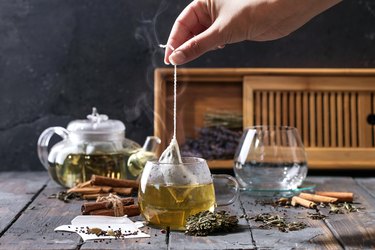
Cold green tea, as well as hot, is a health-boosting and refreshing beverage that contains roughly half the amount of caffeine per serving as a cup of coffee. Packed with antioxidant flavonoids, green tea's benefits have been studied for cancer prevention and lowering stroke and heart attack risk.
Iced Green Tea Benefits
Video of the Day
Green tea comes from the plant Camellia sinensis_,_ an evergreen shrub that grows in mountainous areas in China, India and other countries. To make green tea_,_ fresh leaves from the plant are quickly steamed to stop oxidation, the chemical process that causes browning. Green tea has been used for medicinal purposes in China and Japan for thousands of years.
Video of the Day
Cold green tea or hot green tea is a good source of catechins and epicatechins, compounds believed to provide tea's beneficial health effects, according to Harvard Health Publishing. The compounds belong to a group of plant chemicals called flavonoids, which research suggests help lower inflammation and thus help reduce plaque buildup inside arteries. Green tea has slightly higher amounts of these chemicals than black tea.
The Cleveland Clinic notes that green tea contains L-theanine, an amino acid that may reduce stress. Green tea also contains slightly less caffeine than black tea if you are concerned about caffeine consumption.
A June 2018 study published in the Journal of the American Heart Association found that tea may slow age-related decreases in high-density lipoprotein (HDL) cholesterol, with both green and black tea contributing to slower HDL declines.
Out of the 80,000 study participants, the link between green tea and slower HDL declines was most obvious in people over age 60. But the AHA notes that results of this study are not conclusive, as the quantity of tea consumed per day was not recorded nor were participants' diets analyzed.
Green tea as a beverage can be enjoyed simply for its taste. You may drink it plain or try making iced green tea with honey. There are a variety of brands that offer green tea bags for sale; Lipton green tea is widely available at supermarkets.
Read more: Health Benefits of Green Tea with Lemon
Cold Green Tea: Other Uses
Green tea is also used as a dietary supplement for mental alertness, relieving digestive symptoms and headaches and promoting weight loss. Both black and green teas contain modest amounts of caffeine, Harvard Health Publishing notes, ranging from about 20 to 45 milligrams per 8-ounce cup or about half the amount of caffeine found in a cup of coffee.
Among their many biological activities, the predominant polyphenols in green tea ― EGCG, EGC, ECG and EC — have antioxidant activity, prompting clinical trials and studies to try to determine if green tea is effective in warding off cancer and other maladies. The Cleveland Clinic cites research that green tea can lower heart attack and stroke risk and may improve memory as well as protect bone health.
But as the National Center for Complementary and Integrative Health notes, more scientific evidence is needed to show whether green tea is helpful for most of the purposes for which it is used.
In a Harvard Health Publishing interview, Dr. Howard Sesso, an associate professor in the Department of Epidemiology at Harvard Medical School, cites studies that show green tea may positively impact cardiovascular health — but cautions that could be circumstantial.
Though the amount of caffeine found in green tea is relatively low compared with coffee, Harvard advises consuming no more than two to three cups per day. If you find you are drinking too much cold green tea, try switching to a decaffeinated version.
- Harvard Health Publishing: "Flavonoids: The Secret to Health Benefits of Drinking Black and Green Tea?"
- National Center for Complementary and Integrative Health: "Green Tea"
- Journal of the American Heart Association: "Tea Consumption and Longitudinal Change in High‐Density Lipoprotein Cholesterol Concentration in Chinese Adults"
- Harvard Health Publishing: "Tea: Drink to Your Health?"
- Cleveland Clinic: "Beyond Superfoods: 6 Health-Boosting Teas"