
Paraplegic Abdominal Exercises
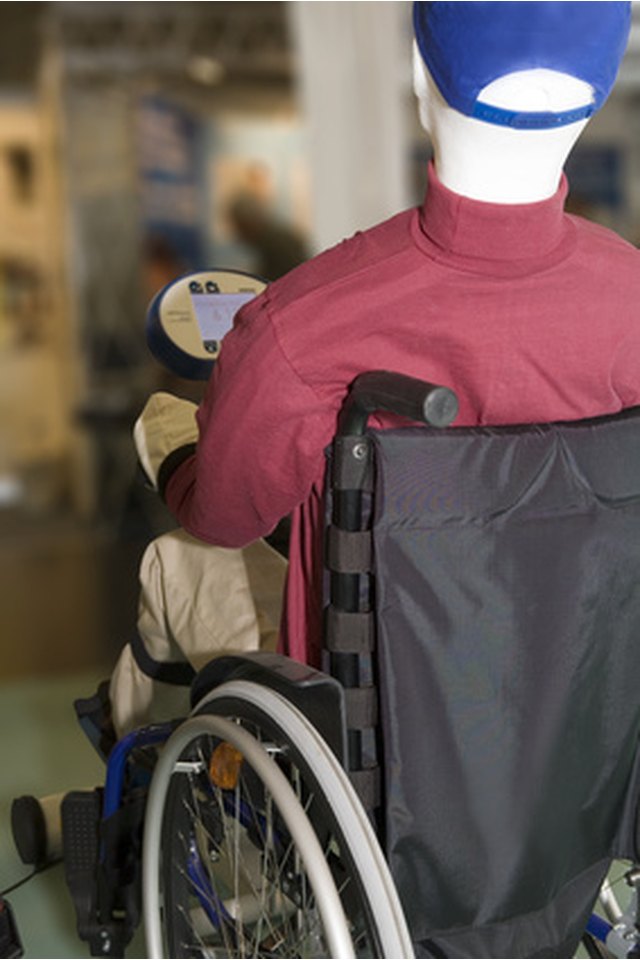
Paraplegia involves the loss of function and movement in the muscles below the waist. Most paraplegics are in wheelchairs to accommodate the paralysis in their legs, but most have full function above their waist and are able to perform abdominal exercises in order to stay in shape and mobile. Most paraplegic abdominal exercises are done from a seated position.
Medicine Ball Rotations
Medicine ball rotations exercise and strengthen the three major muscles of the abdomen: the rectus abdominis, transverse abdominis and obliques. Using a weighted medicine ball and twisting the torso works all these muscles, including the deeper layers. While sitting, hold a weighted medicine ball with both hands and face forward. Engaging your abdominal muscles, twist your torso to the right, bringing the ball with you as you look over your right shoulder. Twist to the left, not stopping in the center. The farther out you extend your arms, the more challenging this move becomes and the more you use your abdominal muscles to keep you stabilized as you rotate.
Woodchoppers
Woodchoppers work the obliques, or love handles, and the transverse abdominis, which runs vertically from your sternum to pubic bone. Hold a weighted medicine ball or a large dumbbell with both hands above your head. Using your abdominal muscles to stabilize and keep your spine straight, bring the weight down toward your left hip, as if chopping wood. Next, raise the weight above your head before lowering it toward your right hip. Sitting on a chair without a backrest will make this exercise more challenging. Each time you lower the weight, slightly twist your torso in the direction of the weight to help protect your spine.
Oblique Crunch
Seated oblique crunches are effective in targeting the obliques and the rectus abdominis muscle, which runs laterally across your waistline. Begin with your spine straight and hold a dumbbell in both hands; your arms should hang naturally alongside your torso. Slowly lower the right dumbbell toward the floor, squeezing the muscles on the side of your torso as you lower, then lift it back up. Lower the left dumbbell toward the ground, then lift it back in line with the right dumbbell. Oblique crunches should be small, controlled movements that generate from the obliques, which are the muscles on either side of the stomach. The rectus abdominis will be responsible for stabilizing your spine from leaning too far forward or rocking back and forth as you move laterally.
References
- "Exercise Physiology: Energy, Nutrition and Human Performance"; William D. McArdle, Frank I. Katch, Victor L. Katch; 2006
- "Essentials of Anatomy and Physiology, Fifth Edition"; Tina Sanders, Valerie Scanlon; 2000
Writer Bio
Sapna Pathak is a certified professional yoga therapist, yoga instructor, diet and nutrition consultant. She is also certified as a prenatal yoga and aerial yoga teacher. A sports writer for the "Boston Globe," Pathak has won numerous awards for her coverage of sports, health, diet and fitness issues. In 2004, she earned bachelor's degrees in journalism and exercise physiology/neurobiology.