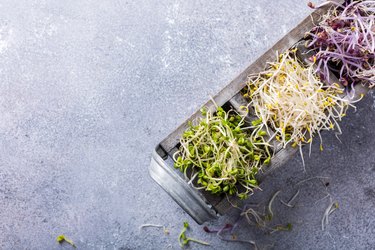
Sprouts are a commonly consumed food that can come from beans or other plants, like grains, nuts, seeds and vegetables. Although they can come from a variety of different sources, sprouts are all essentially young plants that can be eaten raw or cooked. Bean sprouts are a particularly good source of plant-based protein and contain a variety of vitamins and minerals.
Read more: List of Sprouts to Eat
Video of the Day
Video of the Day
Bean Sprouts Nutrition
Bean shoots nutrition is somewhat complex because there are so many types and each one is different. Many different bean sprouts are popularly consumed, including pinto bean sprouts, mung bean sprouts, soybean sprouts and lentil sprouts. All bean sprouts are generally considered to be nutritious foods. Obviously, bean sprouts nutrition varies between types, but sprouts are typically thought to be more nutritious than unsprouted variants of the same plants, with protein in particular increasing with the germination process.
Since bean sprouts can come in a variety of types (and consequently different shapes and sizes), a standard cup-sized serving can range from as little as 75 grams to more than twice that much at about 200 grams. In general, bean sprouts tend to be low in calories, a good source of plant-based protein and contain a wide range of vitamins and minerals. One hundred grams of one of the most popular types of bean sprouts, mung bean sprouts, contains:
- 6 percent of the recommended daily amount (RDA) of protein
- 7 percent of the RDA of fiber
- 22 percent of the RDA of vitamin C
- 41 percent of the RDA of vitamin K
- 6 percent of the RDA of thiamin (vitamin B1)
- 7 percent of the RDA of riboflavin (vitamin B2)
- 15 percent of the RDA of folate (vitamin B9)
- 5 percent of the RDA of iron
- 5 percent of the RDA of magnesium
- 5 percent of the RDA of phosphorus
- 8 percent of the RDA of copper
- 9 percent of the RDA of manganese
Mung bean sprouts also contain small amounts of vitamin E, niacin (vitamin B3), pantothenic acid (vitamin B5), vitamin B6, calcium, potassium, zinc and selenium. Like all bean sprouts, mung bean sprouts have few calories, with about 30 calories per 100 grams (which is roughly the size of the average cup-sized serving).
Bean Sprouts Pros and Cons
Bean sprouts are extremely nutritious foods that can be easily integrated into all sorts of meals, including salads, sandwiches and stir-fries. These foods are not only rich in nutrients, but contain a variety of healthy antioxidants and fatty acids. Given the variety of beneficial nutrients found in bean sprouts, it should come as no surprise that these foods have been linked to a variety of different health benefits.
For instance, mung bean sprouts have been historically used in China to help with gastrointestinal problems, heat stroke and inflammation (swelling), as well as many other health issues. These beans are thought to have anti-inflammatory, anti-diabetes, anti-tumor and anti-microbial effects. They're also thought to help prevent a variety of different heart problems, as well as diabetes. Other types of bean sprouts, like cow peas and soybean sprouts, have nutrients and antioxidants that have been tied to similar health benefits.
There is one main downside to sprouts. These plants and their seeds have been tied to many different cases of food poisoning. This is because sprouts are essentially all young plants. Since they are grown in humid, wet environments or even directly in water, they can carry disease-causing bacteria when not cooked thoroughly. Fortunately, bean sprouts consumed raw or lightly cooked are most likely to carry such bacteria, so thoroughly cooking them should remove disease-causing microbes.
Safe Consumption of Bean Sprouts
Bean sprouts are consumed around the world and have been for many years. Although you may be most familiar with them from their use in sandwiches, salads or as a garnish, these foods are traditionally used in a variety of cuisines. Bean sprouts are particularly popular in various Chinese, Indian and Korean dishes and are becoming increasingly popular in Brazilian cuisine.
Many types of bean sprouts, especially those involving the fully grown versions, are integrated into hot dishes. These sprouts, which are often sautéed, steamed or blanched, are typically cooked thoroughly. However, the younger the plant, the less likely that it will be cooked as it's already so tender. This means that salads or garnishes involving bean sprouts are more likely to cause health problems.
Like all fruits and vegetables, bean sprouts should be washed prior to eating them raw. However, consuming raw sprouts doesn't remove bacteria like E. coli, Salmonella, Staphylococcus and Listeria. It's bacteria like these that cause the food poisoning associated with bean sprouts. Unfortunately, mung bean sprouts, which are one of the most commonly consumed type of sprout, are often eaten raw or lightly cooked.
Should Everyone Eat Bean Sprouts?
The health benefits of bean sprouts are a part of their wide appear. Although they've been used as a component of Asian foods for a long time, they're increasingly popping up elsewhere. Almost everyone can benefit from eating bean sprouts because they are so nutritious. However, since the conditions used to grow these plants result in an increased likelihood of bacterial contamination, they may not be an ideal food for everyone.
People with compromised immune systems, pregnant women, children and older adults may want to swap bean sprouts for another healthy source of protein and nutrients. You could also choose to remove the seed part of the sprout, as this is the part of the plant that is usually tied to disease outbreaks.
If you're a member of one of these groups and choose to consume bean sprouts, you should always wash them thoroughly, although washing won't remove the bacteria. The Food and Drug Administration recommends always cooking sprouts to reduce the risk of food-related illnesses. You should also avoid eating sprouts that have browned or otherwise changed color.
- Foodsafety.gov: Sprouts: What You Should Know
- National Health Service: Eat Well: Sprouted Seeds Safety Advice
- Food Research International: Glycine max (L.) Merr., Vigna radiata L. and Medicago sativa L. Sprouts: A Natural Source of Bioactive Compounds
- Journal of Food Protection: Salmonella Internalization in Mung Bean Sprouts and Pre- and Postharvest Intervention Methods in a Hydroponic System
- Revista de Nutrição: Total Phenolics and Antioxidant Activity of the Aqueous Extract of Mung Bean Sprout (Vigna radiata L.)
- Food and Drug Administration: Sprout Safety: Letter to Seed Suppliers, Distributors, and Sprouters
- Current Pharmaceutical Design: Total Polyphenols and Bioactivity of Seeds and Sprouts in Several Legumes
- Chemistry Central Journal: A Review of Phytochemistry, Metabolite Changes, and Medicinal Uses of the Common Food Mung Bean and Its Sprouts (Vigna radiata)
- LWT - Food Science and Technology: Impact of Germination on Flour, Protein and Starch Characteristics of Lentil (Lens culinari) and Horsegram (Macrotyloma uniflorum L.) Lines
- International Journal of Food Science and Technology: Dynamic Changes in Phytochemical Composition and Antioxidant Capacity in Green and Black Mung Bean (Vigna radiata) Sprouts
- SELFNutritionData: Beans, Pinto, Mature Seeds, Sprouted, Raw
- SELFNutritionData: Mung Beans, Mature Seeds, Sprouted, Raw
- SELFNutritionData: Lentils, Sprouted, Raw