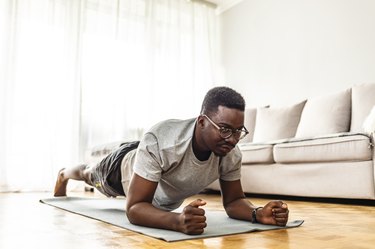
Planks are billed as the must-do ab move if you're serious about developing a strong core. And that's important, as a strong core supports your spine, protects your internal organs, improves your posture and powers all of your movements.
While the plank, and its numerous variations, are excellent at training your core in a functional way — assisting with stability, posture and spinal alignment — the move alone will not give you a six-pack, according to the American Council on Exercise (ACE). You also need good nutrition, full-body strength training and cardio to develop visible abs.
Video of the Day
3 Benefits of Planks for Abs
1. They Work Your Whole Core
When you get into the plank position, the muscles throughout your core work to suspend you off the floor. The move requires stabilization and muscle activation of not only the abs, but also the muscles of the upper, middle and lower back, pelvis and hips, and glutes and quads, according to the ACE.
Crunches and sit-ups, however, focus effort solely on the rectus abdominis — the front sheath of abs — and miss many of these other crucial parts of your core.
2. They Take It Easy On the Spine
Unlike crunches and sit-ups, which put stress on the vertebrae as you push your back toward the mat to curl up, planks keep the back in its intended alignment. You'll also be less likely to cause stress on the neck by pulling on it to curl up as can occur with crunches.
3. There Are So Many Variations
A body that's strong in the standard plank is ready for added challenges. Plank variations provide continued improvement in core strength and ab development. Perform plank on an unstable surface, such as a stability ball or BOSU ball, hold a plank with one leg lifted, perform single-arm planks, balance in a single-arm and single-leg plank or add a side plank.
Once you've mastered plank, it serves as an exceptional warm-up to make your body strong for other ab exercises that further develop a strong core.
Related Reading
How to Strengthen Your Core With Planks
To build core strength and stability, do planks at least two to three times a week. Focus on holding the isometric exercise only as long as you can do so while keeping great form and without letting your lower back arch.
Working up to holding a plank for 30 to 60 seconds provides you with a foundation of strength in your abs. But holding the position for longer doesn't necessarily bring about greater benefits.
Plank
- Start on all fours, hands under shoulders and knees under hips.
- Lower down onto your forearms so that your elbows are under your shoulders. Press your hands and forearms into the floor.
- Extend your legs out straight behind you. Support your weight on your toes and forearms. Keep your neck, back, butt and legs in a straight line, similar to a plank of wood.
- Breathe naturally and hold the plank. Keep your back straight throughout the exercise. Keep your knees straight, but not locked.
- Slowly lower your body to the floor, keeping your back and legs straight. Relax and breathe deeply.
Tip
If you find it difficult to support your weight, try holding a plank with your arms outstretched and palms on the floor.
Planks Alone Won't Sculpt Your Abs
Do planks really help build abs muscles? A strong core derived from regular planking isn't necessarily a sculpted one. If you have a layer of fat covering the muscles, your ab muscles won't show through. You need to be lean — about 6 to 9 percent body fat for a man and 16 to 19 percent for a woman, according to Len Kravitz at the University of New Mexico — to reveal developed abs.
To reduce body fat to these levels and see your abs, a portion-controlled diet that emphasizes whole foods and specific ratios of carbohydrates, protein and fats must be followed. Doing regular cardiovascular exercise — roughly 30 to 60 minutes daily — and some at a high-intensity and total-body strength training three or more times per week are other key strategies.
Related Reading