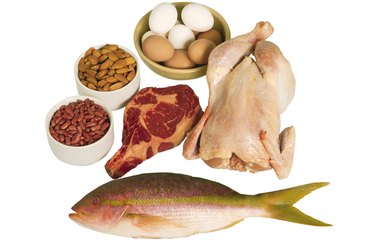
Protein is an essential macronutrient that can help with muscle development and retention. The body can only utilize a specific amount at any one time, and simply excretes the rest through urine or stores the excess amino acids as fat. While protein digestion and utilization may vary slightly from person to person, knowing roughly how much you should consume in one sitting helps you optimize your intake.
Significance
You may increase your daily protein intake to support workouts in an attempt to build muscle. More muscle means a leaner, tauter physique that burns a greater number of calories at rest. Your body uses the amino acids in protein to help repair muscles after workouts and to help them grow larger and stronger. A position statement in the journal "Sports Medicine" published in 2004 noted that a diet that features about 25 to 30 percent of the calories from protein helps reduce body fat and maximizes muscle growth for bodybuilders. Overloading on protein in one sitting, however, does not yield bigger muscle-building benefits.
Considerations
Gaining muscle takes time and effort. The fastest you can expect to gain muscle is about 1 lb. per week. An extra pound of muscle requires about 10 to 14 g of protein per day, notes Karen Ansel, R.D., on the "Oxygen" magazine website. Your body does not store protein for later use.
Research
While some bodybuilders consume up to 70 g of protein in one sitting, a study in the "Journal of the American Dietetic Association" published in September 2009 found that 30 g of protein at one time increases protein synthesis by 50 percent in both young and elderly participants. When researchers increased the protein intake to 90 g in one sitting, they observed no additional gains. A January 2009 study published in the "American Journal of Clinical Nutrition" found that 20 g of protein was an amount sufficient enough to stimulate muscle protein synthesis post-exercise.
Sources
Optimal protein sources contain all 22 amino acids in optimal ratios. Animal products such as beef, chicken, fish, milk, yogurt, whey and eggs are common choices among bodybuilders. You can also obtain quality protein from sources such as soy, quinoa and hemp. Focus on proteins low in saturated fat to minimize health risks associated with eating too much artery-clogging fat.
References
- "Journal of the American Dietetic Association"; A Moderate Serving of High-Quality Protein Maximally Stimulates Skeletal Muscle Protein Synthesis in Young and Elderly Subjects; T. Brock Symons, Ph.D., et al.; September 2009
- "Sports Medicine"; Macronutrient Considerations for the Sport of Bodybuilding; C.P. Lambert, et al.; 2004
- "American Journal of Clinical Nutrition"; Ingested Protein Dose Response of Muscle and Albumin Protein Synthesis After Resistance Exercise in Young Men; Daniel R. Moore, et al.; January 2009
- "Oxygen"; Power-Packed Protein; Karen Ansel, M.S., R.D.


Member Comments