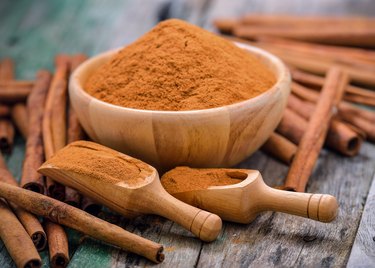
You're probably quite familiar with cinnamon — the warm, fragrant spice that flavors everything from rolls to toast to oatmeal. If you have a recipe that calls for cinnamon powder, you might wonder if the ground cinnamon in your pantry will do.
The short answer is yes. Ground cinnamon and cinnamon powder are essentially the same thing; the latter may be a bit finer, but both incorporate into recipes smoothly. Both have the same flavor, too, as long as they're the same type of cinnamon. All cinnamons are not the same, however. Cinnamon varieties differ and the two major types, cassia cinnamon and Ceylon cinnamon, are different in their nutritional qualities and flavor.
Video of the Day
Video of the Day
Tip
Ground cinnamon and cinnamon powder are essentially the same thing as long as they’re the same variety of the spice. Ceylon, or true cinnamon, may be superior to cassia cinnamon.
Types of Cinnamon
The two major types of cinnamon both come from the bark of trees in the Lauraceae family. Cassia cinnamon is most readily found in your local supermarket. Ceylon cinnamon is not always available at your local grocer.
The two are harvested differently and produce two products distinct in smell, taste and chemical makeup. Cassia cinnamon is your run-of-the-mill cinnamon that comes from a thick bark that provides an intense flavor when ground. A little can go a long way for home cooks and industrial producers.
Cassia cinnamon can come from China, Saigon (Vietnam) or Indonesia. All have different nuances in flavor with Indonesian being the sweetest, least expensive and most commonly found in the United States. Chinese cassia is less common in America; it's bitter and most often plays a role in traditional Chinese medicine treatments. Saigon cinnamon is quite spicy and flavorful with a strong aroma.
Sri Lankan cinnamon, or Ceylon cinnamon (sometimes called "true" or "Mexican" cinnamon) is scientifically known as Cinnamomum zeylacicum. It's slightly sweet and lighter in color. This is the preferred, but harder to find type, due to its low coumarin levels and delicate taste, explains research in Pharmacognosy Research published in June 2015.
Coumarin naturally occurs in cinnamon and other foods, but a paper in the Journal of Agriculture and Food Chemistry in May 2013 notes that the U.S. bans it as a food additive due to potentially adverse side effects. Coumarin may be toxic to the liver and carcinogenic if eaten in high quantities. The levels in most cinnamon are considered safe; Ceylon cinnamon gives the least exposure while cassia cinnamon has the highest concentration.
Both cassia cinnamon and Ceylon cinnamon can be sold as bark, ground cinnamon and cinnamon powder. They may also be used to make cinnamon oil and tea.
Health Benefits of Cinnamon
According to research published in Advances in Experimental Medicine and Biology in 2016, both cassia and Ceylon cinnamon are rich in minerals including manganese, iron and calcium. Cinnamon also has small amounts of potassium and trace amounts of some important vitamins, such as vitamin C, E and K.
The spice is also a powerful antioxidant, meaning it combats the free radicals you encounter in the environment and through your diet. Free radicals are a major cause of cell damage that results in aging and chronic disease.
Read more: High Antioxidant Fruits and Vegetables
Cinnamon has anti-inflammatory, anti-diabetic, antimicrobial and anti-cancer effects, too. These health effects are present whether you consume ground cinnamon, cinnamon powder or cinnamon oil.
Cinnamon's anti-diabetic effects have received much attention since the use of cinnamon seems effective in reducing the complications of metabolic syndrome, including cases of death associated with the condition, explains a review published in the Iranian Journal of Basic Medical Sciences in December 2016.
The researchers confirmed by reviewing the findings in multiple publications that cinnamon does offer the positive effects of:
- Reducing blood pressure
- Decreasing blood sugar levels
- Combating obesity
- Curbing lipid (fat) levels in the blood
These benefits are what makes cinnamon effective as a therapy for metabolic syndrome. Metabolic syndrome is diagnosed when you have the combination of insulin resistance, high blood sugar, excessive abdominal fat, high blood pressure, high lipid levels and low levels of high density lipoprotein cholesterol (HDL) — the good kind. Metabolic syndrome often develops into full-blown diabetes.
Cinnamon Side Effects
Ground cinnamon or cinnamon powder used in recipes should be perfectly safe for most people. The National Center for Complementary and Integrative Health also confirms that cinnamon supplements should be safe when taken in moderate amounts for a short duration.
If you have liver disease, do talk to your doctor before you consume large amounts of cassia cinnamon since the chemical compound coumarin that's present in cassia cinnamon can worsen liver disease. Also, remember that if you do have health problems, such as metabolic syndrome or diabetes, cinnamon shouldn't replace your conventional medications or doctor's care.
As a side note, Ceylon cinnamon doesn't present these possible side effects. BMC Complementary and Alternative Medicine published a clinical trial in December 2017 showing that Ceylon cinnamon did not cause liver toxicity or affect blood coagulation.
As noted in the Pharmacognosy Research paper, an intake of more than 0.1 milligrams per kilogram of body weight can have an effect on your blood's ability to maintain a healthy viscosity if you're also on warfarin, or another similar blood thinner.
A happy side effect you might be after by adding cinnamon to your diet is weight loss. Cinnamon isn't a magical compound that will cause you to shed lots of pounds, but it can help with the reduction of inflammation and level out insulin levels so your body is better at processing foods.
Read more: Is a Teaspoon of Ground Cinnamon Good For You?
Plus, cinnamon does have 1.4 grams of fiber per teaspoon. Adding adequate fiber to your diet can help fill you up and curb hunger, making it easier to stick to a low-calorie eating plan.
- Pharmacognosy Research: "Cinnamon: Mystic Powers of a Minute Ingredient"
- Journal of Agricultural and Food Chemistry: "Cassia Cinnamon as a Source of Coumarin in Cinnamon-Flavored Food and Food Supplements in the United States"
- Advances in Experimental Medicine and Biology: "Cinnamon and Chronic Diseases"
- Iranian Journal of Basic Medical Sciences: "Cinnamon Effects on Metabolic Syndrome: A Review Based on Its Mechanisms"
- National Center for Complementary and Integrative Health: "Cinnamon"
- BMC Complementary and Alternative Medicine: "Evaluation of Pharmacodynamic Properties and Safety of Cinnamomum Zeylanicum (Ceylon Cinnamon) in Healthy Adults: A Phase I Clinical Trial"
- USDA National Nutrient Database: "Spices, Cinnamon, Ground"