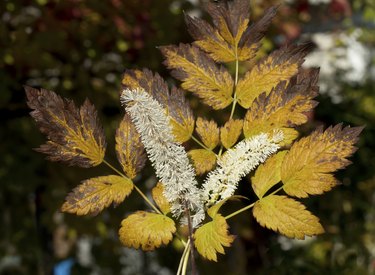
Black cohosh has been used for countless generations by Native Americans for a variety of conditions, including gynecological disorders. More recently, it has become a popular herbal remedy to counteract the symptoms of premenstrual syndrome and menopause because of its estrogen-like properties. Men can benefit from taking black cohosh also, although in high doses it may disrupt the male hormonal balance.
Identification
Video of the Day
Black cohosh, also known as Actaea racemosa or black snakeroot, is a buttercup-like plant native to eastern regions of North America, especially in woodland habitats. Native Americans have used black cohosh to treat gynecological problems and other conditions, including minor infections, sore throats, arthritis, kidney dysfunction, sterility, anxiety, depression and for increased breast milk production, according to "The Essential Book of Herbal Medicine." Extracts and dried preparations from the roots and rhizomes of black cohosh are primarily used, which display analgesic, sedative, anti-inflammatory and possibly estrogen-like properties.
Video of the Day
Estrogen-Like Effects
According to "Medical Herbalism," black cohosh has been shown to display estrogen-like effects in some studies, such as vasomotor relaxation in menopausal people, but other studies have demonstrated no estrogenic effects. According to a study published in a 2003 issue of the "Journal of Agriculture and Food Chemistry," the researchers believe that some of the physiological effects of black cohosh may be due to compounds that bind and activate serotonin receptors, which are responsible for enhanced mood and general relaxation. If compounds in black cohosh do not strongly mimic estrogen, then that would be good news for men, as other phytoestrogens found in plants can reduce male libido, decrease energy levels and contribute to male breast enlargement, or gynecomastia. On the other hand, male-pattern baldness, which is often hormone related, might be combated by the estrogen effects.
Beneficial Effects
Regardless of the estrogen issues, men can benefit from other properties of black cohosh. According to the University of Maryland Medical Center, some studies have shown that black cohosh can reduce inflammation associated with rheumatoid arthritis and osteoarthritis. A study published in a 2007 issue of "Planta Medica" found that black cohosh extract inhibits proliferation of human prostate cancer cells. Further, men can benefit from the general analgesic and anti-inflammatory properties of black cohosh, derived mainly from its isoferulic acid compounds.
Other Side Effects
In addition to possible side effects arising from hormonal imbalance, black cohosh can cause other side effects in both genders, such as stomach discomfort, nausea, diarrhea, headaches, dizziness, seizures, weight gain, reduced heart rate and possible liver toxicity, as cited in "PDR Guide to Drug Interactions, Side Effects, and Indications." Naturally, all symptoms depend on dosage. Consulting a health professional before embarking on an herbal supplement regimen is always recommended.