
What does fact checked mean?
At SportsRec, we strive to deliver objective content that is accurate and up-to-date. Our team periodically reviews articles in order to ensure content quality. The sources cited below consist of evidence from peer-reviewed journals, prominent medical organizations, academic associations, and government data.
The information contained on this site is for informational purposes only, and should not be used as a substitute for the advice of a professional health care provider. Please check with the appropriate physician regarding health questions and concerns. Although we strive to deliver accurate and up-to-date information, no guarantee to that effect is made.
Running for Swimmers
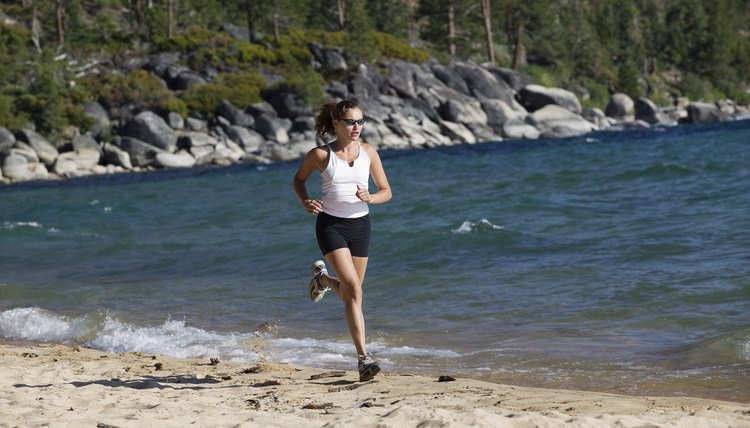
Running and swimming are both total body workouts that use aerobic and anaerobic energy systems. You can improve your performance in the water by cross training with dry land workouts. Adding running to your workout routine can also help prevent overuse injuries you could get from only swimming for your workouts.
Intervals
The American Council on Exercise explains that interval training requires short bursts of intensity followed by a recovery period. You can interval train in a pool and when running on land. Many swimming races are sprints, and training with running can help you build your anaerobic threshold. Running intervals is similar to pool training because you work hard for a short period. For example, in the pool, you might sprint for 25 meters and recover for 50 meters. While running, you might sprint for 30 seconds followed by a one-minute recovery. Interval train for 30 minutes to improve your swimming sprints.
Distance
Both runners and swimmers are endurance athletes, so cross training with running as a swimmer provides many benefits. Distance running can help swimmers build cardiovascular fitness. Running at a moderate pace helps to build a base for endurance. Choose to run for 30 minutes at a moderate pace, and slowly increase your mileage as you build more stamina on land.
Hill Training
Hill training helps to build the muscles in your lower body, allowing them to be more powerful and gain more strength. Running uphill places more resistance on your quadriceps and hamstrings. Both these muscles allow you to have a powerful kick when you are in the water. Find a hill in your neighborhood, or run on an incline on a treadmill. Maximize your speed on the way up, and recover by reducing your speed on the way down. Train on hills one day a week for 30 minutes.
Considerations
Running and swimming both place a great demand on your body. It is important to incorporate stretching into your fitness routines. Flexibility training prevents injuries and can enhance your performance by increasing your range of motion. Perform dynamic stretches before your runs with leg swings, high knee kicks and lateral lunges. Perform static stretches after your run with a standing quadricep stretch, forward fold and a runner's lunge to open up the lower body.
References
- American Council on Exercise: Interval Training
- McColl P. The benefits of speed-training for non-athletes. Ace Fitness. 2014.
- Roche D. Chase performance gains (safely) by increasing your mileage. Trail Runner. 2017.
- Folland JP, Allen SJ, Black MI, Handsaker JC, Forrester SE. Running Technique is an Important Component of Running Economy and Performance. Med Sci Sports Exerc. 2017;49(7):1412-1423. doi:10.1249/MSS.0000000000001245
- McMillan G. Cadence: is 180 the ultimate goal? McMillan Running.
- Beck K. What exactly is a tempo run? Runners World. 2018.
- Sandford GN, Kilding AE, Ross A, Laursen PB. Maximal Sprint Speed and the Anaerobic Speed Reserve Domain: The Untapped Tools that Differentiate the World's Best Male 800 m Runners. Sports Med. 2019;49(6):843-852. doi:10.1007/s40279-018-1010-5
- Interval training for runners. National Health Service. 2019.
- What is a fartlek run? Canadian Running. 2014.
- Barnes K, Kilding A. Strategies to improve running economy. Sports Medicine. 2014;45(1).
- Spiker T. 6 Reasons Why Rest Days Can Actually Help You Run Stronger. Runner’s World. 2018.
- Huber M. The best running training plans. Outside. 2017.
- Burfoot A. What’s your ideal weight? Runner’s World. 2007.
- Beck KL, Thomson JS, Swift RJ, Von hurst PR. Role of nutrition in performance enhancement and postexercise recovery. Open Access J Sports Med. 2015;6:259-67. doi:10.2147/OAJSM.S33605
- Brautigam V. Why do muscles tighten up? Ace Fitness. 2011.
- How to stretch after a run. National Health Service. 2017.
- Hung KC, Chung HW, Yu CC, Lai HC, Sun FH. Effects of 8-week core training on core endurance and running economy. PLoS ONE. 2019;14(3):e0213158. doi:10.1371/journal.pone.0213158
- How to do the perfect plank. Illinois Bone & Joint Institute. 2018.
- Tips for better sleep. Centers for Disease Control and Prevention. 2016.
- Strength training for the runner. Furman Institute of Running and Scientific Training. 2016.
- Prieske O, Krüger T, Aehle M, Bauer E, Granacher U. Effects of Resisted Sprint Training and Traditional Power Training on Sprint, Jump, and Balance Performance in Healthy Young Adults: A Randomized Controlled Trial. Front Physiol. 2018;9:156. doi:10.3389/fphys.2018.00156
- Cross-training for fun and fitness. Ace Fitness. 2009.
- Find a running club. Road Runners of America.
- Eyestone E. Finish Strong. Runner’s World. 2008.
- Pre-race day tips: preparing for a half marathon. Penn Medicine. University of Pennsylvania. 2018.
- McMillan G. Simple tactics for successful racing. Runner’s World. 2009.
- Magness S. How to Run: Running with proper biomechanics. Science of Running. 2010.
Writer Bio
Roger Cahill has been a health and fitness professional since 2004. Cahill holds a Bachelor of Science in kinesiology from Arizona State University. He also has excelled as a professional runner and was a former Sun Devil Student Athlete. Cahill has earned his American Council of Exercise personal training certification and has trained many professional athletes.