
The Differences Between Yoga, Aerobics & Pilates
If you're into fitness, chances are you've taken a yoga, Pilates or aerobics class, or done cardio at the gym. You know they're all good for your health, but what about the other differences and similarities? Including all three in your fitness regimen is a great way to improve your overall physical conditioning and build strength and flexibility. You'll even experience benefits for your mental health. Learn the specifics of each program so you know where it came from and how it can benefit you.
History and Significance
Yoga is an ancient discipline that originated in India thousands of years ago. It not only involves the physical practice -- asana -- popular today, but also teachings on proper diet, breathing techniques, meditation and ethical living. Many people who practice yoga advocate "living yoga" each day, rather than just "practicing" yoga when they exercise.
Pilates was developed in the early 1900s by Joseph Pilates, a fitness teacher and natural health enthusiast. Pilates believed mental and physical strength were closely connected. His approach was to develop core strength, flexibility and physical control through exercise, through which practitioners would develop greater balance, strength, flexibility and control over the body and the mind.
A system of exercises called aerobics was developed in the 1960s by Dr. Kenneth Cooper as a means to prevent coronary artery disease. In the ensuing decades, aerobics was adopted by the mainstream fitness culture in a group-class format aimed at improving overall physical conditioning. Broadly defined, aerobics can include any form of exercise that utilizes the large muscle groups, increases the heart rate and is sustained for a period of time.
Methodology
The physical practice of yoga builds strength, flexibility and endurance, in some cases. There are many styles of yoga practiced today, including vinyasa, ashtanga, Iyengar, Bikram and power yoga. All of these styles involve performing a series of postures linked with rhythmic breathing.
Most yoga poses are the same no matter which style of yoga you practice, although technique may be instructed slightly differently. Poses such as Warrior I and II, Downward Dog and Boat pose are commonly practiced without much variation. Depending on the style of yoga, poses may be held for up to three minutes, or they may be moved through quite quickly. Practices range from easy to intense, with some classes held in heated rooms of over 100 degrees Fahrenheit.
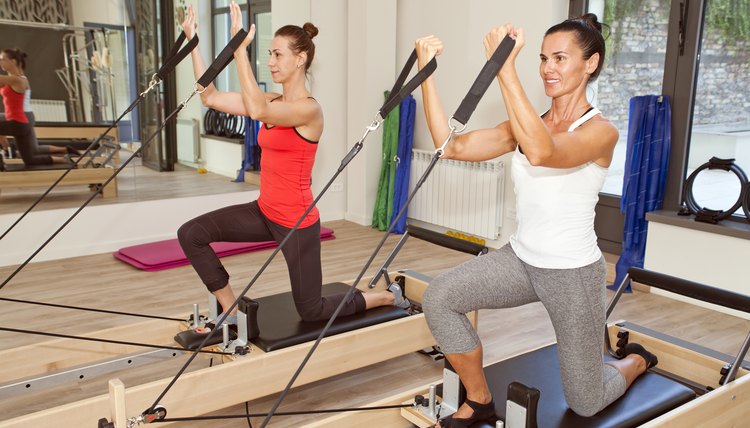
Pilates exercises focus on building the body's core, consisting of the hips, glutes, abdomen and lower back. Exercises may be performed on a mat, using body weight as resistance, or they may be performed on a special machine called a reformer in which a spring and pulley system provides resistance. Like yoga, there are set Pilates exercises, such as the hundred, the frog and leg circles, all of which can be practice on the mat or on the reformer.
Aerobics shares relatively little in common with yoga and Pilates, although it also improves overall physical conditioning. Aerobic exercise, or "cardio," includes examples such as running, biking, swimming and rowing. Aerobic exercises can also be performed on gym equipment such as treadmills, elliptical machines and stationary bikes. The common theme is that they keep the body in constant motion and the heart rate up for a prolonged period of time.
Aerobics as a conditioning routine is usually performed in a class setting. It comes in many forms, but typically involves performing choreographed movements in time with upbeat music. Popular examples include Jazzercise, Zumba and step aerobics.
Physical Requirements
All three exercise styles are accessible to individuals of any fitness level and even to those with physical limitations.
In yoga and Pilates, poses and exercises can be modified to make them easier or more challenging. Beginners classes are excellent places to start if you are new to either practice. These classes are taught in a slower, gentler fashion, so you have time to learn the movements and don't risk overexertion. If you have an injury or pre-existing health condition, you may speak to the instructor before class to receive suggestions for modifications.
Aerobics is also very accessible. If you're new to aerobic exercise you can become conditioned simply by starting a walking routine. After that, you may progress to jogging or even running. Some cardio activities do require a certain amount of skill, for example cycling and swimming. You may need to receive specific instruction before engaging in those activities.
Aerobics classes run the gamut from beginner to advanced. Some aerobics classes may have particular requirements or prerequisites. It's always a good idea to inquire before your first class to find out whether it is a good fit for your current condition.
If you have any injuries or health conditions, you should consult with your doctor before performing any type of exercise routine.
End Results
While the goal of yoga, Pilates and aerobics may be overall health and well-being, practice of each produces particular end results. Yoga is purported to alleviate stress, headaches, back pain and other health conditions. Pilates helps you develop strong core muscles, especially in the torso, and large muscle groups of the body. Both Pilates and yoga help to increase flexibility and balance.
Aerobics is most effective at improving cardiovascular function and for weight loss, although yoga and Pilates can also help you meet those goals. The good news is you can combine all three in your fitness routine to build total-body strength, flexibility and cardiovascular fitness while losing weight and lifting your spirits.
References
- Gaiam: SHOULD YOU DO PILATES ON A MAT OR ON A REFORMER?
- Yoga Basics: HISTORY OF YOGA
- Balanced Body: Pilates Origins
- Woodyard C. Exploring the therapeutic effects of yoga and its ability to increase quality of life. Int J Yoga. 2011;4(2):49-54. doi:10.4103/0973-6131.85485
- Sengupta P. Health impacts of yoga and pranayama: a state-of-the-art review. Int J Prev Med. 2012;3(7):444-58.
- Di lorenzo CE. Pilates: what is it? Should it be used in rehabilitation?. Sports Health. 2011;3(4):352-61. doi:10.1177/1941738111410285
- Wells C, Kolt GS, Marshall P, Hill B, Bialocerkowski A. Effectiveness of Pilates exercise in treating people with chronic low back pain: a systematic review of systematic reviews. BMC Med Res Methodol. 2013;13:7. doi:10.1186/1471-2288-13-7
- Yamato TP, Maher CG, Saragiotto BT, et al. Pilates for low back pain. Cochrane Database Syst Rev. 2015;(7):CD010265. doi:10.1002/14651858.CD010265.pub2
- Cramer H, Lauche R, Haller H, Dobos G. A systematic review and meta-analysis of yoga for low back pain. Clin J Pain. 2013;29(5):450-60. doi:10.1097/AJP.0b013e31825e1492
- Achilefu A, Joshi K, Meier M, Mccarthy LH. Yoga and other meditative movement therapies to reduce chronic pain. J Okla State Med Assoc. 2017;110(1):14-16.
Writer Bio
A professional writer since 2008, Tracey Planinz writes articles on natural health, nutrition and fitness. She holds a doctorate and two professional certifications in her field, and continues to develop her education with additional classes and seminars. She has provided natural health consultations and private fitness instruction for clients in her local community.