
What does fact checked mean?
At SportsRec, we strive to deliver objective content that is accurate and up-to-date. Our team periodically reviews articles in order to ensure content quality. The sources cited below consist of evidence from peer-reviewed journals, prominent medical organizations, academic associations, and government data.
The information contained on this site is for informational purposes only, and should not be used as a substitute for the advice of a professional health care provider. Please check with the appropriate physician regarding health questions and concerns. Although we strive to deliver accurate and up-to-date information, no guarantee to that effect is made.
Hockey's Advantages & Disadvantages
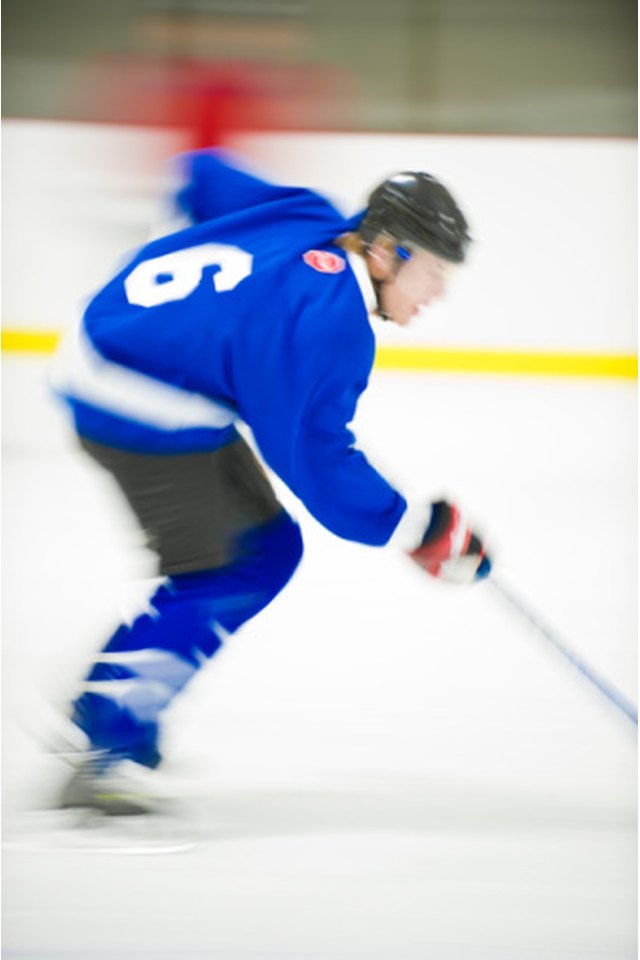
The fast-moving sport of hockey is rooted firmly in Canada and across the United States, with National Hockey League franchises scattered across the continent from Canada to California. Professional, Junior, college, high school and house leagues fill the stands with excited spectators in every state and province. Depending on the league and age levels, hockey may be played as a checking or non-checking game and house leagues are often played year-round. But like every sport, hockey has its advantages and disadvantages.
Advantage: Aerobic Exercise
Hockey provides a cardiovascular workout as you race up and down the rink, pushing the limits of your heart rate and lung capacity. Thirty minutes on the ice burns 240 calories in a 125-pound player and 355 calories in a 185-pound player. It strengthens your leg and back muscles, and builds up your arms when dangling your way through the defense and shooting the puck. The quick moves and direction changes in hockey also improve your balance and coordination.
Disadvantage: Injury Risk
Even in a non-checking league, hockey players suffer from concussions, shoulder, elbow, back, hip, knee and ankle injuries. Whether checking or non-checking, the fast-moving sport still has plenty of contact and spills on the ice. A study published in the Canadian Medical Association Journal found that there are three times as many injuries in youth leagues that allow contact than those that don’t and among teen hockey players, body checking accounted for 86 percent of hockey-related injuries, and 23 percent of those were to the head and neck.
Advantage: Character Building
Participating in any team sport develops a sense of teamwork and good sportsmanship. Tempers may run hot and the penalties abound during the game, but a time-out in the penalty box teaches players the direct correlation between action, reaction and the consequences. When the game is over, a long-standing tradition in hockey is the handshake line at the end of a game or a series. The players, from kids on up to the pros, shake hands one by one with their opponents. Hockey teaches you how to play hard, but when the game is over, you treat each other with respect.
Disadvantage: Violence
Casual fans think of hockey as a game often marred by fighting and cheap shots. While fighting is only a small part of the game, players and teams use it to settle differences and defend teammates. In international play and college hockey, fighting is seldom seen, but in North American minor leagues, Junior hockey and to a lesser degree the NHL, fights are a longtime component of the game. Many people are turned off by this aspect of the game and some parents may discourage their kids from participating in a sport that allows the occasional fisticuffs.
Advantage: A Life-Long Sport
Hockey is a part of the fabric of life in Canada and the U.S. Players begin playing in roller or ice hockey leagues between ages 5 and 8 and continue playing into their 80s and 90s. In 2013, a Canadian ice hockey tournament that allowed only players ages 80 and up had over 100 teams entered in the competition.
References
- USA Hockey: Leagues & Teams
- Harvard Heart Letter: Calories Burned in 30 Minutes for People of Three Different Weights
- Canadian Medical Association Journal: Effect of Bodychecking on Injury Rates Among Minor Ice Hockey Players
- The Globe and Mail: Everyone on the Ice Is 80 or Over at This Hockey Tournament for the Ages
- American Academy of Orthopaedic Surgeons. Hockey injury prevention. Updated March 2018.
- Daly PJ, Sim FH, Simonet WT. Ice hockey injuries. A review. Sports Med. 1990;10(2):122-31. doi:10.2165/00007256-199010020-00005
Writer Bio
James Roland started writing professionally in 1987. A former reporter and editor with the "Sarasota Herald-Tribune," he currently oversees such publications as the "Cleveland Clinic Heart Advisor" and UCLA's "Healthy Years." Roland earned his Bachelor of Science in journalism from the University of Oregon.