
What does fact checked mean?
At SportsRec, we strive to deliver objective content that is accurate and up-to-date. Our team periodically reviews articles in order to ensure content quality. The sources cited below consist of evidence from peer-reviewed journals, prominent medical organizations, academic associations, and government data.
- ACSM.org: Recommendations on Quantity and Quality of Exercise
- ACSM.org: Recommendations on Quantity and Quality of Exercise
The information contained on this site is for informational purposes only, and should not be used as a substitute for the advice of a professional health care provider. Please check with the appropriate physician regarding health questions and concerns. Although we strive to deliver accurate and up-to-date information, no guarantee to that effect is made.
20-Minute Treadmill Workouts
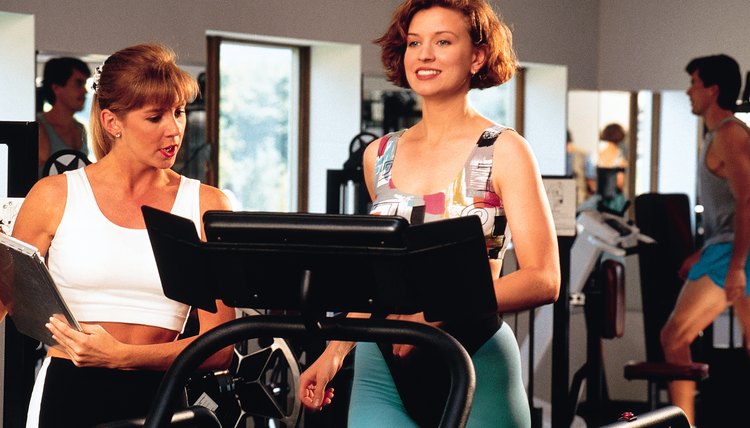
While 20 minutes may not seem like a long enough time for an adequate workout, a treadmill lets you reach a heart rate that provides multiple beneficial exercise options in that time frame. The American Heart Association recommends vigorously intense, 20-minute workouts, three times a week to maintain heart health. Using a steady pace or performing start-and-stop sprints, you can get an excellent workout in 20 minutes on a treadmill.
Beginner Workout
If you are new to exercise, you may not be able to exercise at a high intensity or for very long. Treadmills are an effective way to ease into exercise and build cardiovascular stamina and muscular endurance. Start your workout at a slow speed -- around 2 mph -- and add .5 mph each minute until you reach a speed you can maintain for 15 minutes. This will probably be between 3 mph and 4 mph. If your treadmill has an automatic program, it will include a warmup. After you are familiar with the treadmill, bend your elbows and swing your arms for more benefit. After a week or so, add two, one-minute bursts of higher-intensity walking or even jogging.
Aerobic Workout
If you have the stamina to exercise at a higher intensity, set the treadmill for a cardio workout. Hold onto the heart rate monitor or place your hands on it every few minutes to make sure you stay in your target heart rate for aerobic exercise. Add 30- to 60-second sprints, or change the incline on the treadmill, to build your cardiorespiratory system and burn more calories.
Sprint Training Workouts
If you are a well-conditioned athlete, use a treadmill for sprint training. This type of workout consists of repeated bouts of high-intensity running, followed by a break to recover. You can jog for 30 seconds, run for 30 seconds then sprint all out for 30 seconds, then recover for two minutes as one option. Alternately, you can run at 80 percent to 90 percent of your target heart rate for 90 to 120 seconds, then slow down and recover.
Don't Shortcut Workout
If you only have 20 minutes, you may be tempted to burn as many calories as you can during that time. Asking your heart, lungs, circulatory system and muscles to work at a high intensity before they are all working together is not healthy. Take several minutes to gradually raise your speed as your heart rate rises and your muscles warm and stretch. Similarly, you should slow down for several minutes at the end of your workout to get lactic acid and other wastes out of your muscles before you stop moving them. Save a minute or two for stretching, as well, to prevent stiffness and soreness in your muscles later.
References
- ACSM.org: Recommendations on Quantity and Quality of Exercise
- Zhang H, Tong TK, Qiu W, et al. Comparable effects of high-intensity interval training and prolonged continuous exercise training on abdominal visceral fat reduction in obese young women. J Diabetes Res. 2017;2017:5071740. doi:10.1155/2017/5071740
- Wewege M, van den Berg R, Ward RE, Keech A. The effects of high-intensity interval training vs. moderate-intensity continuous training on body composition in overweight and obese adults: A systematic review and meta-analysis. Obes Rev. 2017;18(6):635-646. doi:10.1111/obr.12532
- Unick JL, Gaussoin S, Bahnson J, et al. Validity of ratings of perceived exertion in patients with type 2 diabetes. J Nov Physiother Phys Rehabil. 2014;1(1):102.
Writer Bio
Sam Ashe-Edmunds has been writing and lecturing for decades. He has worked in the corporate and nonprofit arenas as a C-Suite executive, serving on several nonprofit boards. He is an internationally traveled sport science writer and lecturer. He has been published in print publications such as Entrepreneur, Tennis, SI for Kids, Chicago Tribune, Sacramento Bee, and on websites such Smart-Healthy-Living.net, SmartyCents and Youthletic. Edmunds has a bachelor's degree in journalism.