
Can You Gain Flexibility After 40?
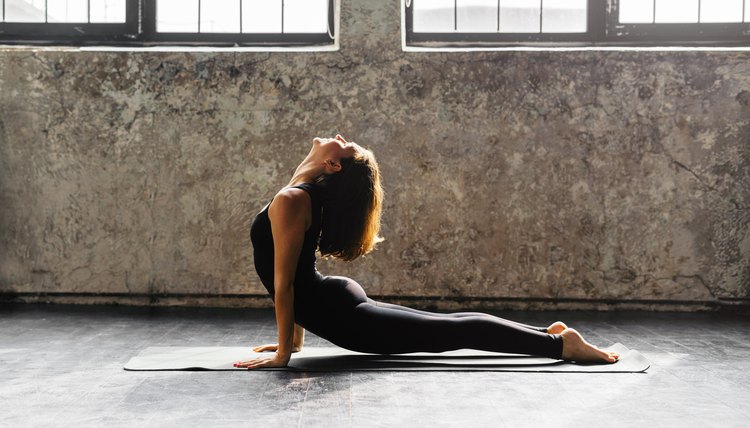
It's never too late to enjoy the benefits of flexible muscles — and in fact, the older you get, the more important those benefits become. So not only can you gain flexibility after 40, it's imperative that you do so in order to lay the groundwork for a healthy, independent and long-lived life with reduced risk of injury. But there's no need to jump straight into master-level yoga poses or attempts at the full splits; the key is to start a program that suits your knowledge and flexibility levels.
Tips
With a regular full-body stretching regimen, you can definitely gain flexibility after 40.
Stretching at Any Age
The benefits of stretching may even be enhanced as you age — if only because you get stiff enough to really feel the edge a little extra flexibility gives you. For example, in a 2017 study published in the Journal of Strength and Conditioning Research, the author found that older men (around age 70) reported greater relief from stretching than the group of younger test subjects (around 25 years of age), although both groups did experience relief.
Other benefits of taking the time to develop your flexibility include reduced risk of injury, better balance, better range of motion and better performance in your favorite sports or hobbies. You might even feel stronger once you gain a bit of flexibility, simply because that flexibility gives you the range of motion to let your muscles work more efficiently.
Tips
There's a surprising amount of discussion among experts about the effect that pre-workout stretching has on exercise performance and whether you should do dynamic or static stretching before a workout. But if you're looking at things from the standpoint of becoming more flexible, there's a well-developed body of evidence demonstrating that static stretching is the way to go.
Stretching Exercises for Over 40
Having a few decades of life behind you means that you've probably had time to buy into some common dysfunctional movement and postural patterns, especially if you happen to work at a desk. Tight quads, tight hip flexors and tight lower back muscles are the norm, along with tight pecs and anterior shoulders (the front of your shoulder), as your back releases and rounds forward into the classic "I've been at my computer all day" posture.
The good news is that stretching can help counteract these postural imbalances and might even provide some relief from the chronic discomfort that often accompanies them. With that in mind, these starter stretches can form the core of a beginning flexibility program.
Warm up before you stretch with five to 10 minutes of exercise — walking around the block, walking up and down stairs at home, or using a treadmill or elliptical trainer.
Aim to hold each stretch at the point of tension, not pain, for between 10 and 30 seconds — or longer, if you like — and repeat each stretch three to five times in a session. If you're doing a stretch that targets one side of your body at a time, make sure you pay equal attention to both sides.
Tips
It might be tempting to subscribe to the idea that more is better, but that isn't always the case when it comes to how far you should stretch. Exercise professionals have long contended that stretching to the point of tension, not pain, is all you have to do to gain flexibility. This is backed up by a 2017 study in the European Journal of Applied Physiology, which showed that stretching to the point of pain doesn't produce any greater gains in flexibility than stretching to the point of slight discomfort.
Quads and Hip Flexors Stretch
Believe it or not, tight quads and hip flexors can contribute to a sense of nagging back pain and even develop into postural or gait problems, because in extreme cases they can keep you from truly standing up straight. But one stretch can tackle quads and hip flexors at once:
Stand next to a wall or piece of sturdy furniture you can use for balance. Lift your left leg as if you were trying to kick yourself in the butt, and grasp the ankle of that leg with your left hand. Keep your left knee pointing downward, tucked against your other leg.
Next, gently press your left hip forward or, if you prefer, think of bringing your left knee gently back until you feel a stretch across the front of your hip and down your thigh. Make sure you stretch your other leg too.
Tips
If doing this stretch while standing causes a problem, try doing it on the floor; just lie on one side and stretch the leg that is uppermost. Then roll over to stretch the other side.
Lower Back Stretch
There are many ways to stretch your lower back, so it's easy to choose the method that best suits you:
Cat and Cow
This classic yoga pose is an effective stretch: Position yourself on your hands and knees, spine in a neutral position. Arch your back up as if you were an angry or scared cat; hold this position for a few seconds; then let your belly button sink down as you adopt the swaybacked position of a cow. Don't force yourself into extremes of flexibility; just look for that feeling of a gentle stretch as you arch upward into the "cat" position and treat the "cow" position as a chance to relax.
You can also duplicate the "cat" portion of this stretch by draping yourself facedown over a stability ball, letting your spine curve naturally forward with the ball as support.
Knees to Chest
You can easily do this stretch on a yoga mat: Lie on your back and draw one knee up to your chest. Hold that stretch; then release and repeat with the other knee. If lifting one leg at a time doesn't stretch your lower back, bring both knees up to your chest at once.
A Little Rotation
Lie flat on your back, arms out to the side for stability. Keep one leg extended straight as you bring the knee of the other leg up, then gently across your body, as if you were trying to touch that knee to the floor on the other side of your hip.
Keep both shoulders on the floor as you do this, and don't worry about pressing your knee all the way to the floor if it doesn't reach. Just stretch to the point of tension in your lower back.
Release Your Chest and Shoulders
The easiest tool for stretching your chest and shoulders is a simple doorway. Stand facing the open doorway; if there's a door in it, stand on the side away from the door. Raise both arms straight overhead, palms facing forward; then bring your elbows down until they're even with your shoulders. Your forearms should still point up. This position looks a bit like you're impersonating a field goal.
Step forward into the doorway until your forearms rest on either side of it. Lean gently forward, keeping your feet underneath you, until you feel a gentle stretch in your chest and shoulders.
Don't Forget Your Hamstrings
Although the typical seated-at-desk posture of a modern-day, sedentary lifestyle lends itself to weak hamstrings, that doesn't translate to flexibility. In fact, tight hamstrings may even contribute to the chronic back pain that nags many people. So don't forget to stretch your hamstrings too.
You can do this easy stretch on the edge of a park bench, a weight bench or even on the edge of your bed. Start by sitting sideways at the very edge of the bench, extending the leg closest to the bench so your leg and hip rest on the bench. Let your other leg rest on the floor beside the bench. Hinge forward from the hips, gently stretching until you feel tension, not pain, in the backs of your thighs. Make sure you take the time to stretch both legs.
How Often Should I Stretch?
In a perfect world, you'd be able to commit at least 30 minutes to just stretching, three times a week, plus the time it takes to warm up before each stretching session. But that's a lot of time to carve out of a busy schedule, and even a little bit of stretching is better than nothing — so don't be shy about sneaking in a quick stretch here or there throughout the day.
Other Workouts That Encourage Flexibility
If carving out the time for workouts that focus solely on stretching feels like too much for you, there's another option: You could aim for workouts that incorporate flexibility without excluding other types of fitness.
Starting yoga at 40 is a great way to get your stretching in. Pilates is also very effective for increasing flexibility, and both workouts are well-suited to bodies that may have picked up some injuries over a few decades of life. But you'll also find flexibility enhanced in most types of dance classes and in many martial arts classes.
In fact, there's usually some flexibility component involved in almost all professionally taught group fitness classes, although some instructors might leave it up to you to hang around after if you really want stretching time.
References
- National Strength and Conditioning Association: Benefits of Flexibility Training
- NHS: Common Posture Mistakes and Fixes
- Mayo Clinic: Stretching: Focus on Flexibility
- Journal of Bodywork and Movement Therapies: Comparison Between Static Stretching and the Pilates Method on the Flexibility of Older Women
- UW Health: Dynamic Stretching Versus Static Stretching
- National Institute of Aging: Go4Life: Flexibility
- Journal of Strength and Conditioning Research: Acute Effects of Constant-Angle and Constant-Torque Static Stretching on Passive Stiffness of the Posterior Hip and Thigh Muscles in Healthy, Young and Old Men
- Physiotherapy Theory and Practice: Influence of Static Stretching on Hamstring Flexibility in Healthy Young Adults: Systematic Review and Meta-Analysis
- European Journal of Applied Physiology: The Effects of 4 Weeks Stretching Training to the Point of Pain on Flexibility and Muscle Tendon Unit Properties
- American Council on Exercise: Benefits of Flexibility
- BurningHeart View Profile
- Mtguy8787 View Profile
- LJ57 View Profile
- redhawk76 View Profile
Writer Bio
Lisa Maloney is a travel and outdoors writer based in Anchorage, Alaska. She's written four outdoors and travel guidebooks, including the award-winning "Moon Alaska," and regularly contributes to local and national publications. She also has a background in personal training, with more than 6,000 hours of hands-on experience.