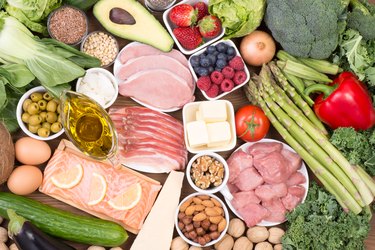
Although a regimen of working out in the gym can deliver positive health results such as increased cardiovascular performance and lowered insulin resistance, let's face it — you want to look good, too. Building muscle and reducing subcutaneous fat are key to looking cut, and diet plays an important role in achieving your goal. Eating low-carb may help you lose weight and reduce fat, but in the end, building muscle boils down to protein intake and exercise.
Tip
Yes, you can build muscle on a low-carb diet provided you get plenty of protein and other nutrients essential to building lean muscle mass.
Video of the Day
Types of Low-Carb Diets
The Dietary Guidelines for Americans recommends getting 130 grams of carbohydrate per day, making any diet with fewer than that technically low carb. However, there are three basic types of low-carb diets.
Video of the Day
The most liberal allow between 100 and 150 grams of carbs per day. This type of carbohydrate diet is best suited for highly active athletes burning a lot of calories and/or those who are trying to gain weight but not necessarily concerned with losing fat. People who don't respond well to lower-carb diets and suffer unwanted side effects are also good candidates for liberal low-carb diets. The Zone and Eco-Atkins diets are two examples, but this level of carbs makes it easy to customize your own dietary intake according to your tastes.
The strictest carb-restricted diets, such as the ketogenic diet, are favored by many bodybuilders wanting to minimize fat surrounding muscle. This type of diet restricts carbs to fewer than 50 grams per day to fuel rapid weight loss, and it focuses on a diet of 70 to 80 percent fat along with sufficient protein to build muscle.
Fueling Muscle Growth Through Ketosis
Traditional muscle-building advice calls for high carbs plus plenty of protein. To this end, it's not hard to find protein powder to maximize carbohydrate and calorie intake. Some of the highest carb protein powders deliver 40 or more grams of carbs per serving.
When sticking to a low-carbohydrate diet of 20 grams of carbs or less, your body will go into ketosis, where it no longer uses carbs converted to glucose for its fuel. Instead, the liver converts fat in the diet or the body to ketones that provide a steady flow of energy.
Although traditional bodybuilding advice regards glucose stored in the muscles to be key in producing muscle mass, intramuscular fat is equally useful when the body switches to ketosis.
Food Quality Matters
High vs. low carb isn't the only aspect of the muscle growth equation. Fill up on high-carb options like pastries and soda all day and you'll definitely "bulk up" if you're doing a lot of resistance training. However, you're likely to gain a lot of fat as well as well muscle. That muscle will be tucked away underneath a blanket of subcutaneous fat that can make you look pudgy instead of ripped.
High-calorie options such as sweets deliver energy and simple carbs that can theoretically fuel muscle growth, but they provide little nutrition. Eat a cupcake and you'll get 200 or more calories but little in the way of nutrients. By contrast, half an avocado and two large eggs can deliver a similar number of calories with the building blocks your body needs to go to work building lean muscle mass.
Low-Carb Muscle Building
Don't believe myths that say low-carb dieting will cause you to lose muscle. As you lose body fat over your muscles, they may initially appear to be smaller. Also, as the glycogen in your muscles gets depleted, the water stored along with it also disappears, making muscles seem smaller. No worries, though; as your body adjusts to a low-carb diet, it replaces the glycogen and the water in the muscle from other sources and the muscles regain their original size.
Increase your protein intake to 1.2 to 1.7 grams of protein per kilogram (2.2 pounds) of body weight to start building muscle on a low-carb diet advises Diet Doctor. A 170-pound person would need 92 to 130 grams of protein daily. Shoot for at least 20 grams of protein at every meal, centering the fare around high-protein choices like salmon (31.5 grams per 5 ounces), chicken (31.5 grams in 6 ounces) or eggs (approximately 6.3 grams per large egg). Bump up the protein count with protein-rich flavorings such as cacao at 27 grams of muscle-building macro per 100 grams or hard, yellow cheeses such as Parmesan cheese at 9 grams per ounce.
Although 1.5 grams is average, those recovering from injury could benefit from higher levels of protein, such as 2 grams of protein per kilogram of body weight.
The Gluconeogenesis Myth
Eating a low-carb diet for muscle gain will make you feel more satiated with lower calories, providing you focus on getting enough fiber, protein and fats. Count your protein macros carefully to make sure you're getting enough to replenish the muscle you break down in your workouts. Failure to do so will prevent the muscle development you're hoping for.
When you have too much protein, your body converts the excess to glucose in a process known as gluconeogenesis. Although some ketogenic dieters worry that it will knock them out of ketosis, this is extremely unlikely for those focused on building muscle through intense workouts.
Getting a little too much protein on a low-carb diet can actually help the body as well. Any extra protein converted to glucose helps fuel the brain and the muscles.
Eat Like a Superhuman
Sports nutritionist and exercise physiologist Ben Greenfield recommends no more than 1.54 grams of protein per kilogram of body weight combined with a diet rich in fats. In the example of a 170-pound person, that would mean eating just 119 grams of protein. Lower levels of carbs can help those dealing with cancer or other conditions that can be affected by getting too much protein, according to Diet Doctor.
Greenfield's Superhuman Food Pyramid places fats as the firm foundation of a low-carb diet designed for building muscle. But that doesn't mean just throwing back shots of olive oil or chowing down on butter-and-coconut-oil fat bombs. The base level of the pyramid includes wild-caught fish, grass-fed red meat and organic tree nuts.
But not just any fat is OK for filling up. Greenfield's pyramid puts the most beneficial foods to the right of the pyramid, foods you should moderate in the middle and those to be avoided on the left side of the pyramid. Dark chocolate, for example, is something to use in moderation, and margarine is to be avoided altogether.
Eat Your Veggies
Low-carb veggies are the second-most important food in the Superhuman Food Pyramid, with protein taking third place. The pyramid then stacks complex-carb sources, fruits and sweeteners as the smallest amount of things you should eat on a low-carb diet for muscle gain.
Here's Living Proof
If you need some data that shows Ben knows what he's talking about, consider his brother Zach Greenfield. The actor changed careers from a firefighter paramedic to a model shooting with some of the world's top photographers and has appeared in a number of movies, music videos and TV shows.
Zach Greenfield put on 20 pounds of lean muscle mass by following the ketogenic diet using the macros in his brother's Superhuman Food Pyramid for just six months, tipping the scales at 230 pounds for his 6-foot 5-inch frame.
Zach's typical day starts with four eggs cooked in coconut oil with a side of spinach and fruit such as berries or apricots. A midmorning snack consists of a homemade protein shake created from full-fat coconut milk, protein powder and almond butter. Zach's lunchtime salad is rich in fats such as avocado and sardines, and dinner features grass-fed beef with a low-glycemic sweet potato.