Hockey is one of the most physically demanding sports. To compete, players must combine skill, speed, explosiveness and endurance. For those who play full-contact hockey, the challenge can be even more daunting, as the potential for injury is magnified even further. Preparing your body for the challenges of a full hockey season is not an easy task. While no training program can guarantee success, there are a number of things the average player can do during the off-season to prepare for the challenges that lie ahead.
Skills Training
Step 1
Stick-handle as often as possible. For most hockey players, puck possession is the object of the game. When you become more comfortable with the puck on your stick, you are less likely to panic with the game on the line. You will gain the ability to handle the puck without looking directly at it and be more confident looking up ice for an open man or a scoring opportunity.
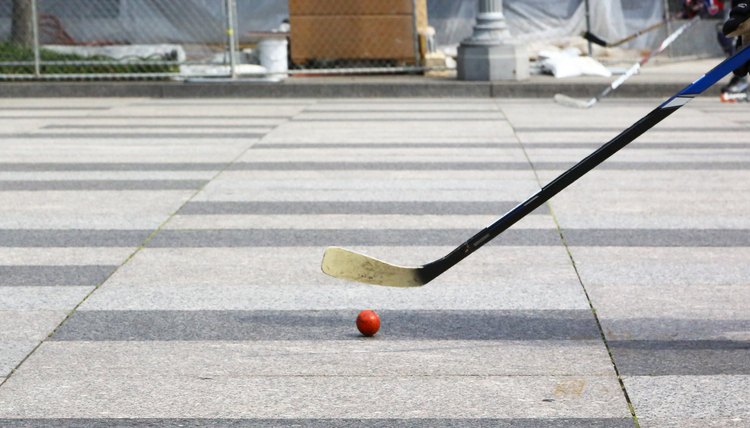
Similar to the football player who carries a football wherever he goes, you should never be far from a stick and ball. Be creative as you maneuver through coffee tables, chair legs, and family pets. The more time you spend with your hockey stick, the more it will feel like an extension of your body and the more natural stick-handling will become.
Step 2
Score 100 goals per day. Simple repetition makes all the difference when developing your shot. Developing muscle memory within the wrists and forearms will allow you release your shot quicker, harder and with more accuracy. Use the plexiglass or hard plastic as a shooting surface and take at least 100 shots on net per day. Vary your targets between the four corners of the net and shoot from several different angles. If you play forward, take 70 wrist shots and 30 slap shots. If you play defense, take 70 slap shots and 30 wrist shots.
Step 3
Skate three times per week for 30 minutes. This can be done on ice or with roller blades. The goal of these skating sessions should not be to develop endurance or power, but rather to generate foot speed and balance.
Spend 10 minutes focusing on starting, stopping and changing direction. Then take 10 minutes to focus on crossing over and accelerating through turns. Finally, spend 10 minutes skating backwards. These are three of the most underdeveloped areas for many hockey players. By strengthening your skills in these key areas, you will begin to pull away from competition on the ice.
Fitness Training
Step 1
Develop power with resistance training. This should be done by focusing mainly on your core, back and legs, which are the main muscle groups involved in playing hockey. Two-thirds of your resistance program should be focused on these muscles. Execute sets of six to eight repetitions with the maximum weight possible. This will allow for the greatest gains in both strength and size. Exercises like squats, deadlifts and pullups are ideal for developing this type of strength.
Step 2
Use interval training to develop explosiveness and endurance. Because hockey players generally take shifts that are between 60 and 90 seconds in duration, traditional cardiovascular training is limited in its effectiveness. By training in shortened, intensified bursts, your body will become better accustomed to the demands placed upon it during an actual game of hockey. Simply plan a route exactly as you would for a normal run. Begin by jogging at a light pace for three to five minutes to warmup. Next, use your stopwatch to time a 30-second sprint, followed by 60 seconds of quick-paced walking. Alternate between the two until you have completed your run.
Step 3
Refine the details. While power and endurance are both very important, hockey is also a game of details. You should spend time twice per week developing the smaller, hockey-specific muscle groups. Focus these sessions on wrist and ankle strength by performing wrist curls, forearm curls, and balance maneuvers.
Yoga is one training method that offers an entertaining and refreshing approach that will work on these key areas while also enhancing flexibility and strengthening the core and lower back.
Tips and Warnings
- Remember that being in game-shape involves more than simply preparing your body. It is also important to stay mentally sharp during the off-season. Simply watching as much as hockey as possible is a great place to start. Even playing sports related video games has been shown to enhance a player's mental capacity for the game.
- As with any fitness or exercise program, you should speak with your doctor before attempting any of these suggestions.
Things You'll Need
- Hockey stick
- Hockey ball
- Plexiglass or hard plastic, approximately 60 inches by 24 inches
- Hockey pucks
- Hockey net
- Stopwatch


Member Comments