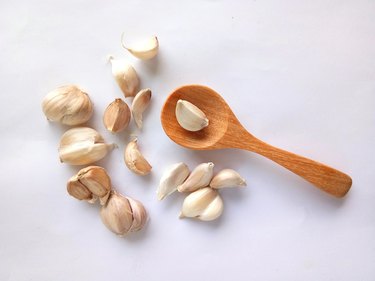
Eating garlic is a great way to boost your health. In addition to being nutritious, garlic has been shown to reduce the risk of chronic conditions such as cardiovascular diseases and certain types of cancer. The greatest health advantages come from fresh, raw garlic. But if you prepare it correctly, you may be able to get many of the garlic benefits from its cooked form, also.
Tip
Raw garlic will give you the maximum health benefits. Just finely chop a garlic clove and sprinkle it on your salad, a thick slice of whole-wheat bread or on your cooked vegetables to release the heart-healthy allicin.
Video of the Day
Nutrition in Raw Garlic
With only 13 calories per a serving (considered three cloves), garlic contains healthy vitamins and minerals. Raw garlic provides B vitamins, especially vitamin B6, supplying 6 percent daily value (DV) in a serving, and niacin, pantothenic acid, riboflavin (B2) and thiamine. The B vitamins function as coenzymes to help your body produce energy from food.
Video of the Day
Fresh garlic is a good source of the antioxidant vitamin C, supplying 5 percent DV per three cloves. Garlic also contains vitamin K, for blood coagulation. The minerals in garlic include manganese, with 8 percent DV per serving, for your nervous system and brain. In addition, garlic contains smaller amounts of copper, zinc, phosphorus, potassium and iron, according to Nutrition Value.
Nutrition in Cooked Garlic
Unfortunately, cooking garlic diminishes its vitamin content significantly. Vitamins B and C in garlic are water soluble, so they are easily destroyed during food preparation, especially cooking. Since boiling reduces vitamins, especially vitamin C , the National Institutes of Health suggests that steaming and shortening cooking times may help preserve the vitamin C in garlic. Vitamin K is fat soluble so cooking will not affect it.
Although minerals cannot be broken down, boiling garlic may leach out some of the manganese, calcium and other minerals, according to Austin Community College. To retain the vitamin content of garlic in your recipe, add it at the end of the cooking process to avoid lengthy exposure to heat.
Allicin Is the Powerhouse
Most of the health benefits in garlic can be attributed to the compound that is responsible for its strong odor. When garlic is chopped, crushed, sliced or chewed, alliinase enzymes are activated and, through a series of conversions, form a sulfur phytonutrient called allicin, according to the Linus Pauling Institute.
The antioxidant properties of allicin in garlic have been studied extensively for their potential benefit for chronic inflammatory diseases and effects on the cardiovascular system, as demonstrated in a 2013 review published in Phytotherapy Research.
During a study to assess the biologic activities of garlic in its raw as well as heated form, researchers found that both fresh and heated garlic had anti-inflammatory effects. However, results published in Food and Chemical Toxicology in 2013 found that heated garlic had a lesser effect and a lower level of concentration of allicin.
The Linus Pauling Institute reports that heating garlic cloves whole or immediately after crushing can destroy the sensitive enzyme (alliinase) in garlic that is responsible for producing allicin. However, the health benefits can be partially conserved by crushing garlic and allowing it to stand for 10 minutes prior to cooking. That gives the enzyme time to be released and for allicin to form. Once formed, allicin is relatively heat stable, according to NutritionFacts.org.
Garlic May Lower Cholesterol
Much attention has been given to the potential positive effect of garlic on cardiovascular health. In addition to allicin, many compounds in both raw and cooked garlic may contribute to health benefits, including flavonoids, selenium and allyl sulfides.
A meta-analysis examined the effect on blood lipids when subjects were given preparations from garlic powder, aged garlic extract, garlic oil and fresh garlic. Findings suggested that garlic was more effective in reducing total, LDL and HDL cholesterol in individuals with elevated total cholesterol levels, compared to the placebo group.
The conclusion, which was published in Nutrition Reviews in 2013, reported that garlic may provide an alternative option to conventional cholesterol-lowering medications for people with slightly elevated cholesterol.
A garlic supplement may be useful for reducing cholesterol. Aged garlic pills are a popular form of supplementation, since they don't add a garlicky smell to your breath.
Raw Garlic May Deter Cancer
The American Institute for Cancer Research suggests that consuming high amounts of garlic may reduce the risk of cancers of the pancreas, esophagus, prostate and breast. Furthermore, the National Cancer Institute says an analysis of data has shown that the higher the amount of raw and cooked garlic consumed, the lower the risk of stomach and colorectal cancer.
A study published in the Iranian Journal of Basic Medical Sciences in 2013 indicated that garlic can slow down the growth of cancer cells. To investigate the antibacterial function of garlic, the study compared the effect of elephant garlic to antibiotics used for common bacterias.
The results found that elephant garlic cloves have antimicrobial properties that are stronger than ampicillin against many bacteria, including E. coli and Staphylococcus. In addition, garlic inhibits the growth of the type of cancer cells that contribute to bone cancer.
Furthermore, a population-based study in 2013 published in the journal Cancer Prevention Research reported that people who ate raw garlic at least twice a week had a 44 percent lower risk of developing lung cancer over the seven-year study period. The conclusion suggested that garlic may be a chemopreventive agent for lung cancer.
- National Cancer Institute: Garlic and Cancer Prevention
- National Institutes of Health: Vitamin C
- Austin Community College: Vitamins and Minerals
- Nutrition Reviews: Effect of Garlic on Serum Lipids: An Updated Meta-Analysis
- Linus Pauling Institute: Garlic and Organosulfur Compounds
- Food and Chemical Toxicology: Short-Term Heating Reduces the Anti-Inflammatory Effects of Fresh Raw Garlic Extracts on the LPS-Induced Production of NO and Pro-Inflammatory Cytokines by Downregulating Allicin Activity in RAW 264.7 Macrophages
- Phytotherapy Research: A Review of the Cardiovascular Benefits and Antioxidant Properties of Allicin
- Iranian Journal of Basic Medical Sciences: Antibacterial Activity of Elephant Garlic and Its Effect Against U2OS Human Osteosarcoma Cells
- American Institute for Cancer Research: Foods That Fight Cancer
- Nutrition Value: Garlic, Raw
- International Journal of Scientific and Technology Research: Effect of Heating on Vitamin C Content of Some Selected Vegetables
- NutritionFacts.org: How Can I Preserve the Anti-Cancer Effects of Cooked Garlic?
- VeryWellHealth: Does Garlic Reduce Your Risk of Cancer?
- Cancer Prevention Research: Raw Garlic Consumption as a Protective Factor for Lung Cancer, a Population-Based Case–Control Study in a Chinese Population
Is this an emergency? If you are experiencing serious medical symptoms, please see the National Library of Medicine’s list of signs you need emergency medical attention or call 911.