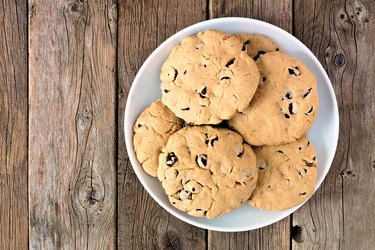
If you're already a health-conscious diner, eating better is usually about small incremental changes rather than a radical alteration of your diet. For example, you can replace butter with oil in cookies as part of your larger strategy to cut saturated fats.
Liquid oils aren't a direct replacement for solid fats such as butter, but you can still make good cookies with a little practice and enjoy the sweet rewards in moderation.
Video of the Day
Video of the Day
Tip
Vegetable oil is a viable substitute for butter when baking cookies. You will likely need to use a smaller amount to keep your cookies from being greasy.
Function of Fat in Baking
Before you substitute oil for butter in cookies, it's a good idea to understand what these ingredients do. Fats have three primary purposes in baking:
- They soften your baked goods by coating the particles of flour and preventing the formation of long, chewy gluten strands.
- Some fats, such as butter, add a richly distinctive flavor of their own.
- Solid fats play a vital role in determining the lightness and texture of the baked goods.
According to an article published in April 2013 by Foods and Raw Materials, one factor to consider when choosing which fat to use when baking is saturated fat content. If you're looking to make your cookies a little healthier, consider switch butter, which is 63 percent saturated fat content, for canola oil, at only 7 percent saturated fat, according to USDA FoodData Central.
Cream Your Fats
In recipes, such as cakes and especially cookies, that call for the butter and sugar to be creamed together, the mixer's paddle itself and the sharp corners of the sugar crystals gouge holes in the stiff fat as the paddle whips through the butter. This creates millions of tiny air spaces in the fat, which are retained in the finished batter or dough.
These air pockets expand in the oven and trap carbon dioxide from the baking powder or baking soda, giving cookies their rise and spread. Even the best of liquid oils can't duplicate this effect.
Going With Oil
You can make a good cookie with vegetable oil, but the butter to oil substitute ratio isn't straightforward. First, butter is only about 80 percent fat, with the remaining 20 percent being milk solids and water content.
On the other hand, oil is pure fat, according to the USDA, so only use about 3/4 of the amount called for. Otherwise your cookies will be greasy. Your cookies will tend to spread more and be flatter, and will be chewy rather than crisp.
It's helpful to start with cookie recipes designed for vegetable oil before you begin adapting your own favorites. That gives you the opportunity to get a feel for oil-based dough and understand how the ingredients work together. Oil-based recipes typically make cookies with a soft, cake-like crumb, though they can have a crisp crust if you increase the quantity of sugar.
Compromises and Alternatives
When baking with oil instead of butter in your recipes, keep in mind that some cookies just won't work as they're supposed to without a solid fat. Try replacing just half the butter with oil, which still cuts your saturated fats but retains much of the cookies' original texture. Alternatively, use solid fats such as non-hydrogenated vegetable shortening or coconut oil in your cookies.
Coconut oil is solid at room temperature, like butter, and can cream to a pleasantly light consistency. It melts at a lower temperature than butter, so if you live in a warm climate you'll need to chill both the coconut oil and your mixing bowl before you start.