
What does fact checked mean?
At SportsRec, we strive to deliver objective content that is accurate and up-to-date. Our team periodically reviews articles in order to ensure content quality. The sources cited below consist of evidence from peer-reviewed journals, prominent medical organizations, academic associations, and government data.
The information contained on this site is for informational purposes only, and should not be used as a substitute for the advice of a professional health care provider. Please check with the appropriate physician regarding health questions and concerns. Although we strive to deliver accurate and up-to-date information, no guarantee to that effect is made.
Cleats & Foot Pain
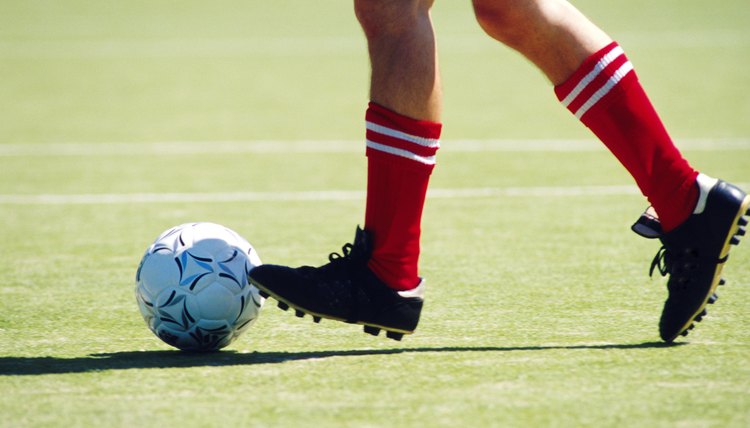
From the youth level to the professional ranks, go to an outdoor game and you’re likely to see the players wearing cleats on their feet. This specialized footwear has its uses and advantages, but improper use, sizing and fits can cause the game to be a painful experience for the player. Without proper considerations, wearing cleats can lead to foot pain.
Cleats
Baseball, football, soccer, lacrosse golf and competitive bicycling are examples of outdoor sports that utilize cleats on the feet of the players. Each of these sports requires a different type of cleat that is designed for the game surface and the types of movement required of the players. Princeton University’s online dictionary defines cleats as “shoes with leather or metal projections on the soles.” Cleats gain grip or traction on the playing field to allow the athlete to perform. They also provide support and control.
Foot Pain
The foot has 26 bones, 33 joints and hundreds of muscles and ligaments, so there are many areas that can cause pain. Foot pain can be felt on any part of the foot, top or bottom, toes to heel. As the feet are necessary for mobility and getting to and from places, an injury or severe foot pain can be devastating to the quality of life. Some foot pain like breaks and infections can lead to long-term damage or disability if it not treated. Foot pain is often due to shoes that don’t fit properly.
Fit
To avoid foot pain from cleats, a proper fit is essential. Make sure you know the sizing of the sport-specific shoe prior to making a decision. For example, soccer shoes are sized like regular shoes but may be narrower at the top of the shoe. Shoes that are made from leather will stretch more after wear so they should be snug when tried on initially. Never purchase and attempt to wear shoes that feel too small or cramp any part of the foot when trying on in the store. The heel of a baseball cleat should be snug, but not rubbing the back of the heel raw and the widest part of the foot should fit comfortably.
Injuries
Common forms of foot pain due to cleats include heel pain like plantar fasciitis, Achilles tendon injuries, ankle sprains and blisters. Sprains are stretched or torn ligaments that can result from pivoting or having a foot caught while trying to move in another direction. Plantar fasciitis is inflammation on the bottom of the foot that can be caused by shoes without padding or shoes that don’t fit properly. The burning sensation can be painful. Plantar fasciitis can also cause arch pain. Blisters result from shoes not fitting properly and rubbing the skin of the foot raw.
Considerations
Cleats should always be broken in prior to wearing in a competitive environment. A game is not the best time to try a new pair of cleats. If you have any pre-existing ankle conditions, speak to a podiatrist before wearing cleats. Children should not wear used cleats. Most foot pain issues can be treated with self-care at home. Keep weight off the foot as often as possible. Use an ice pack for 15 to 20 minutes three times a day and a compression bandage during the day to reduce swelling. Also keep the foot elevated to reduce swelling. Cover blisters with bandages to prevent infection and irritation.
References
Resources
Writer Bio
Karen Cashin began writing and working in public relations in 1999. Her work has appeared in the "hapwise" newsletter and on after5detroit.com. Cashin has experience in the health care, consumer and automotive fields, and holds a Health Insurance Associate designation from America’s Health Insurance Plans, along with her Master of Arts in public relations and organizational communication from Wayne State University.