
The Daily Exercises Needed to Get in Shape for Soccer

Soccer athletes build strong muscles without mass, they develop the agility to step around players; they move laterally, backward and forward with speed and they learn to kick with accuracy and strength. Getting in shape and developing the athletic qualities of a soccer player require daily dedication to training.
The Power of Preparation

Ryan McVay/Photodisc/Getty Images
Exercising cold muscles subjects you to injury and makes your practice less effective. Warm up for five to 10 minutes with light jogging and stretching to get your breathing and heart rates up. Spend another 30 minutes loosening up and strengthening your lower body with low-resistance exercises -- such as walking, squatting and straight-leg walking with mini bands on your ankles and knees. Work on balance and symmetry with single-leg toe touches and jumping. Jump up on one leg and land on the same leg. Jump backward, sideways and forward. Be sure to work both legs.
Cardio for Endurance
Ryan McVay/Photodisc/Getty Images
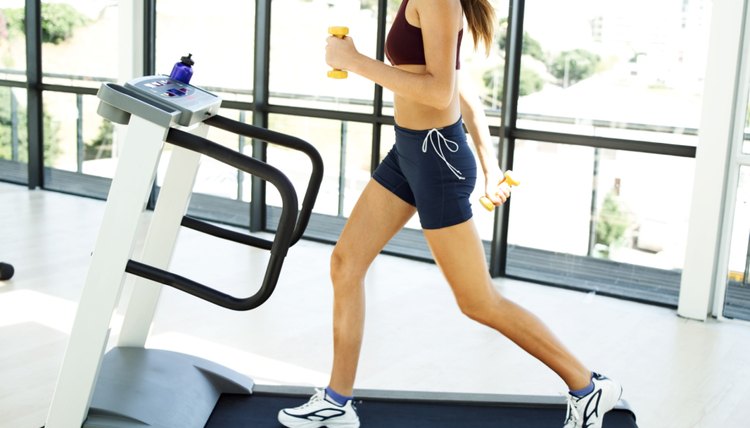
Get your cardio exercise daily by striding, which involves walking vigorously with long steps. Get your heart rate up to 70 percent to 80 percent of your maximum heart rate and stride for 100 yards to 120 yards. Your goal is to build cardio endurance without straining your muscles.
Jog an Obstacle Course
Ryan McVay/Photodisc/Getty Images
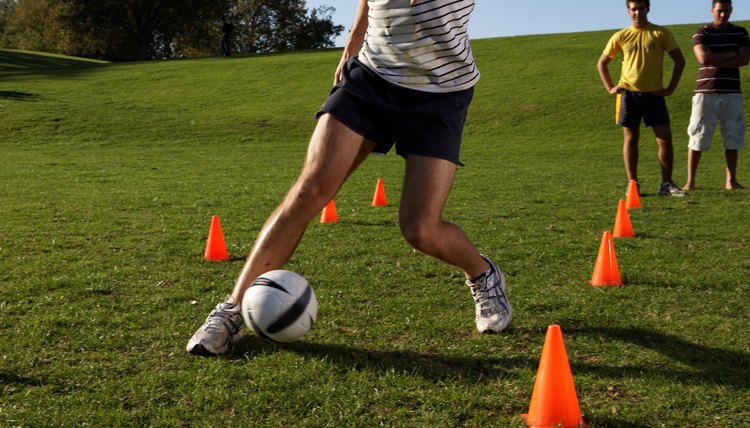
In the book "Soccer Anatomy," Donald T. Kirkendall recommends jogging an obstacle course to work your hip flexors, quadriceps, hamstrings, gastrocnemius, soleus and gluteals, as well as your abdominal core and spinal extensors. Set up six to 10 sets of cones 5 yards to 10 yards apart in parallel lines. Beginning at the first set of cones, jog to the second set of cones using short and quick steps. Stop abruptly and jog backward to the first set. Jog forward to the third set and then jog backward to the second set. Continue in a two-cones-forward, one-cone-back pattern until you reach the last set of cones. Jog back to the first set of cones. Repeat the exercise twice.
Plyometrics Training for Explosive Power
Slow-twitch muscles give you endurance, while fast-twitch muscles give you speed. Both types of muscles are important for soccer players. You can develop your fast-twitch muscles with plyometric jumps. Stand beside a sturdy box or step that is 1- to 2-feet high. With your feet together and your arms swinging for extra propulsion, jump on and off the box 10 times. Switch sides and jump from the other side. To increase the challenge of this exercise, use a higher step or jump back and forth over the box.
Plyometrics Running and Interval Training

Ryan McVay/Photodisc/Getty Images
Run in slow motion, making leaps like a gazelle, for a length of 10 to 20 feet. Bend your knees and jump as high as you can with each leap for plyometric benefits. Build running speed with interval training. Jog lightly for five to 10 minutes, and then sprint a distance the width of a soccer field, giving it all you've got but not so hard that you pull or strain a muscle. Then slow down to a light jog once again. Continue the jog-sprint-jog exercise intervals for 30 minutes.
References
Writer Bio
For Judy Kilpatrick, gardening is the best mental health therapy of all. Combining her interests in both of these fields, Kilpatrick is a professional flower grower and a practicing, licensed mental health therapist. A graduate of East Carolina University, Kilpatrick writes for national and regional publications.