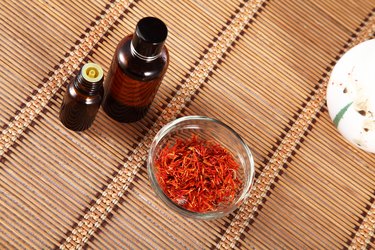
Losing weight and keeping it off requires lifestyle modifications such as diet and exercise. The Dietary Guidelines for Americans recommend eating healthy fats as part of a balanced diet. One fat that comes up often when discussing weight loss is safflower oil, which is made from safflower seeds.
Safflower Seeds and Safflower Oil
Video of the Day
Safflower seeds are used to make safflower oil, which is a polyunsaturated fat, according to Harvard Health. A polyunsaturated fat is an essential fat that your body cannot make, which means you need to get it from food.
Video of the Day
The American Heart Association (AHA) says that polyunsaturated fats can help reduce the LDL cholesterol levels in your blood, which is great news for anyone concerned about their risk of stroke or heart disease. The AHA also points out that polyunsaturated fats also provide essential fats such as omega-6 and omega-3 fatty acids, with safflower oil being an omega-6 fatty acid.
The Mayo Clinic recommends replacing saturated fat with plant-based foods that contain omega-6 fatty acids, such as safflower oil. When eaten in moderation, they say this swap can help decrease your saturated fat intake and potentially benefit your heart. And the safflower oil benefits don't end there: The AHA lists safflower oil as one of its recommendations for healthy cooking oil.
Safflower oil and weight reduction are sometimes linked since safflower oil is a linoleic acid, according to the peer-reviewed scientific journal Natural Product Research, which leaves many people wondering if the oil has any role in weight loss.
Read more: The Pros and Cons of Safflower Oil
Safflower Oil and Weight Loss
Reducing body fat, especially belly fat, is one of the top goals for millions of Americans each year. In addition to a reduced-calorie diet and plenty of exercise, some people will use dietary supplements as part of their plan. One supplement that gets linked with weight loss is conjugated linoleic acid or CLA.
Since safflower oil is a linoleic acid, it often gets confused as a safflower oil weight loss product. However, the weight-loss claims come from companies that chemically alter linoleic acid to produce CLA. But as a food source, safflower oil is not a good source of CLA, so consuming safflower oil for weight loss is not the way to go.
Plus, the research on the effectiveness of CLA and weight loss is mixed, with the National Institutes of Health Office of Dietary Supplements reporting that CLA has minimal effect on body weight and body fat. So, when it comes to products promising weight loss or reduced body fat, proceed carefully and do your homework.
In fact, the U.S. Food and Drug Administration says to be cautious of the claims a product makes and always check with your doctor or health care professional before taking a supplement. With that in mind, the Academy of Nutrition and Dietetics recommends a diet that allows you to make smart choices from every food group. This generally includes plenty of fresh fruits and vegetables, lean protein, complex carbohydrates and healthy fats.
To round out your weight loss plan, make sure to include cardiovascular and resistance training exercise, most days of the week. The minimum health standards set by the U.S. Department of Health and Human Services call for at least 150 minutes of moderate-intensity cardio exercise each week.
You can also reduce the 150-minute recommendation by participating in 75 minutes a week of vigorous-intensity aerobic activity such as high-intensity interval training or HIIT. Plus, at least two days a week of strength training involving all the major muscles in the body.
- U.S Department of Health and Human Services: "Dietary Guidelines for Americans"
- Harvard Health Publications: "The Truth About Fats: The Good, the Bad, and the In-Between"
- National Institutes of Health Office of Dietary Supplements: "Dietary Supplements for Weight Loss"
- Journal Natural Product Research: "Fatty Acid Composition and Tocopherol Profiles of Safflower (Carthamus tinctorius L.) seed oils"
- U.S. Food and Drug Administration: "Beware of Products Promising Miracle Weight Loss"
- Centers for Disease Control and Prevention: "Attempts to Lose Weight Among Adults in the United States, 2013–2016"
- American Heart Association: "Polyunsaturated Fat"
- American Heart Association: "Healthy Cooking Oils"
- Academy of Nutrition and Dietetics: "Back to Basics for Healthy Weight Loss"
- U.S. Department of Health and Human Services: "Physical Activity Guidelines for Americans"
- The Mayo Clinic: "Omega-6 Fatty Acids: Can They Cause Heart Disease?"
Was this article helpful?
150 Characters Max
0/150
Thank you for sharing!
Thank you for your feedback!