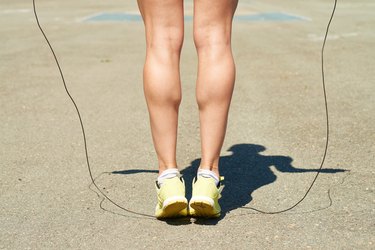
The Achilles tendon connects the calf muscle — the gastrocnemius and soleus muscles — to the heel bone in the foot. This tendon connection allows the calf muscles to move the foot in both plantar flexion (downward) and dorsi flexion (upward) and is vital to sprinting, jumping and other activities.
The tendon is made up of strands of interwoven collagen fibers. When the tendon ruptures, these strands can detach from the calf muscle. Surgery is usually performed to reattach the tendon. Recovery time can take six months or longer, and it is important to follow the right guidelines to rehabilitate the tendon and rebuild the calf muscle.
Video of the Day
Video of the Day
Always consult with your physician prior to exercise after injury.
Initial Treatment Options
Most patients who have an Achilles tendon rupture undergo surgery. The chances of returning to full strength are good and there is a less than five percent chance of re-injury. Following surgery, you will be on crutches and in a hard cast for two to four weeks.
It is important to try to keep the foot elevated above the heart as much as possible to reduce swelling. There should be no weight bearing on the injured foot, as this could cause re-injury early in the recovery process.
Initial Movement Rehabilitation
After the cast comes off, you will be in a walking boot and can begin the initial stages of rehabilitation for the injured tendon and calf muscle. You can often begin walking after Achilles tendon surgery as long your foot is in a walking boot, and initial range of motion exercises can begin.
Perform ankle flexion-extension, ankle circles or ABCs for 20 reps each, three times a day. Swelling may occur, and you should still try to keep the foot elevated above the heart as much as possible.
Beginning Strength Exercises
Approximately eight to 12 weeks following surgery, you may begin basic strength exercises for the injured ankle. Remain in a walking boot and also continue elevating your leg whenever possible to reduce swelling.
For this initial strengthening period, use a light elastic band wrapped around the ankle. Using the band for light resistance, practice plantar flexion (toes pointing down); dorsi flexion (toes pointing up); ankle inversion (rotating inward); and ankle eversion (rotation outward).
Thirty repetitions of each once a day is often the recommended amount. Always consult with your physical therapist or doctor prior to beginning strength exercises after surgery.
Building the Calf Muscle
From 12 weeks onward, you may be able to begin walking without assistance (always get clearance from your physician ahead of time). Continue exercises with the elastic band and can progress to a heavier resistance. You can also begin more complex exercises, including calf stretches, calf raises and single-leg balancing.
For calf raises, begin for the first couple months using both legs simultaneously, performing the exercise every other day. After two to three weeks, begin calf raises on two feet while lowering only on the injured foot, 10 repetitions every other day.
Finally, within six months of the operation, you should progress to performing calf raises only on the injured foot. Expect to return to light exercise approximately six to eight months post-op and to full sport activity by eight to 12 months post-op.
Was this article helpful?
150 Characters Max
0/150
Thank you for sharing!
Thank you for your feedback!