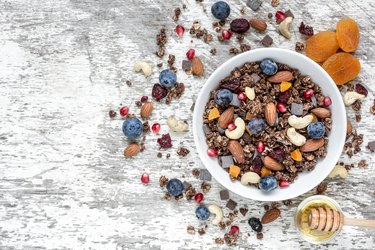
Labels across the cereal aisle shout "good source of vitamin D" or "25 percent daily value of vitamins A, B, C and E." While these claims make it seem like cereal sprouted vitamins itself, it's important to remember the nutrients in these processed foods are, for the most part, not naturally occurring.
Rather, these are fortified cereals that have vitamins and minerals added to them.
Video of the Day
Video of the Day
What Is Fortified Cereal?
Food fortification is the practice of increasing or adding essential vitamins and minerals to improve the nutritional quality of the food, according to the World Health Organization (WHO). While the process can help improve micronutrient deficiency in a given population, it can also make it easier to eat highly processed foods.
Fortified cereal has been commonplace in the food industry for several decades, with roots spanning as far back as the late 1930s when Kellogg's introduced a whole-wheat cereal called "Pep," the first-ever cereal that was fortified with vitamin D and B vitamins.
Given that cereal is convenient, affordable and tasty, it's been widely adopted as the ideal food for nutrient fortification.
Healthy Fortified Cereals
If you're looking for the best fortified options in the cereal aisle, stick to whole grains.
Whole grains contain the bran, the germ and the endosperm of the grain, whereas refined grains contain only endosperm, according to the Academy of Nutrition and Dietetics. The two missing ingredients in refined grains (the bran and the germ) are linked to a reduced risk for heart disease and diabetes.
Whole-grain oatmeal is a great source of beta-glucan fiber, which can help lower cholesterol, according to Harvard Health Publishing. Look for a variety that is high in fiber, as it will keep you full for longer. You'll also want to pick packaged oatmeal brands that have some protein and are low in sugar.
Best Fortified Cereal Brands
While whole-grain cereals may still be fortified with micronutrients, these options are the healthiest choices, especially those that contain low amounts of added sugar. Here's a list of fortified cereal brands and oatmeal we like:
- Total Whole Grain Breakfast Cereal ($8.09 on Amazon)
- Post Great Grains ($23.99 per 12-pack on Amazon)
- Post Bran Flakes ($26.99 per 4-pack on Amazon)
- Special K Original ($22.12 per 6-pack on Amazon)
- Special K Nourish ($3.99 per box on Amazon)
- Special K Brown Sugar Cinnamon ($5.49 on Instacart)
- Happy Belly Strawberry Good Balance ($7.80 on Amazon)
- Cheerios Original ($5.41 per box on Amazon)
- Food for Life Ezekiel 4:9 Sprouted Whole Grain Cereal ($43.79 per 6-pack on Amazon)
- Quaker Oatmeal Squares Breakfast Cereal ($9.29 per 3-pack on Amazon)
- Quaker Life Cinnamon Cereal ($5.39 on Amazon)
Less Nutritious Fortified Cereals
Just because a cereal is fortified with added vitamins and minerals doesn't mean it's nutritious.
Many cereals are refined, which increases the shelf life but strips the grain of important nutrients like B vitamins, iron and fiber, according to the American Heart Association. Even during the fortification process, companies rarely add fiber back in, which means processed cereals lack fiber and won't keep you full too long.
List of Fortified Cereals to Limit
Yet another offender is the sugar content of most processed cereals. Just like a cake made of fortified flour is still a cake, high-sugar cereals still contain loads of the sweet stuff, despite also boasting added nutrients. Here are some fortified breakfast cereals it's probably best to steer clear of:
- Cocoa Puffs
- Cookie Crisp
- Froot Loops
- Frosted Mini-Wheats
- Trix
- Corn Pops
- Reese's Puffs
- Cinnamon Toast Crunch
- Count Chocula
- Franken Berry
The list certainly goes on. Although these cereals may be fortified with up to 100 percent of the daily value for certain vitamins and minerals, they also may have up to 10 to 15 grams of sugar in one serving (and many people eat more than the recommended serving size).
That's nearly or more than half the daily added sugar limit of 25 to 36 grams, according to the American Heart Association.
So, Why Are Foods Fortified Anyway?
The goal of fortification is to address potential nutrient deficiencies in the general population. Many adults do not get enough calcium, magnesium and vitamins D, A, E and C, according to the WHO.
Is Your Diet Missing Certain Nutrients?
People who are pregnant or may become pregnant have an increased need for vitamin D and folic acid, according to the USDA. But most people can get all the nutrients they need from a balanced diet that includes fruits and vegetables, lean protein, dairy, healthy fats and whole grains.
Another problem is that some cereals may be over-fortified, which poses a risk of excessive intake, especially for children. Many of these cereals contain levels of zinc, niacin and vitamin A, according to the Environmental Working Group, that could exceed kids' daily limit for these nutrients set by the Institute of Medicine.
When looking for fortified cereals, keep in mind that more is not always better.
How Well Do You Absorb the Nutrients in Fortified Cereals?
Iron and Zinc in Cereal
In some cases, zinc affects iron absorption and the other way around. But taking these minerals with food might prevent the interaction, according to the U.S. National Library of Medicine.
An older September 1995 study in the British Journal of Nutrition that found no significant difference in people's absorption of zinc from foods fortified with iron and zinc from non-iron-fortified foods.
Iron and Calcium in Cereal
Children absorb similar amounts of iron from calcium-fortified cereals and cereals without added calcium, per the USDA. Children also absorbed similar amounts of calcium from calcium-fortified cereals and milk.
The researchers concluded that calcium-fortified foods can help children increase their daily calcium intake without slowing iron absorption.
Tip
Vitamin C can increase iron absorption, so try having iron-fortified cereal with a glass of orange juice or top your bowl with fruit such as citrus or strawberries.
- World Health Organization: "Guidelines on food fortification with micronutrients"
- Academy of Nutrition and Dietetics: "What Is a Whole Grain?"
- Academy of Nutrition and Dietetics: "5 Whole Grains to Keep Your Family Healthy"
- American Heart Association: "Whole Grains, Refined Grains, and Dietary Fiber"
- EWG: "HOW MUCH IS TOO MUCH? : EWG IDENTIFIED 23 EXCESSIVELY FORTIFIED CEREALS"
- AHA: "Added Sugars"
- EWG: "In New Round of Tests, Monsanto’s Weedkiller Still Contaminates Foods Marketed to Children"
- USDA: "WHAT ABOUT FORTIFIED FOODS?"
- National Institute of Health: "Nutrient Recommendations: Dietary Reference Intakes (DRI)"
- Harvard Health Publishing: "Oats"