
Soccer Drills for 6- and 7-Year-Olds
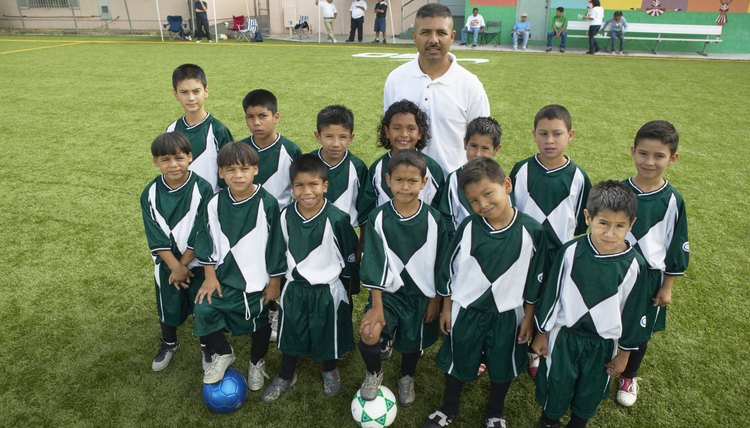
Soccer drills for 6- and 7-year-olds help to improve their dribbling, scoring and passing skills. Drills also help develop teamwork and communication skills for each of your young players, which can improve team chemistry and their ability to win games. Soccer drills for 6- and 7-year-olds range from conditioning drills to corner kicks. Making a game out of the drill keeps it fun for the kids while they work on fundamental soccer skills.
Red Light, Green Light
This basic soccer drill is designed to improve each player's ability to control the ball while dribbling. Have one player stand 20 to 30 yards away from the rest of the team. From here, give each of the other players a ball and spread them out in a straight line. The player standing 20 to 30 yards away is considered the light. Once he yells "green light," the other players can start dribbling toward him. As soon as he yells "red light," everyone must stop dribbling and freeze. Any player who continues to dribble is out of the game. The first player to pass the light wins.
Circle Drill
This drill will improve a player's passing abilities and accuracy. Create a circle out of cones with a 5- to 6-yard radius. From here, put eight cones in the middle of the circle. Have several players on the team pair on opposite sides of the circle. Have one player kick the ball to the other, trying to knock down a cone while doing so. If the ball does not reach the other player, have him retrieve the ball and bring it back outside the circle. Have the players kick the ball back and forth until all the cones are knocked down.
Find the Coach
This drill is designed to help your players quickly identify a target and chase after it. Tell your players to face you. From here, have them close their eyes while you begin running away from them. On your mark, have them open their eyes, identifying where you are and then chasing after you. As the children improve, have them try to take a soccer ball away from you after they open their eyes and chase you.
One on One
One-on-one drills help to improve a player's ability to maneuver past defenders and work on her defensive skills. Place a ball between two players. On your whistle, have them race to the ball to battle for possession. Whoever gets the ball must continue to dribble until she passes her defender. If she passes the defender, she gets one point. The first player to five wins.
References
Writer Bio
Jason Aberdeene has been a freelance writer since 2008. His articles have appeared in the "UCSD Guardian" and on various websites, specializing in teen health. An assistant at Kagan Physical Therapy since 2009, Aberdeene has a Bachelor of Arts in philosophy from the University of California, San Diego.