Can Taking Vitamin B12 Shorten Cold Sores?
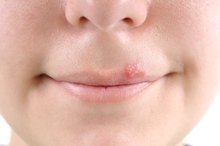
Cold sores are common, highly contagious skin lesions triggered by infection with herpes simplex virus type 1, also called HSV-1. They differ from common non-contagious skin lesions called canker sores. Taking vitamin B-12 will not shorten the duration of a cold sore outbreak. You can potentially shorten a cold sore outbreak with certain prescription medications. Use of vitamin B-12 may help prevent the recurrence of canker sores. Consult your doctor before using any cold or canker sore remedy.
If you are experiencing serious medical symptoms, seek emergency treatment immediately.
Cold Sore Basics
People most typically acquire an HSV-1 infection in their preschool years as a result of close or direct contact with previously infected adults or children, according to the Nemours Foundation’s TeensHealth website 2. Once acquired, the virus migrates to nerve cell groups called ganglia and goes dormant. It can reactivate and trigger the onset of a cold sore in circumstances that include stress, illness, sun exposure and hormonal changes such as those associated with menstruation. While cold sores most commonly appear on your lips, they can also appear on your chin, nostrils, fingers, gums or the roof of your mouth 3.
Shortening Cold Sore Outbreaks
Bumps in the Corners of the Lips
Learn More
Without treatment, a cold sore will typically heal on its own within roughly two weeks. Use of an oral antiviral medication can potentially shorten the duration of a cold sore by a small amount if you start treatment as soon as possible at the beginning of an outbreak, MayoClinic.com reports. Medications used for this purpose include famcyclovir, valacyclovir and acyclovir. Your doctor may prescribe an oral antiviral if you develop related illnesses during a cold sore outbreak, develop cold sores very frequently or have identifiable cold sore triggers and expect to encounter those triggers during your day-to-day routine.
- Without treatment, a cold sore will typically heal on its own within roughly two weeks.
- Use of an oral antiviral medication can potentially shorten the duration of a cold sore by a small amount if you start treatment as soon as possible at the beginning of an outbreak, MayoClinic.com reports.
Canker Sores and B-12
A canker sore, also called aphthous stomatitis, typically appears in areas of the mouth that include your tongue or the inner linings of your cheeks or lips. Most commonly, they first appear between the ages of 10 and 20, and manifest as small round or oval lesions that burst open within a day of formation. No one knows exactly what causes canker sores, the U.S. National Library of Medicine’s MedlinePlus explains 3. Abnormally low levels of vitamin B-12, or another B vitamin called folate, may play a role. If you frequently develop canker sores, your doctor may ask you to take B-12 or folate in order to prevent the onset of future outbreaks.
- A canker sore, also called aphthous stomatitis, typically appears in areas of the mouth that include your tongue or the inner linings of your cheeks or lips.
Considerations
Cold Sore Stages
Learn More
The Mayo Clinic lists several treatments that can potentially ease your discomfort during a cold sore outbreak. They include applications of cold or heat at the site of a sore, use of nonprescription ointments that contain benzocaine or lidocaine, avoiding touching a sore or disturbing it in any way and use of nonprescription painkillers such as aspirin, ibuprofen or acetaminophen. Don’t use a benzocaine-containing ointment on a child under the age of 2 without a doctor’s explicit advice. Also speak to your doctor before giving aspirin to a child or teenager.
- The Mayo Clinic lists several treatments that can potentially ease your discomfort during a cold sore outbreak.
- They include applications of cold or heat at the site of a sore, use of nonprescription ointments that contain benzocaine or lidocaine, avoiding touching a sore or disturbing it in any way and use of nonprescription painkillers such as aspirin, ibuprofen or acetaminophen.
Related Articles
Bumps in the Corners of the Lips
Learn More

Cold Sore Stages
Learn More

Vaseline Lip Therapy on a Cold Sore
Learn More
Signs & Symptoms of Human Skin Mites
Learn More
Causes of Cold Sores Other Than Herpes
Learn More
Grapefruit Seed Extract for Cold Sores
Learn More
Stages of Cold Sores
Learn More

Baking Soda for Cold Sores
Learn More

Facial Herpes Symptoms
Learn More

How Long Does an Outbreak of Genital Warts Last?
Learn More
References
- MayoClinic.com; Cold Sore (Pages, 1, 2, 6 and 7); April 14, 2011
- The Nemours Foundation - TeensHealth: Cold Sores (HSV-1) (Pages 1 and 2)
- MedlinePlus: Mouth Sores
- Federal Citizen Information Center/National Institute of Dental and Craniofacial Research; Fever Blisters and Canker Sores
- Johns Hopkins Medicine. Oral Herpes.
- Mailoo VJ, Rampes S. Lysine for Herpes Simplex Prophylaxis: A Review of the Evidence. Integr Med (Encinitas). 2017 Jun;16(3):42-46.
- Ramchandani M, Kong M, Tronstein E, et al. Herpes Simplex Virus Type 1 Shedding in Tears and Nasal and Oral Mucosa of Healthy Adults. Sex Transm Dis. 2016;43(12):756-760. doi:10.1097/OLQ.0000000000000522
- Institute for Quality and Efficiency in Health Care (IQWiG). Cold sores: Overview. 2018.
- Montgomery-cranny JA, Wallace A, Rogers HJ, Hughes SC, Hegarty AM, Zaitoun H. Management of recurrent aphthous stomatitis in children. Dent Update. 2015;42(6):564-6, 569-72. doi:10.12968/denu.2015.42.6.564
- Krissel JD, Bhatia A, and Thomas A. Cold sore susceptibility gene-1 genotypes affect the expression of herpes labialis in unrelated human subjects. Hum Genome Var. 2014; 1: 14024. doi:10.1038/hgv.2014.24
- Fatahzadeh M and Schwartz RA. Human herpes simplex virus infections: Epidemiology, pathogenesis, symptomatology, diagnosis, and management. J Am Acad Dermatol. 2007;57(5):737-63. doi:10.1016/j.jaad.2007.06.027
- Formica M, Kabbara K, Clark R, Mcalindon T. Can clinical trials requiring frequent participant contact be conducted over the Internet? Results from an online randomized controlled trial evaluating a topical ointment for herpes labialis. J Med Internet Res. 2004;6(1):e6.
- American Academy of Dermatologists. Cold sores: Overview.
- American Academy of Dermatologists. Cold sores: Signs and symptoms.
- American Academy of Dermatologists. Cold sores: Tips for managing.
Resources
Writer Bio
M. Gideon Hoyle is a writer living outside of Houston. Previously, he produced brochures and a wide variety of other materials for a nonprofit educational foundation. He now specializes in topics related to health, exercise and nutrition, publishing for various websites.