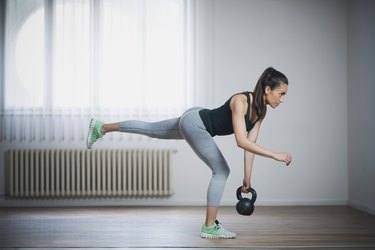
Two popular deadlift variations — the Romanian deadlift and stiff-legged deadlift — both work your lower back and hamstrings. Since they are very similar exercises, the differences in technique are minor, but the differences in application remain significant. In addition to building muscle, both exercises can help improve your squat and deadlift by building lower-body strength reports ACE Fitness.
Read more: Romanian vs. Standard Deadlift
Video of the Day
Video of the Day
Do a Romanian Deadlift
The Romanian deadlift is a lift that was developed by Romanian weightlifter Nicu Vlad, to assist with the pull on the clean and jerk. This lift is performed in a similar manner to the stiff-legged deadlift, but there are differences. Unlike the stiff-legged deadlift, when you lower the bar on the Romanian deadlift, you push your hips back so the bar is closer to your body at all times.
Your torso will approach parallel to the ground faster than in the stiff-legged deadlift, and when the bar is just past your knees, you straighten your legs quickly and explosively pull the weight back up.
HOW TO DO IT: To do a Romanian deadlift properly, stand behind a barbell and reach down to grab it with both hands, hinging at the hips. Bend your knees slightly but keep your torso straight and parallel to the ground. Squeeze your hamstrings and glutes as you stand up straight, keeping the barbell close to your body. Hinge forward again, lowering the weight to your shins for one rep.
Do a Stiff-Legged Deadlift
The stiff-legged deadlift may be done for up to 20 repetitions per set, but on high-repetition sets, take care to ensure that your technique does not suffer due to fatigue. Dumbbells can be used for this exercise, but this significantly reduces the weight you can use.
HOW TO DO IT: Hold a barbell with an overhand grip and extend your arms straight down. Bend your knees slightly, just enough so that your legs are not locked. Without allowing your knees to bend any further, lower the barbell to either the limit of your flexibility or where your lower back starts to round. Stand up by reversing the path of the bar.
Differences in Muscle Recruitment
Both exercises work your hamstrings and lower back, but by pushing your hips to the rear, you are increasing the rotation at your hip joint in the Romanian deadlift. This means your hips are flexing more, and you're working your gluteus maximus, or posterior muscle, to a higher degree along with your core says ACE Fitness.
Your torso angles more, so there is greater activation of your spinal erectors, or lower back, in the Romanian deadlift. No research has been performed to determine if there is any difference in activation of your hamstrings when comparing the two lifts.
Read more: What Are the Benefits of Deadlifting?
Review the Applications
If your only goal is to work the muscles of your lower back, hips and hamstrings, the stiff-legged deadlift works well. If your goal is to improve your pull in Olympic weightlifting, then not only does the Romanian deadlift work better, the mechanics of the lift are the same.
The stiff-legged deadlift features a different bar path, which can disrupt the pattern of your pull. This is rather like a receiver running a pattern that is slightly off — the quarterback will have to adjust his position and timing to compensate for the minor differences.
Try Other Deadlift Variations
Aside from these two deadlift variations, there are plenty of others that you can try out and add to your lower-body workout routine.
- Sumo Deadlift: Start with your legs several feet apart (wider than hip-width apart), knees facing out. Try and "spread" the floor out with your feet to ensure that the knees remain spread according to the National Strength and Conditioning Association. Grab the bar in between your legs.
- Single-Leg Deadlift: Balance on just one leg.
- Single-Arm Deadlift: Cut your normal weight in half (or completely unload the bar) and grab the bar with one arm.
- Deficit Deadlift: Stand on a stable box that's one to four inches high while you perform a deadlift.
- Eccentric Deadlift: Take twice as long on the eccentric phase of this exercise (lowering the bar).
- Wide-Grip Deadlift: Hold the bar outside the distance of your legs.
- Hack Lift: This one is for healthy, experienced lifters only. Start with the bar behind you and perform a backward deadlift.