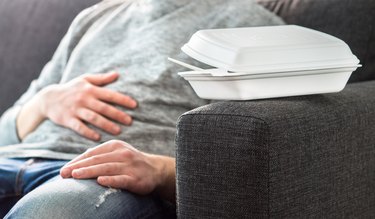
Once you eat a meal, the contents mix with your digestive juices and move through your digestive tract in an orderly and efficient manner — at least that is what is supposed to happen.
If you have gastroparesis, a condition marked by slow to no movement of the muscles in your stomach charged with helping to digest food, this isn't always the case, explains William J. Bulsiewicz, MD, a gastroenterologist in Mount Pleasant, South Carolina, and author of the forthcoming book Fiber Fueled. "In some people, the digestive process doesn't work as well as it should, and their stomach doesn't empty or contract and food gets stuck and piles up," he says.
Video of the Day
Video of the Day
About 10 men and 40 women out of 100,000 will have this condition, according to the National Institute of Diabetes and Digestive and Kidney Diseases (NIDDK). Symptoms may include feeling full soon after a meal and long after you have finished eating, nausea, vomiting, pain, heartburn and bloating, among others.
Exactly what causes gastroparesis is not fully understood. Dr. Bulsiewicz says it may occur with poorly controlled diabetes. Or, "if you have had surgery on your esophagus, stomach or small intestine, you may be more likely to have food not digesting, sitting in your stomach," he adds.
Radiation to your chest or stomach as part of cancer treatment, as well as medical conditions, such as hypothyroidism (low thyroid), Parkinson's disease and multiple sclerosis, may increase the risk for gastroparesis. Medicines, such as opioid pain relievers, some antidepressants and high blood pressure and allergy medications can also lead to slower gastric emptying, says NIDDK.
Read more: What Are the Causes of a Slow Digestive System?
Foods to Speed Up Gastric Emptying
Certain foods may help speed up or slow down the pace at which your stomach empties, Dr. Bulsiewicz says. "It's not what you eat as much as what you avoid," he says. "High-fat foods slow digestion."
Certain types of fiber — namely insoluble fiber in wheat bran, vegetables and whole grains — should only be consumed in moderation if you are prone to gastroparesis. "Roughage and vegetables with thick skin can get stuck, increasing risk of a bezoar," Dr. Bulsiewicz says.
A bezoar is a mass of material in your digestive tract that cannot be digested and can cause a blockage, according to the Mayo Clinic. "It's a pile-up of the fiber because your stomach is not emptying," Dr. Bulsiewicz explains. Choose well-cooked fruits and vegetables over raw ones. "A smoothie is a better choice than a salad," he says.
Soluble fiber is a different story, he says. "Soluble fiber attracts water and turns it to gel during the digestive process so it will not slow gastric emptying," he says. Good sources of soluble fiber include oat bran, nuts, barley, beans, seeds, lentils and peas, along with certain fruits and vegetables, according to the U.S. National Library of Medicine. Alcohol and tobacco slow gastric motility and should be avoided, the Mayo Clinic notes.
There aren't necessarily any herbs to speed up gastric emptying, but ginger is associated with improved movement, Dr. Bulsiewicz says, so "ginger tea with a meal may help speed up gastric emptying."
Read more: Foods You Can Eat When You Have Gastroparesis
Drugs to Speed Up Gastric Emptying
"Gastroparesis is a tough condition," Dr. Bulsiewicz says. "We don't have great medications yet."
One medication, metoclopramide, increases the contraction of the muscles in your stomach and may improve gastric emptying, according to U.S. National Library of Medicine.
"It needs to be taken every six hours, and if you stop taking it, it won't work," Dr. Bulsiewicz says. "Chronic use causes side effects, including tightening of the muscles in your jaw or neck and speech problems that are reversible, but only if you stop taking the drug."
Another drug, domperidone, increases the contraction of the muscles in the wall of your stomach with fewer side effects than metoclopramide, he says, but it's not approved by the Food and Drug Administration for sale in the U.S. It is only available for use under limited circumstances for patients with difficult-to-manage conditions.
Erythromycin, an antibiotic, also increases stomach muscle contraction and may improve gastric emptying, according to the NIDDK. "After a couple of weeks, it stops working because your body gets used to it," Dr. Bulsiewicz says, "and we know that antibiotics can also affect the gut microbiome and result in other gastrointestinal issues."
Symptom relief with anti-nausea drugs is also an option, he says.
In addition, treating the cause of gastroparesis may sometimes improve gastric emptying. For instance, if diabetes is causing the delayed stomach emptying, getting your blood sugar under tight control may help, according to the NIDDK. In extreme cases, surgery may be required, the agency notes.
- William J. Bulsiewicz, MD, a gastroenterologist in Mount Pleasant, South Carolina"
- National Institute of Diabetes and Digestive and Kidney Diseases (NIDDK): “Definition and Facts for Gastroparesis”
- Mayo Clinic: "Gastroparesis"
- Mayo Clinic: "Bezoars: How Do They Happen?"
- U.S. National Library of Medicine: “Soluble vs. Insoluble Fiber”
- U.S. National Library of Medicine: “Metoclopramide”
- NIDDK: “Treatment for Gastroparesis”
- U.S. Food and Drug Administration: "How to Request Domperidone for Expanded Access Use"
- NIDDK: "Symptoms and Causes of Gastroparesis"
- Mayo Clinic: "Gastroparesis - Diagnosis and Treatment"
Is this an emergency? If you are experiencing serious medical symptoms, please see the National Library of Medicine’s list of signs you need emergency medical attention or call 911.