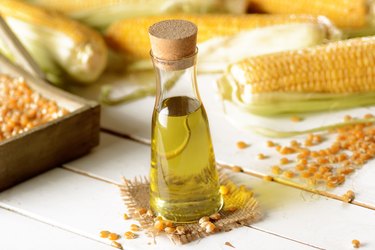
Corn oil fits in perfectly with a healthy diet. It's full of good fats and a powerful antioxidant that can keep you in tip-top shape. Even though corn oil can be beneficial, it's incredibly high in calories.
Always use the smallest amount possible while cooking and pour into measuring spoons to help you monitor your portion.
Video of the Day
Video of the Day
Tip
Corn oil is a good source of healthy fats.
Use Healthy Cooking Oil
More than a quarter of the total fats in corn oil, nearly 4 grams per tablespoon, are monounsaturated fatty acids, according to the USDA. Eating foods with these type of fats, known as MUFAs, is one of the best things you can do for your heart, according to the American Heart Association (AHA).
MUFAs play a role in lowering your low-density lipoprotein, or LDL. This damaging cholesterol is the one that makes your arteries hard as it clogs them up, increasing your chances of having cardiovascular issues.
Know the Perks of Polyunsaturated
Over half of the fat in corn oil, or 7.4 grams per tablespoon, is polyunsaturated fat, according to nutrient data from the USDA. Polyunsaturated fatty acids, more commonly known as PUFAs, are as important as monounsaturated fats for stabilizing cholesterol and safeguarding your heart, notes the AHA.
Some of the PUFAs in corn oil are omega-6 fatty acids, and a tiny fraction are omega-3s. Omega-3 and omega-6 fatty acids are essential in your diet, since your body cannot make them. You need them for brain cell communications, growth, reducing inflammation and further protecting your heart.
Americans consume more omega-6s than omega-3s, according to Harvard Health Publishing. Past research suggested that too much omega-6 and not enough omega-3 fatty acids could contribute to obesity, as discussed in this March 2016 article published by Nutrients.
However, cutting back on your omega-6s is no longer recommended, according to Harvard Health Publishing. Instead, add more omega-3s to your diet to bring the two into balance.
Read more: Why You Need to Eat Fat to Burn Fat
Understand Vitamin E Benefits
Corn oil is also high in vitamin E, giving you almost 15 percent of your recommendation from just one tablespoon. Vitamin E is a type of antioxidant, meaning it scavenges through your body, nullifying free radicals.
Without the help of vitamin E, free radicals would be free to stick onto healthy cells, eventually causing chronic conditions like heart disease and certain cancers. Get 15 milligrams of vitamin E daily, the Food and Nutrition Board of the Institute of Medicine states. Corn oil has 2 milligrams in each tablespoon.
Consume in Moderation
Just because corn oil is full of good-for-you components doesn't mean you want to have it regularly. Corn oil is a fat and full of calories. One tablespoon has almost 125 calories from the 13.5 grams of fat.
Because you should consume only 44 to 78 grams of fat daily for a 2,000-calorie diet — 20 to 35 percent of your total calories — a tablespoon of corn oil takes up as much as 30 percent of your fat allowance for the day. Since calories and fat quickly add up, avoid pouring freely from the bottle and measure out corn oil instead.
- FoodData Central: "Corn Oil"
- Office of Dietary Supplements: "Vitamin E"
- American Heart Association: "Monounsaturated Fats"
- American Heart Association: "Polyunsaturated Fats"
- Harvard School of Public Health: "Ask the Expert: Omega-3 Fatty Acids"
- Nutrients: "An Increase in the Omega-6/Omega-3 Fatty Acid Ratio Increases the Risk for Obesity"
- Harvard Health Publishing: "No Need to Avoid Healthy Omega-6 Fats"