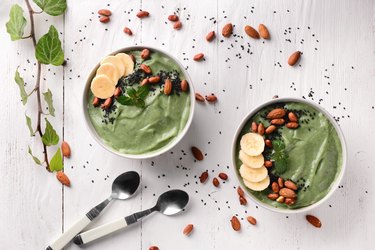
Who would want to eat pond scum? As it turns out, humans — for many centuries in Mexico and Africa, and in the U.S. since the 1970s, reports the U.S. National Library of Medicine. But just what is it, what are its benefits and what is the right spirulina dosage?
Tip
There is no standardized spirulina dosage. A variety of dosages have been used in research studies, and supplement manufacturers list their own recommended dosages on product labeling.
Video of the Day
What Is Spirulina?
Spirulina is not a plant. Commonly called blue-green algae because of the blue-green pigments it produces, spirulina is not actually an algae either, but a type of bacteria called cyanobacteria. Cyanobacteria grows in saltwater and some freshwater lakes and thrives in warm, nutrient-rich aquatic environments. Its name comes from the spiral shapes in which the bacteria grow, explains Winchester Hospital.
Video of the Day
Historically, spirulina was used as a food source. It was first discovered by a Spanish scientist, Hernando Cortez, who observed it being eaten by Aztecs during a visit to Lake Texcoco in the Valley of Mexico. According to an article published in Trends in Food Science & Technology in September 2017, botanists began to study the health benefits of spirulina and then it started to become commercialized for its health benefits.
The first spirulina processing plant was established by the French in 1969. Since then, the popularity of spirulina has skyrocketed in the West, especially in the U.S. where nearly 80 percent of the population consume dietary supplements, according to the Council for Responsible Nutrition.
Read more: The 12 Most Overrated Supplements
What Are Spirulina's Benefits?
Authors of the Trends in Food Science and Technology article refer to spirulina as "the most nutritious, concentrated food that is known to mankind," providing an array of macro and micro nutrients, antioxidants, phytochemicals, probiotics and nutraceuticals.
Compared to other plant foods, spirulina is a richer source of protein, which comprises 60 percent of its dry weight, reports Harvard Health Publishing. According to USDA data, 1 tablespoon of dried spirulina provides 4 grams of protein — nearly 10 percent of the recommended daily intake for women established by the Food and Nutrition Board of the National Academies of Sciences, Engineering, and Medicine. With only 20 calories in that tablespoon, it's a low-calorie source of protein for those who are following a low-calorie, plant-based diet.
Spirulina is a good source of the mineral iron, with 1 tablespoon providing 25 percent of the recommended daily intake for men and people after menopause, and 11 percent of the recommended intake for women, according to the National Institutes of Health. It's also a source of several fatty acids, including gamma-linoleic acid (GLA), an essential fatty acid that must be obtained from the diet. As a type of omega-6 fatty acid, GLA plays a role in energy production and bone, skin and hair health.
According to Harvard Health Publishing, spirulina's rich nutrient content is its only proven benefit, although it has been touted for its ability to prevent and treat numerous conditions, such as high cholesterol, hypertension, diabetes, depression, viral hepatitis and malnutrition. It's also said to improve immune function and liver and kidney health.
But the fact is, there's scant research to support any of these claims. While the macro- and micronutrients it contains may boost overall health and aid in the prevention and treatment of certain conditions, spirulina doesn't provide any novel nutrients that other plant foods don't also provide.
The U.S. National Library of Medicine supports this, saying there is insufficient evidence for spirulina's ability to improve, prevent, treat or cure any of the following:
- Hay fever
- Insulin resistance caused by drugs used to treat HIV/AIDS
- Arsenic poisoning
- Athletic performance
- Attention deficit-hyperactivity disorder
- Eyelid ticks or twitching
- Diabetes
- Fatigue
- Hepatitis C
- HIV/AIDS
- High cholesterol or other fats in the blood
- Menopause
- Mental alertness
- Obesity
- White patches in the mouth caused by smoking
- Gum infection
- Anxiety
- Iron deficiency anemia
- Premenstrual syndrome
- Cancer
- Non-alcoholic fatty liver disease
- Depression
- Stress
- Indigestion
- Heart disease
- Memory
- Wound healing
The only condition for which spirulina might be effective, according to the science, is for reducing blood pressure in some people.
A small study published in European Review for Medical and Pharmacological Sciences in 2016 found that three months of daily spirulina supplementation resulted in improved blood pressure in 40 overweight participants with hypertension. It also improved endothelial function. According to Cedars Sinai, endothelial dysfunction plays a role in stroke and heart attacks.
If you are interested in taking spirulina to reduce blood pressure, talk to your doctor about whether it is right for you.
What Is the Right Spirulina Dosage?
According to Winchester Hospital, researchers have used a variety of dosages in scientific studies, ranging from 1 to 8.4 grams per day. In the European Review study, the spirulina dosage used was 2 grams daily.
However, since spirulina hasn't been confirmed effective for any health condition, there is no standard dosage. Spirulina is an over-the-counter supplement, which means manufacturers determine the dosage listed on the labels. That dosage is typically around 3 to 3.5 grams, according to commercially available packages.
If you are looking to take spirulina as a source of nutrients, that small serving isn't going to get you much. Three and a half grams of spirulina provides only 2 grams of protein and minimal amounts of vitamins, minerals and fatty acids.
Tip
There are many ways to incorporate spirulina into your diet beyond just mixing it with water or juice or popping some tablets. You can add it to a green smoothie, sprinkle the powder on salads or soups, or add it to raw chocolate brownies or energy balls with other healthy ingredients.
What Are Spirulina Side Effects?
At recommended dosages, the U.S. National Library of Medicine reports that spirulina is "possibly safe." This only applies to products that are free of contaminants, including liver-damaging substances called microcystins, toxic metals and harmful bacteria.
Daily doses of as much as 19 grams of contaminant-free spirulina have been used safely for up to two months, and doses of 10 grams daily have been used for up to six months. Any side effects are typically mild and may include nausea, vomiting, diarrhea, abdominal discomfort, fatigue, headache and dizziness.
Side effects and potential dangers of spirulina increase when products are contaminated. Contaminated spirulina can cause liver damage, stomach pain, nausea, vomiting, weakness, thirst, rapid heartbeat, shock and even death.
Pregnant and breastfeeding women should be especially cautious. There isn't sufficient evidence showing that uncontaminated spirulina is safe to use when pregnant or breastfeeding. Harmful toxins in contaminated products may be transferred to an infant in the womb or through breast milk. The U.S. National Library of Medicine urges pregnant and breastfeeding women to avoid using any spirulina product.
It also advises the following people with the following conditions to avoid spirulina:
- Autoimmune disorders, including multiple sclerosis, lupus, rheumatoid arthritis and pemphigus vulgaris: The potential for spirulina to increase immune system activity can worsen symptoms of autoimmune diseases.
- Bleeding disorders: Spirulina could slow blood clotting and encourage bruising and bleeding.
- Phenylketonuria: Spirulina contains phenylalanine, which can worsen phenylketonuria.
Spirulina may also interact with medications and other herbs and supplements, including immunosuppressants, anticoagulant/antiplatelet drugs, herbs and supplements that slow blood clotting, such as angelica, clove, danshen, garlic, ginger, gingko and others.
Additionally, although spirulina is high in iron, it may decrease the body's ability to absorb iron from other foods. If you have or are at risk of an iron deficiency, talk to your doctor about how to safely take spirulina.
Read more: What You Should Know About the Safety of Supplements
What Are the Best Supplements?
To prevent the potential danger of spirulina, it is important to choose supplements that have been tested for contaminants. However, those are few and far between. Spirulina is a dietary supplement and therefore is not regulated by the Food and Drug Administration. The FDA does not review products for safety or effectiveness before they go to market.
By law, supplement manufacturers are required to ensure the safety of their products, which includes ensuring that they are free from contaminants. However, according to Harvard Health Publishing, the lack of FDA regulation means that there is no guarantee that the product you choose will be contaminant-free, even if the label makes that claim.
Some supplement manufacturers seek third-party testing to ensure their products are free of particular contaminants. Three U.S. organizations that provide testing and certification are ConsumerLab.com, NSF International and U.S. Pharmacopeial Convention. Products that have been certified by one of these organizations will carry the organization's seal on the label.
The FDA offers a few more tips on how to choose safe supplements:
- Search for supplements on non-commercial websites, such as NIH, FDA and USDA.
- Ask your healthcare provider for a recommendation.
- Call the manufacturer to ask any questions you or your healthcare provider may have about the supplement.
- Don't trust claims on labels that sound too good to be true. If a product is marketed for the treatment or cure of a specific health condition, or says it works better than a prescription drug, steer clear.
Lastly, evaluate whether or not spirulina will really benefit you. After reviewing all the research and getting your healthcare provider's opinion, is it worth the financial investment?
Spirulina supplements can be exorbitant. In many cases, you will gain more benefit from investing that money in your diet — making sure to eat fresh, whole foods, organic fruits and vegetables and grass-fed hormone-free meats and dairy. A healthy diet and regular exercise are proven methods for building a strong immune system, preventing disease and improving existing health conditions.
- Council for Responsible Nutrition: "Dietary Supplement Use Reaches All Time High — Available-For-Purchase Consumer Survey Reaffirms the Vital Role Supplementation Plays in the Lives of Most Americans"
- Minnesota Pollution Control Agency: "Blue-Green Algae and Harmful Algal Blooms"
- U.S. National Library of Medicine: "Blue-Green Algae"
- Trends in Food Science & Technology: "Spirulina – From Growth to Nutritional Product: A Review"
- Harvard Health Publishing: "By the Way, Doctor: Is Spirulina Good for You?"
- USDA: "Seaweed, Spirulina, Dried"
- Food and Nutrition Board of the National Academies of Sciences, Engineering, and Medicine: "Dietary Reference Intakes (DRIs): Recommended Dietary Allowances and Adequate Intakes, Total Water and Macronutrients"
- NIH: "Iron"
- Cochrane: "Omega-6 Fats to Prevent and Treat Heart and Circulatory Diseases"
- European Review for Medical and Pharmacological Sciences: "Effects of Spirulina Consumption on Body Weight, Blood Pressure, and Endothelial Function in Overweight Hypertensive Caucasians: A Double-Blind, Placebo-Controlled, Randomized Trial"
- Cedars Sinai: "Endothelial Function Testing"
- Winchester Hospital: "Spirulina"
- Journal of the Academy of Nutrition and Dietetics: "Quality Certification Programs for Dietary Supplements"