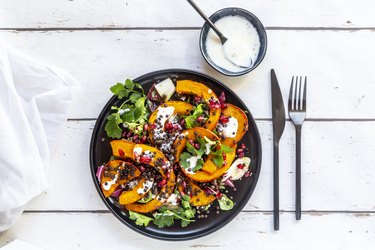
Many people think the word "vegetarian" equates with healthy, but just like any other diet plan, the way you design it matters. If you want to follow a vegetarian meal plan for weight loss, 1,000 calories may seem like a good target, but that can put you at risk for nutrient deficiencies.
There are some nutrients of concern that can be difficult to get on a vegetarian diet, and when you restrict your calories too much, getting proper amounts of these nutrients gets even harder. Instead of restricting calories to 1,000 per day, make sure you're eating at least 1,200 and optimizing your vitamin and mineral intake by choosing nutrient-dense, whole foods.
Video of the Day
Video of the Day
Nutrients of Concern
There are some nutrients that are already a concern on a vegetarian diet plan, and if you drop below 1,200 calories, those concerns get even higher. As Harvard Health Publishing states, women should get at least 1,200 calories and men should aim for 1,500 daily calories, unless you're under the supervision of a medical professional.
According to the Mayo Clinic, the most common nutrient deficiencies associated with a vegetarian diet are:
- Calcium
- Vitamin D
- Vitamin B-12
- Protein
- Omega-3 Fatty Acids
- Iron
- Zinc
Read more: 12 Tips to Getting a Vegetarian Diet Right
The American Academy of Family Physicians points out that, as a whole, Americans tend to choose foods that are high in calories, but low in micronutrients (or vitamins and minerals). To optimize the amount of nutrients you're getting on a low-calorie vegetarian diet, include lots of nutrient-dense foods, like:
- Calcium: Dairy products, chickpeas, black beans, broccoli, dark leafy greens (like collard greens, turnip greens and kale), almonds and almond butter
- Vitamin D: Eggs and vitamin D-fortified milk or orange juice
- Vitamin B-12: Dairy products, eggs, fortified breakfast cereals and nutritional yeast
- Protein: Beans, peas, lentils, eggs, dairy products, nuts and nut butters
- Omega-3 Fatty Acids: Flaxseed, flaxseed oil, chia seeds, hemp seeds, walnuts and pumpkin seeds
- Iron: Spinach, Swiss chard, beans and eggs (Note: consuming iron-rich foods with a high content of vitamin C, like citrus fruits, peppers and tomatoes, can increase the amount of iron you absorb)
- Zinc: Oats, tempeh, legumes, nuts, seeds, fortified breakfast cereals and dairy products
These types of foods give you the most bang for your buck by providing a large amount of vitamins, minerals and antioxidants, but a low number of calories.
Sample Vegetarian Meal Plan
To optimize your intake of nutrients while staying within your 1,200 calorie limit, a sample vegetarian diet plan may look something like this:
- Breakfast: 1/2 cup plain Greek yogurt with 1 tablespoon sliced almonds and 1/2 cup wild blueberries
- Lunch: A mixed greens salad, made with 2 cups of mixed greens, 1/2 sliced avocado, one hard-boiled egg, 1 tablespoon of hemp seeds and 1 tablespoon of olive oil dressing
- Snack: 1 medium apple with 2 tablespoons peanut butter
- Dinner: 1 cup bean chili with 1 tablespoon sour cream, 1/2 avocado and 1 tablespoon sliced black olives
This meal plan provides 1,233 calories from nutrient-dense foods that also contribute to your intake of vitamins, minerals and antioxidants. You can swap out some things, like sliced almonds for walnuts or wild blueberries for raspberries according to your tastes, but if you stay on a meal plan that looks similar to this, you'll likely hit your calorie goals and nutrient needs.
- Academy of Nutrition and Dietetics: "Food Sources of 5 Important Nutrients for Vegetarians"
- Mayo Clinic: "Vegetarian Diet: How to Get the Best Nutrition"
- American Academy of Family Physicians: "Changing Your Diet: Choosing Nutrient-Rich Foods"
- Harvard Health Publishing: "Calorie Counting Made Easy"
- Cleveland Clinic: "Plant Sources of Omega-3s"
- The Medical Journal of Australia: "Zinc and Vegetarian Diets"
Was this article helpful?
150 Characters Max
0/150
Thank you for sharing!
Thank you for your feedback!