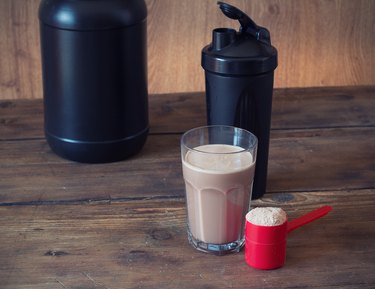
Don't believe the hype about protein shake benefits. Getting enough protein is key, but gaining muscle mass is mostly about genetics, your training plan and overall nutrition. Protein shakes for muscle gain are convenient, and they may be helpful in some situations, but most people don't need them.
Tip
You'll get big only if your genetics, training program and overall diet are conducive to gaining mass. If you need a lot of extra protein and calories, you may find protein shakes for muscle gain helpful and convenient.
Video of the Day
How to Build Muscle Mass
There are a lot of misconceptions about how to build mass. You can suck down protein shakes all day, but if you are not training properly, you will not get big. Actually, you may get big if you drink too many protein shakes and gain fat instead of muscle.
Video of the Day
One of the main determinants in how big you can get with strength training is your body type, according to the American Council on Exercise. Your body type is largely determined by genetics, and it predicts your muscle and bone size, how you gain and lose fat and how your muscle fibers react to stimuli, among other things. There are three main body types:
Ectomorphs are typically thin with small bones and muscles. They often make good long-distance runners because they are quick and light, but they have a hard time putting on mass in the gym. For that reason, they are sometimes called "hard gainers."
Mesomorphs have the "ideal" body type to put on muscle easily and shed fat easily. They typically have broad shoulders and a narrow waist — think Superman. They don't have to work as hard to maintain an athletic figure; however, if they slack off, they can put on fat.
Endomorphs are large-boned, often short and stocky and quick to put on muscle. But they are also quick to put on fat, and losing it can be challenging.
Tip
It's important to note that lifestyle factors also affect body type. According to the National Academy of Sports Medicine, a person's body type isn't necessarily a life sentence. Lifestyle, diet and activity modifications can help ectomorphs and endomorphs achieve a more mesomorphic body type.
The second most important factor is the right training plan. A well-designed, resistance training routine for building mass manipulates variables such as exercise selection, intensity, progression, load, repetitions, frequency and rest intervals. Combined with genetics, these variables can make or break your ability to gain mass, no matter how many protein shakes you drink.
Nutrition and Mass Gain
Your nutrition plan for getting big — muscle-wise, not fat-wise — is determined by your body type and the demands of your training program. Your overall calorie intake, including protein, carbohydrates and fats, provides the energy and raw materials you need to build muscle. Generally, ectomorphs will need more calories to gain muscle mass, and endomorphs will need fewer calories to avoid gaining fat.
This can change the proportion of macronutrients required from individual to individual. Once you have your calorie needs figured out, you can calculate your protein needs and decide whether you need protein shakes to help you consume enough protein.
But first, why do you even need protein?
Your muscles, along with your skin, ligaments and other tissues, are comprised of protein. Protein is made up of amino acids, nine of which are "essential," meaning your body doesn't produce them and they must come from the protein in your diet. When you eat a piece of fish or chicken — or drink a protein shake — your body digests the protein into its constituent amino acids, which it then uses to build new tissues.
Resistance training increases your body's need for protein and amino acids. Strength training exercises damage the muscle fibers, which your body then must repair. The more intense your training program, the more damage the body has to repair and the more protein it needs.
Read more: The 6 Rules of Gaining Muscle Mass
How Much Do You Need?
Protein needs are highly individual. For the general population not involved in rigorous resistance training for mass gain, protein requirements are lower. For example, the recommended dietary intake determined by the Food and Nutrition Board of the National Academies of Medicine is 46 grams for women and 56 grams for men each day. That recommendation is based on an estimated .8 grams per kilogram of body weight. For a 170-pound person, that's 62 grams daily.
But that's definitely not enough for strength-trained athletes. According to a paper published in the Journal of the Academy of Nutrition and Dietetics in March 2016, resistance-trained athletes benefit from 1.2 to 2 grams of protein per kilogram of body weight per day. For a 170-pound person, that's 92 to 154 grams of protein daily.
In certain circumstances, even greater protein intakes could be beneficial — for example, if exercise intensity increases or when energy intake is decreased for fat loss. According to the International Society of Sports Nutrition (ISSN) "Position Stand on Protein and Exercise" published in the Journal of the International Society of Sports Nutrition in June 2017, nascent research points to intakes of over 3 grams as having positive effects on body composition in resistance-trained individuals.
Benefits of Protein Shakes
The main benefit of protein shakes for muscle gain is convenience. According to ISSN, daily protein intake should ideally be evenly divided and consumed every three to four hours. Additionally, the position of the Academy of Nutrition and Dietetics, Dietitians of Canada, and the American College of Sports Medicine states that 15 to 25 grams of high biological protein delivering 10 grams of essential amino acids should be consumed within two hours following exercise. But you don't always find the opportunity to have a meal every three or four hours or within two hours of exercise, which is when the benefits of protein shakes and bars can come in handy.
Hardgainers, who sometimes need to consume thousands of calories a day at frequent intervals, will also find protein shakes useful. Sometimes, getting all the necessary calories through food is challenging because of the quantity of food that needs to be eaten. A protein shake is an easier way to get 60 grams of protein than stuffing yourself with six eggs.
Read more: 20 Best Muscle Building Foods
Should You Drink Them?
Drinking protein shakes for muscle gain will be effective only if they fit into your overall daily calorie and protein needs — and those are highly individual. If you eat more calories than you need to support your activity level and muscle growth, you'll put on fat, as well as muscle. If you have an endomorph body type, you may even need to slightly restrict calories to stay lean while putting on mass.
The other problem with shakes is that they vary widely in terms of ingredients. Many protein shakes on the market are full of sugar and no better than milk shakes. Those should be avoided by everyone — even hardgainers. Sugar is high in calories but low in nutrition. It spikes your insulin levels, provides a quick surge of energy, but then leaves you feeling drained. It's not going to help your performance or your gains.
Whenever possible, get your protein from real foods. High biological-value protein can be found in fish, chicken, eggs and dairy. Just one 3.5-ounce chicken breast has 31 grams of protein, according to the USDA.
Plants also provide protein. Although plant-based protein is considered low-biological value protein, your body can use it just the same when you eat a variety of plant foods containing different amino acids. Quinoa, chickpeas and almonds are all rich sources of plant-based protein.
- NASM: "Body Types: How to Train & Diet for Your Body Type"
- National Strength and Conditioning Association: "The National Strength and Conditioning Association’s (NSCA) Basics of Strength and Conditioning Manual"
- ACE: "9 Things to Know About How the Body Uses Protein to Repair Muscle Tissue"
- National Academies of Medicine: "Summary Tables, Dietary Reference Intakes"
- Journal of the Academy of Nutrition and Dietetics: "Position of the Academy of Nutrition and Dietetics, Dietitians of Canada, and the American College of Sports Medicine: Nutrition and Athletic Performance"
- Journal of the International Society of Sports Nutrition: "International Society of Sports Nutrition Position Stand: Protein and Exercise"
- EUFIC: "High and Low Biological Value Protein Foods"
- USDA: " Basic Report: 05064, Chicken, Broilers or Fryers, Breast, Meat Only, Cooked, Roasted"
- ACE: "How Muscle Grows"
- Center for Wellness Without Borders: "The 3 Somatotypes'