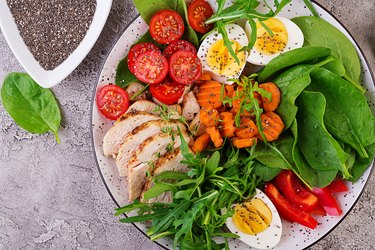
It's pretty hard to exist in mainstream culture these days without hearing people extolling the virtues of a low-carb or carb-free diet. Naturally, you want to see what the buzz is about. No carbs for a week is about enough time to get your feet wet, but probably not enough to see any lasting results.
Choosing to Go Carb-Free
Video of the Day
Although there are medical reasons for very low-carb diet plans, including the need to address epilepsy and Type 2 diabetes, most people choose to cut carbs to lose weight. Diets nearly devoid of carbs, such as the ketogenic and Atkins 20 diets, are aimed at getting the body into a metabolic state called ketosis. Without the immediate energy from carbs, the body begins breaking down fat into molecules called ketone bodies to use for energy.
Video of the Day
Does it work? So far, research has not conclusively found that cutting out carbs either definitely does or definitely doesn't aid weight loss. One of the mechanisms behind low-carb weight loss may be because many foods high in carbs are also highly processed and/or high in sugar and fat. Examples include breads, pastas, pizza crust, baked goods, candy, desserts and sweetened beverages.
When various healthy diets high in one macronutrient and low in another are put head-to-head, there tends to be little difference in the effects on weight. For example, in a study published in JAMA in February 2018, 609 overweight adults followed either a very low-carbohydrate or a very low-fat diet.
Participants were not given any calorie limitations but were instructed to increase vegetable intake, decrease their intake of sugary, refined and processed foods, and eat primarily whole, nutrient-dense foods prepared at home. They were also instructed to follow current physical activity guidelines.
At the end of the 12-month trial, both groups had lost weight, but there was no significant difference between the low-fat and low-carb diet groups. This led the researchers to conclude that it was the nutritional soundness of the diets combined with regular exercise, not the emphasis on one macronutrient or another, that resulted in the lost weight.
Read more: 16 Diet-Friendly Healthful Carbs
Low-Carb Diet Plan
Based on those findings, if you're going to go no carbs for a week, it's crucial to focus on nutrition. While there's probably no risk of cutting out all carbs for one week, you may want to think about making room for just a few. Even the ketogenic diet allows some carbs from healthy foods like non-starchy vegetables. Plant foods contain nutrients not found in animal foods that are important for good health.
Some examples of foods that contain 1 gram of carbs or less per serving are:
- Meat
- Poultry
- Most cheeses
- Eggs
- Fats and oils
- Herbs and spices
There are even a few vegetables that contain less than 1 gram of carbs per one-half cup serving, raw:
- Alfalfa sprouts
- Endive
- Watercress
- Arugula
- Spinach
- Radicchio
- Button mushrooms
Cooking vegetables condenses their carb counts, but you can still get away with under 1 gram eating one-half cup of some cooked veggies, including:
- Bok choy
- Turnip greens
- Collard greens
That's not a bad variety. Most people could get by just fine eating only the foods above for one week. But if you decide to stretch your carb limit a little more, you can add in a few half-cup servings of several raw veggies for less than 3 grams of carbs:
- Avocado
- Green bell pepper
- Cucumber
- Jicama
- Daikon radish
Or you can choose one-half cup of cooked vegetables such as:
- Cauliflower
- Broccoli
- Asparagus
- Eggplant
- Kale
- Green beans
- Cabbage
If you're on a low-carb diet plan such as Atkins, a meal plan for seven days can include either all the options above or only the nearly carb-free foods of your choosing. In addition, you may have small amounts of some sugar-free dressings, vinegars, lemon and lime juice, cream and sour cream, butter, mayonnaise, olive oil and other vegetable oils. You can also have sugar substitutes, including erythritol and stevia, in small amounts.
On a low-carb or carb-free diet, hydration is critical. Not only will it help you feel full, but it will also help you feel better, as your body adjusts to minimal carbs. According to a March 2019 article published online by StatPearls, dehydration is a frequent reason for emergency room visits from people on a keto diet. Water is your best choice for hydration, and the Atkins diet recommends eight 8-ounce glasses a day. You can also drink sparkling water, tea and coffee, unflavored almond and soy milk and sugar-free bouillon.
Other Carb-Free Diet Details
The list of foods to avoid on a carb-free diet is considerably longer than those you can eat. Basically, if it's not on the list above, don't eat it. But some categories of foods you should avoid include:
- Grains (whole and refined and all products made with grains)
- Fruits
- Higher carb, non-starchy and starchy vegetables
- Nuts and seeds, although some are low-carb, so there is some wiggle room here
- Legumes
- Milk and other dairy products (besides those listed above)
- Sugar and any foods and beverages containing sugar and its derivatives
So, what should the rest of your diet look like? That depends. Some people choose to fill in the carb gap with lots of protein. This has its benefits, including appetite control and muscle maintenance. If you are going high protein, choose leaner sources of unprocessed meat, poultry and fish.
On a keto diet, you keep your protein intake low and increase your fat intake dramatically. Some keto diets get as much as 90 percent of their calories from fat, according to Harvard Health Publishing. Eating too much protein can keep you from entering ketosis.
What to Expect
First, the bad news: Ditching carbs is no easy feat, especially if you ate a lot of carbs before. If you previously consumed a lot of sugary foods and beverages and refined foods, you're going to find it even more challenging. Many people report having hunger and food cravings — some intense — while their body adjusts, which can take one week or longer, depending on the person.
Other common effects of a low-carb meal plan include:
- Headache
- Bad breath
- Weakness
- Muscle cramps
- Fatigue — mental and physical
- Nausea
- Skin rash
- Constipation or diarrhea
This may happen the first day you quit carbs, or it may take a few days to develop. But chances are you will experience side effects for some part of your experiment with no carbs for a week. Typically, many of these side effects dissipate once your body adapts to the new diet. But, again, that depends on the person. Some people are more sensitive to carb deprivation and may have a more severe and longer-lasting reaction.
The good news is that you may experience weight loss of a few pounds in your first week, because weight loss tends to happen quickly at the beginning of a diet, according to an article published in March 2014 in the Journal of the Academy of Nutrition and Dietetics. But weight loss depends largely on your calorie intake. It's a common misconception that if you give up carbs, you can eat anything else you want. As the 2018 JAMA study showed, weight loss may have nothing to do with abstaining from carbs, but with the overall nutritional value of your diet — and exercise.
A common mistake keto dieters make is thinking they can binge on high-fat foods because they're not eating carbs. Fat is high in energy, with 9 calories per gram, according to the USDA, while carbs and protein have 4 calories per gram. A diet higher in fat makes it easier to exceed your calorie goals, causing you to gain, not lose, weight. Even in one week, if you don't do the diet right, you could see the number on the scale go up instead of down.
Read more: 10 Convenient Low-Carb Snacks
A Better Option
There's another unfortunate truth to short-term, extreme diets: The weight usually comes right back on once you resume your normal eating habits. Even if you decided to stick with your carb-free diet past the first week, you'd likely find it hard to sustain for an extended period of time.
These sorts of deprivation, or "fad," diets are usually too good to be true, and the Academy of Nutrition and Dietetics warns people to stay away from them. For long-term weight loss, you're better off developing healthy habits — including a well-balanced, calorie-controlled diet and regular physical activity — that you can reasonably maintain for life.
- Harvard Health Publishing: "Ketogenic Diet: Is the Ultimate Low-Carb Diet Good for You?"
- Atkins: "Escaping the Fat Trap: Atkins Diet And Ketosis"
- JAMA: "Effect of Low-Fat vs Low-Carbohydrate Diet on 12-Month Weight Loss in Overweight Adults and the Association With Genotype Pattern or Insulin Secretion"
- Atkins: "List of Low Carb Foods for Atkins 20, Phase 1"
- StatPearls: "Ketogenic Diet"
- Mayo Clinic: "Low-Carb Diet: Can It Help You Lose Weight?"
- Nutrition Journal: "A Randomized Crossover, Pilot Study Examining the Effects of a Normal Protein vs. High Protein Breakfast on Food Cravings and Reward Signals in Overweight/Obese 'Breakfast Skipping', Late-Adolescent Girls"
- Harvard Health Publishing: "Should You Try the Keto Diet?"
- Journal of the Academy of Nutrition and Dietetics: "Time to Correctly Predict the Amount of Weight Loss With Dieting"
- USDA: "How Many Calories Are in One Gram of Fat, Carbohydrate, or Protein?"
- Academy of Nutrition and Dietetics: "Staying Away From Fad Diets"