With a per capita consumption rate that exceeds that of apples and grapes combined, bananas have long been America's favorite fruit. The U.S. Census Bureau estimates that since about 1990, the average American has consumed close to 25 pounds of bananas a year. It's not surprising that this tropical import has an edge over locally grown fruit – bananas are relatively inexpensive, widely available, super sweet and easy to eat on the go.
Fresh Bananas
Video of the Day
Bananas are an excellent source of readily available energy and a good source of several important nutrients. For just over 100 calories, an average-sized fruit provides about 27 grams of carbohydrates, just over 1 gram of protein and less than half a gram of fat. It also supplies 22 percent and 17 percent of the daily value for vitamins B-6 and C, respectively, as well as 12 percent each of the daily values for dietary fiber and potassium. An average-sized banana is one that weighs about 4 ounces or measures between 7 and 8 inches in length, according to the U.S. Department of Agriculture.
Video of the Day
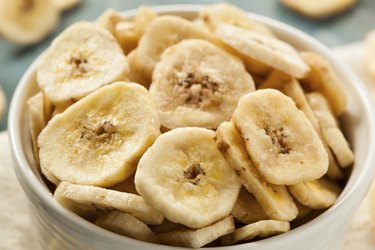
Dehydrated Bananas
A fresh banana gets about 75 percent of its weight from water, according to the USDA. The drying process removes about 96 percent of this water content, making dehydrated bananas a far more concentrated source of calories and nutrients than the source fruit. Ounce for ounce, dehydrated bananas are about four times higher in fiber, potassium, carbohydrates, sugar and calories than the fresh variety. They're only slightly higher in vitamin B-6, however, largely because it's a water-soluble vitamin. Dehydrated bananas are actually about 20 percent lower in vitamin C, a water-soluble vitamin that's particularly sensitive to heat.
Serving Size Matters
Like all dried fruit, the standard size for a serving of dehydrated bananas is 1/4 cup. This makes sense, considering that dehydrated bananas are about four times more concentrated by weight as well as by volume. A 1/4-cup serving of dehydrated bananas has about 90 calories, 22 grams of carbohydrates, 1 gram of protein and less than half a gram of fat, according to the USDA. It delivers right around 10 percent each of the daily values for potassium and fiber, but a far less substantial 6 percent of the daily value for vitamin B-6 and a meager 3 percent of the daily value for vitamin C.
Skip the Chips
The primary benefit of consuming dried fruits is that they last far longer than the fresh variety and are, in general, nutritionally comparable as long as portions are limited. It's important to read product labels, however, to avoid high-calorie products made with added fat and sugar. Dehydrated bananas are typically sold in sliced or in powder form for use in recipes, and the healthiest products contain just one ingredient: dried or dehydrated bananas. Don't confuse banana "chips" with the unadulterated dried fruit. Such products are typically coated in oil, sugar and artificial flavors. According to the USDA, banana chips are almost six times higher in calories – and 100 times higher in fat – than the fresh fruit.
- U.S. Census Bureau: Per Capita Utilization of Selected Commercially Produced Fruits and Vegetables: 1980 to 2009
- Chiquita Bananas: Frequently Asked Questions About Bananas
- USDA National Nutrient Database: Bananas, Raw
- USDA National Nutrient Database: Bananas, Dehydrated, or Banana Powder
- USDA National Nutrient Database: Snacks, Banana Chips
- Bulk Barn: Banana Chips