Belly fat — one of the most common body complaints — can be frustrating to deal with, which is probably why there are so many claims about remedies that can beat the bloat.
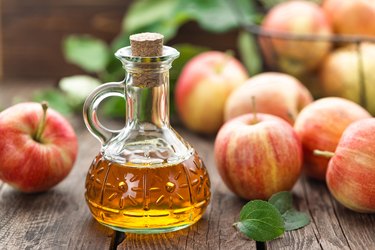
One such example is apple cider vinegar (ACV), a vinegar made from fermented apple juice that is touted for fighting fat around the middle. While some anecdotal experience may support the claim, there is currently no sound, scientific evidence that shows ACV alone is an effective weight-loss aid.
Video of the Day
Video of the Day
That said, ACV does have certain properties that may support weight loss when accompanied by a healthy weight-loss plan.
Because there are many other at-home remedies that some folks claim have fat-burning powers — including ACV, olive oil and the two combined — we took a look into the science behind the assertions to help you determine if any would make a good fit into your diet and lifestyle.
A Note on Language
Here at LIVESTRONG.com, we try to use inclusive language when it comes to sex and gender. Some dietary guidelines distinguish between nutritional needs for women and men, but nutrient requirements are usually more accurate when tailored to a person's individual calorie needs, activity level and overall health.
Still, we understand many people look up this information in relation to their own sex and gender, so we have used the words "women" and "men" throughout this article.
Does Apple Cider Vinegar Burn Belly Fat?
Despite countless claims, there is very little scientific evidence to show that taking a spoonful of apple cider vinegar every day can help you lose weight, but one August 2009 study in Bioscience, Biotechnology & Biochemistry showed a possible link.
In the study, Japanese men with obesity drank either no vinegar, 3 teaspoons of apple vinegar or 6 teaspoons of apple vinegar mixed into a beverage each day for 12 weeks. At the end of the trial, the men who drank the vinegar had lower body mass indexes and waist circumferences compared to those who had not consumed any vinegar.
After the study ended and all participants stopped drinking vinegar, the men's BMIs and waist measurements returned to their original numbers.
Despite this singular study, there's doubt among health professionals that a spoonful of vinegar has any significant effect on weight loss. Additional research on organic apple cider vinegar for weight loss has not consistently shown significant and sustainable weight loss across diverse groups of people, per the Mayo Clinic.
ACV doesn't just come up empty for weight loss, but it also may do more harm than good. Because it is highly acidic, even a spoonful of ACV can cause throat irritation if taken in large amounts over time, and it has the potential to interact with specific supplements and drugs — including diuretics and insulin — which can result in low potassium levels, per the Mayo Clinic.
Can Olive Oil Help You Lose Weight?
While some claim olive oil is the key to burning belly fat, having too much will likely result in the opposite. Olive oil is considered a healthy alternative to other cooking fats (think: butter), but it's still a very high-calorie food.
There isn't much new research, but some older research suggests olive oil may support weight loss. For example, a June 2010 study in the Journal of Women's Health studied two groups of women on diets. One group was on a low-fat diet and the other group was on an olive oil-enriched diet, taking 3 tablespoons of olive oil a day.
In the olive oil group, 80 percent of participants had a weight loss of at least 5 percent. In the low-fat diet group, only 31 percent of participants had a weight loss of 5 percent. The researchers concluded that a supplement of olive oil to a regularly balanced diet brought about a greater weight loss than the low-fat diet.
These findings may sound promising, but keep in mind that it's only one study. And drinking olive oil isn't for everyone. Experts recommend talking with your doctor or dietitian before adding olive oil as a drink to your diet.
Drinking olive oil might also pose a health risk to some individuals. It's high in vitamin E, and drinking large amounts of olive oil might cause an accidental vitamin E overdose, which in turn impairs your ability to form blood clots. Olive oil also contains 120 calories per tablespoon, so the calories add up quickly.
With that said, the 2020-2025 Dietary Guidelines for Americans (DGA) recommend cooking with more vegetable oils like olive oil in place of those high in saturated fat, including butter, shortening, lard or coconut oil. Olive oil is high in fat, but the majority of it is heart-healthy monounsaturated fat, according to the American Heart Association.
And olive oil is a major ingredient in the Mediterranean diet, which is known for its many heart-health benefits and has also been linked to weight loss.
What About Apple Cider Vinegar and Olive Oil for Belly Fat?
This is another case that proves you can't always trust what you hear. Organic apple cider vinegar and olive oil can make for a nutritious and delicious salad dressing, but it's not going to zap your belly fat any more than the two ingredients would on their own.
Still, there's no need to shy away from this recipe. Apple cider vinegar is very low in calories and a good way to add flavor to food. Although not calorie-free, olive oil can be used in small amounts to also add a bit of flavor and texture. Use both the vinegar and oil as the new dressing for your salad greens or in a marinade.
In fact, you and your greens will benefit from a bit of oil mixed in: An October 2017 study in The American Journal of Clinical Nutrition found that eating salad with added fat in the form of oil promotes the absorption of eight different micronutrients that promote human health. On the other hand, eating the same salad without the added oil decreases the likelihood that the body will absorb the nutrients.
How to Lose Belly Fat
When it comes to weight loss, it's not possible to spot-reduce, which means you can't specifically target your belly fat. Fortunately, deep belly fat, called visceral fat, is usually the first to go while following a healthy weight-loss program, according to Harvard Health Publishing.
As with any weight-loss diet, the key is to make better food choices and limit your portions to aid in calorie control. Harvard Health Publishing recommends a diet filled with fruits, vegetables, whole grains, lean proteins and foods rich in polyunsaturated fats such as salmon, walnuts and soy oil.
- Bioscience, Biotechnology & Biochemistry: "Vinegar intake reduces body weight, body fat mass, and serum triglyceride levels in obese Japanese subjects"
- Mayo Clinic: "Drinking apple cider vinegar for weight loss seems far-fetched. Does it work?"
- "Dietary Guidelines for Americans 2020-2025"
- American Heart Association: "Monounsaturated Fat"
- Harvard Health Publishing: "https://www.health.harvard.edu/staying-healthy/abdominal-fat-and-what-to-do-about-it"
- American Journal of Clinical Nutrition: "Modeling the dose effects of soybean oil in salad dressing on carotenoid and fat-soluble vitamin bioavailability in salad vegetables"
- Journal of Women's Health: "Comparing an Olive Oil-Enriched Diet to a Standard Lower-Fat Diet for Weight Loss in Breast Cancer Survivors: A Pilot Study"
- My Food Data: "Olive Oil"