When Should Children Go to the Hospital for a Fever?
When you feel your little one's fiery forehead, it's easy for panic to set in. While fevers in children are usually not serious, there are times when a fever warrants an immediate trip to the hospital. Factors such as your child's age, the level of the fever, how long it has lasted and other accompanying symptoms all play a role in whether your child needs to head to the hospital because of fever 3.
Fever vs. Normal
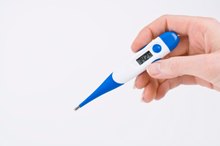
A fever is an indication that your child's body is fighting an illness 2. A temperature of 100.4 F constitutes a significant fever, according to the American Academy of Pediatrics 345. A rectal temperature -- taken in your child's bottom -- is most accurate if your little one is younger than 3. An oral or axillary temperature, taken under the arm, is easier for older children.
Age and Fever Pattern
High Fever of 103.5 in Children
Learn More
Fevers provoke greater concern in young babies because they are more vulnerable than older children to serious infections, such as pneumonia or meningitis. If your child is younger than 12 weeks old and has a fever of 100.4 F or higher, call your doctor 3. If you cannot reach the doctor, take your child to the nearest emergency center for evaluation.
In a child older than 3 months but younger than 2 years old, call the doctor or visit the hospital if the fever has persisted for longer than 24 hours. For children older than 2, a fever may require immediate evaluation if it has lasted for longer than 72 hours. A fever that repeatedly rises above 104 F in a child of any age also requires an immediate call to the doctor or a trip to the hospital.
- Fevers provoke greater concern in young babies because they are more vulnerable than older children to serious infections, such as pneumonia or meningitis.
- In a child older than 3 months but younger than 2 years old, call the doctor or visit the hospital if the fever has persisted for longer than 24 hours.
Behavior
Your child's activity level and behavior are usually good indicators of whether your child's fever requires immediate evaluation at a hospital 3. If your child is generally feeling well and not acting "sick," the fever likely doesn't represent a serious medical problem and typically doesn't require urgent treatment. If your child is eating and drinking normally, playing, alert and has a healthy skin color, the fever generally isn't cause for serious concern.
If your child is not drinking or eating, seems subdued or listless, is uninterested in play, is unable to walk, or complains of a stiff neck, take the child to the emergency room. Severe headache, blue coloring of the lips or nails and difficulty breathing accompanied by fever also require emergency medical evaluation and treatment. Take your child to the nearest hospital emergency room.
- Your child's activity level and behavior are usually good indicators of whether your child's fever requires immediate evaluation at a hospital 3.
- If your child is generally feeling well and not acting "sick," the fever likely doesn't represent a serious medical problem and typically doesn't require urgent treatment.
Vaccination History and Other Illness
Fevers While Pregnant
Learn More
Your child's vaccination history is an important consideration when deciding whether a fever requires immediate medical treatment. Children who have not received all of their scheduled vaccinations are at increased risk for several potentially serious bacterial and viral infections. Because of this, a fever in a child who is not fully vaccinated may require a trip to the hospital if you cannot reach your doctor.
Children who have chronic health conditions, such as diabetes, cystic fibrosis, sickle cell disease, cancer, heart problems or HIV, are more vulnerable to serious infections. Fever is of greater concern in these children and should be evaluated at the hospital if you cannot reach your doctor.
- Your child's vaccination history is an important consideration when deciding whether a fever requires immediate medical treatment.
- Children who have not received all of their scheduled vaccinations are at increased risk for several potentially serious bacterial and viral infections.
Warnings
A fever associated with exposure to high temperatures requires emergency treatment at the nearest hospital. Fever associated with a rash, stiff neck, seizures, severe pain or persistent nausea, vomiting or diarrhea is also concerning and requires immediate medical evaluation. Go to the hospital if your child seems very sick, sluggish or inattentive.
Related Articles

High Fever of 103.5 in Children
Learn More

Fevers While Pregnant
Learn More

Fever in 2-Month-Old Babies
Learn More

Ways to Tell You're Running a Fever
Learn More

A Child That Continuously Awakes From a Nap With a Fever
Learn More

A Child's Temperature Is 103.6: What to Do?
Learn More
104 Fever in a Toddler
Learn More

When Is a Child's Temperature Considered Dangerous?
Learn More

What Causes Fever and Throwing Up in Children?
Learn More

Can a Child Swim With a Fever?
Learn More
References
- American Academy of Family Physicians: Evaluating Fever of Unidentifiable Source in Young Children
- Nemours Foundation: Fever and Taking Your Child's Temperature
- American Academy of Pediatrics: AAP Issues Advice on Managing Fevers in Children
- American Academy of Pediatrics: When to Call the Pediatrician: Fever
- American Family Physician: Evaluation and Management of Infants and Young Children with Fever
- Gunduz S, Usak E, Koksal T, Canbal M. Why Fever Phobia Is Still Common? Iran Red Crescent Med J. 2016;18(8):e23827. doi:10.5812/ircmj.23827
- American Academy of Pediatrics. Fever and Your Baby. Updated August 3, 2016.
- Torreggiani S, Filocamo G, Esposito S. Recurrent Fever in Children. Int J Mol Sci. 2016;17(4):448. doi:10.3390/ijms17040448
- InformedHealth.org. Fever in Children: Overview. Cologne, Germany: Institute for Quality and Efficiency in Health Care (IQWiG); 2013.
- InformedHealth.org. Fever in children: When to see a doctor. Cologne, Germany: Institute for Quality and Efficiency in Health Care (IQWiG); 2009.
- MedlinePlus. When your baby or infant has a fever. Updated February 13, 2020.
- Lim T. Cleveland Clinic. Kids’ Fevers: When to Worry, When to Relax. Published May 12, 2015.
- Murren-Boezem J. The Nemours Foundation. Fevers. Updated September 2018.
Writer Bio
Diana Rodriguez is a Louisville, Kentucky-based full-time freelance writer who specializes in health and real-estate writing. Since 2008 her numerous articles have appeared on various news and health websites. She also specializes in custom Web content for a variety of businesses. She has degrees in journalism and French from Miami University of Ohio.