Satisfy your sweet tooth by snacking on nutrient-rich dates.
These fruits, which come from the date palm tree, are usually sold dry (you can tell by their wrinkled skin) or they can be made into products, such as baked goods, concentrate, paste, date pieces and syrup.
Video of the Day
Video of the Day
Dates are among the longest cultivated fruits and have been a staple food in the Middle East for thousands of years. They're a member of the palm family Arecaceae, or Palmae, with more than two hundred varieties of dates available worldwide, according to a March 2014 review in the International Journal of Clinical and Experimental Medicine.
The dates you regularly find at your grocery store are likely Deglet Noor dates. They are medium-sized with a narrow elongated oval shape and range in color from translucent light red to amber.
A semi-dry date, Deglet Noors are slightly crunchy and chewy with a sweet flavor. Other types of dates include Medjool, Barhi and Sagai.
Dates Nutrition Facts
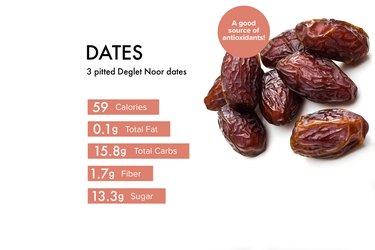
Three pitted Deglet Noor dates, or 21 grams, is equal to a single serving. Three Deglet Noor dates contain:
- Calories: 59
- Total fat: 0.1 g
- Cholesterol: 0 mg
- Sodium: 0.4 mg
- Total carbs: 15.8 g
- Dietary fiber: 1.7 g
- Sugar: 13.3 g
- Added sugar: 0 g
- Protein: 0.5 g
Date Macros
- Total fat: One serving, or three dates, contains 0.1 grams of fat, including 0.008 grams of monounsaturated fat, 0.004 grams of polyunsaturated fat and 0 grams of both saturated fat and trans fat.
- Carbohydrates: Three dates have 21 grams of carbohydrates, which includes 1.7 grams of fiber and 13.3 grams of naturally occurring sugar.
- Protein: Three dates have 0.5 grams of protein.
Vitamins, Minerals and Other Micronutrients
- Copper: 5% of your Daily Value (DV)
- Potassium: 3% DV
- Magnesium: 2% DV
- Niacin (B3): 2% DV
- Pantothenic acid (B5): 2% DV
- Vitamin B6: 2% DV
- Folate: 1% DV
- Zinc: 1% DV
- Iron: 1% DV
- Calcium: 1% DV
- Thiamin (B1): 1% DV
- Riboflavin (B2): 1% DV
- Phosphorous: 1% DV
Note that these values represent only three dates. Eating more than three dates will give you more nutrients including vitamins, minerals, fiber as well as sugar and calories.
Health Benefits of Dates
Dates offer some important health benefits as a result of their fiber content and antioxidant and anti-inflammatory properties.
1. They're a Solid Source of Fiber
Dates give you a good dose of dietary fiber — one serving provides seven percent of the daily recommended intake. You need fiber to maintain good digestive health and to help prevent constipation.
Since this nutrient cannot be broken down by your body, it remains intact, helping to add bulk and soften your stool. This promotes regular bowel movements that may help prevent hemorrhoids and reduce the risk of diverticulitis in people with diverticulosis, per the Mayo Clinic. Fiber may also relieve constipation, alleviating the symptoms of irritable bowel syndrome, or IBS.
Dietary fiber is tied to protecting against colon cancer, according to an October 2015 large-scale study published in the American Journal of Clinical Nutrition.
And if you have high cholesterol, the fiber in dates can help reduce the absorption of cholesterol into your bloodstream. High cholesterol can put you at risk for heart disease and other cardiovascular problems.
2. Dates Pack in Antioxidants
Dates also provide the health benefits of antioxidants. These nutrients may help prevent or reduce damage to your cells from free radical molecules.
Free radicals are toxic byproducts from metabolism, such as digestion, or environmental factors like pollution. They can lead to harmful reactions in your body — a process known as oxidative stress — which can cause disease.
The antioxidant activity in dates comes from their polyphenol content, including phenolic acid, flavonoids and procyanidin compounds. Polyphenols are known for their neuroprotective effects in several age-related conditions, such as Alzheimer's disease, as reported in a September 2017 review in Biomedicine and Pharmacotherapy.
Due to their powerful anti-inflammatory properties, antioxidants in dates are associated with a lower risk of chronic illnesses like cancer and heart disease, as reported in a March 2015 research paper in the Journal of Food Science and Technology.
3. They Make For a Healthy Natural Sweetener
Unlike white sugar, dates contain blood-glucose-stabilizing fiber as well as antioxidants that make it a healthier sweetener.
Next time you're baking at home, try swapping the sugar for date paste in a one-to-one ratio. Simply make date paste by pitting dates and blending them in your food processor until they're smooth.
You can also buy date syrup, which can be used in both sweet and savory recipes (think: in baked goods and as a meat marinade).
We like D'vash Date Syrup ($7.95, Amazon.com) and Joolies Date Syrup ($19.99 per 2-pack, Amazon.com).
Dates Health Risks
Food Allergies
Dates can be allergenic, according to an older December 2001 study in the European Journal of Allergy and Clinical Immunology.
If you think you're allergic to dates, speak to your health care provider. You may need to carry an EpiPen with you.
Medication Interactions
There are no known interactions between dates and medications.
Calories
While dates are nutritious, they are also calorie-dense and calories can add up if you eat a lot of dates. Aim to eat them in moderation and stick to noshing on three or fewer dates at a time.
Buy Dates Online
- Joolies Fresh Organic Medjool Dates ($19.99 per 2-pack, Amazon.com)
- Terrasoul Superfoods Organic Medjool Dates ($14.95 per pack, Amazon.com)

Date Preparation and Useful Tips
Dates are available nationwide and can most often be found packaged in plastic or cellophane containers with or adjacent to the fresh produce area.
For the longest shelf life, keep dates in a resealable bag or airtight container. If stored in the refrigerator, dates can last up to eight months (in room temperature, they can stay fresh for about one month).
To prepare dates, first slice each open and remove the pit. If you need to chop dates, it's helpful to place them in the freezer for 30 to 40 minutes first to firm them up.
Other tricks include snipping them with kitchen scissors instead of using a knife or continuously cleaning your knife blade so that the sugars do not make a possibly dangerous sticky situation.
Now that you have your dates, here are some quick serving ideas.
- On their own as a sweet treat or paired with some nuts.
- Stuff them with a half teaspoon of nut butter for a sweet snack.
- Add to smoothies, oatmeal, yogurt or grains to add sweetness, flavor and texture.
- Swap out raisins for chopped dates in baked goods.
- Mix into nut butter and use with apples, celery or on a sandwich.
- Add to stew for a hint of sweetness.
Date Recipes
Alternatives to Dates
If you don't like the taste of dates or don't have them on hand, you can swap them out for other types of dried fruit.
These include dried apricots, raisins, prunes, dried cherries and dried cranberries. Always look for dried fruit with no added sugar.
- International Journal of Clinical and Experimental Medicine: "Therapeutic Effects of Date Fruits (Phoenix dactylifera) in the Prevention of Diseases via Modulation of Anti-Inflammatory, Anti-Oxidant and Anti-Tumour Activity"
- MyFoodData: "Nutrition Facts for Dates (Deglet Noor)"
- Mayo Clinic: "Q and A: Diet, Lifestyle Choices can Lower Risk of Diverticulosis Developing Into Diverticulitis"
- International Foundation for Gastrointestinal Disorders: "Dietary Fiber"
- American Journal of Clinical Nutrition: "Dietary Fiber Intake and Risk of Colorectal Cancer and Incident and Recurrent Adenoma in the Prostate, Lung, Colorectal, and Ovarian Cancer Screening Trial"
- Mayo Clinic: "Cholesterol: Top Foods to Improve Your Numbers"
- Cleveland Clinic: "Cholesterol: High Cholesterol Diseases"
- Biomedicine & Pharmacotherapy: "Protective Effects of Flavonoids Against Alzheimer’s Disease-Related Neural Dysfunctions"
- Journal of Food Science and Technology: "Study of Phenolic Compound and Antioxidant Activity of Date Fruit as a Function of Ripening Stages and Drying Process"
- European Journal of Allergy and Clinical Immunology: "Allergy to date fruits: characterization of antigens and allergens of fruits of the date palm (Phoenix dactylifera L.)"