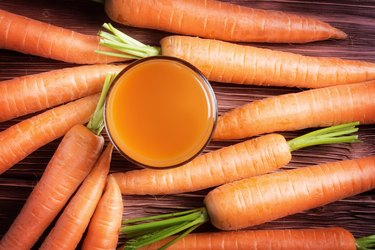
Carrot juice is a sweet and savory alternative to more common varieties of vegetable juice, such as tomato juice, a good option for a healthy and nutritious accompaniment to a meal. Carrot juice has other benefits, however. Carrots can do many good things for your stomach, including maintaining its health and preventing certain conditions and diseases.
Prevents Gastric Cancer
Video of the Day
Gastric cancer, or cancer of the stomach lining, kills more than 10,000 Americans each year, according to the National Cancer Institute. An additional 20,000 Americans receive a diagnosis of this disease each year. Drinking carrot juice may help prevent gastric cancer. A study published in the February 2007 issue of "The American Journal of Clinical Nutrition" indicates that vitamin A, a nutrient carrots supply, may reduce your risk of developing the cancer. A 1-cup serving of carrot juice provides 45,133 IU of vitamin A, several times the daily recommended intake of 5,000 IU.
Video of the Day
Maintains Stomach Lining
The lining of your stomach is called the gastric mucosa. It protects your stomach cavity from micro-organisms and lubricates the foods that reach your stomach to help them move within that organ. Damage to the stomach lining can trigger a number of conditions, including stomach ulcers and gastritis, or inflammation of the gastric mucosa. The vitamin A present in carrot juice may help prevent these problems. Research featured in the December 2003 "Journal of Physiology and Pharmacology" suggests that getting adequate amounts of this vitamin helps prevent breakdown of the gastric mucosa. Because this research was carried out on rat models, human research is needed.
Influences Hunger Satiety
Getting enough fiber in your diet from carrot juice and other foods -- 25 g daily for women and 38 g for men -- helps you feel fuller for longer, primarily by filling your stomach with roughage. The fuller you feel, the less likely you are to consume food, which may help you lose weight. Evidence in the August 2010 issue of the "Journal of the American College of Nutrition" notes that study subjects who ate foods high in fiber displayed greater weight loss than test subjects who did not consume a high-fiber diet. A 1-cup serving of carrot juice contributes 1.9 g of dietary fiber to your daily diet.
Prevents Gastroparesis
Drinking carrot juice may help prevent a disease known as gastroparesis, or delayed emptying of the stomach. This may trigger heartburn, abdominal pain, vomiting and abdominal spasms. It is often caused by diabetes, but you can avoid diabetes -- and gastroparesis -- thanks to the vitamins and minerals in carrot juice. Magnesium, vitamin E and vitamin C may reduce the risk of developing diabetes, and carrot juice contains all of these nutrients. Including carrot juice in your meal plan protects your stomach.
- National Cancer Institute: Stomach (Gastric) Cancer
- "American Journal of Clinical Nutrition"; Vitamin A, Retinol, and Carotenoids and The Risk of Gastric Cancer; S.C. Larsson, et al.; February 2007
- USDA National Nutrient Database: Carrot Juice, Canned
- All About Vision; Vitamin A and Beta Carotene: Eye Benefits; G. Heiting, O.D.; October 2010
- PubMed Health; Gastritis; January 2011
- "Journal of Physiology and Pharmacology"; Vitamin A Deficiency Alters the Bioelectric Parameters and RNA Content of Rat Gastric Mucosa in Vitro; U. Ventura, et al.; December 2003
- MayoClinic.com; Dietary Fiber: Essential For a Healthy Diet; November 2009
- "Journal of the American College of Nutrition"; The Effect of...; B.J. Venn, et al.; August 2010
- National Digestive Diseases Information Clearinghouse; Gastroparesis; July 2007
- "African Health Sciences"; Effect of...; A. Abayomi, et al.; March 2011
- "Evidence Based Complementary Alternative Medicine"; A Regenerative...; J. Patel, et al.; 2011
- "Diabetes Care"; Multivitamins, Individual...; Y. Song, et al.; January 2011