
What Is the Speed of a Volleyball?
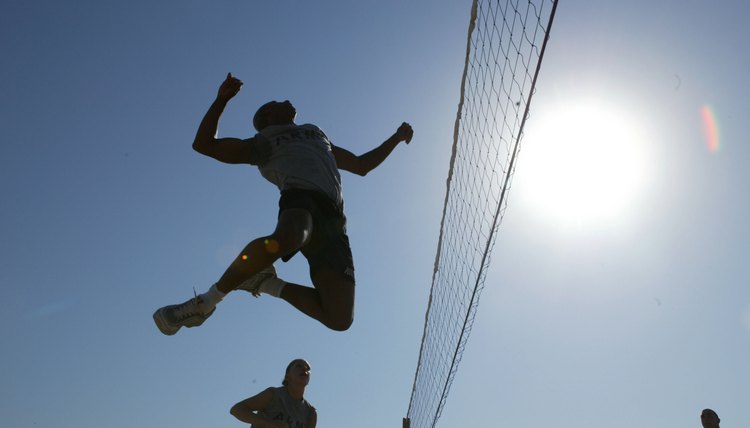
Fast and accurate volleyball hits make it hard for the other team to counterattack. Trajectory matters as well because the ball must arc high enough to pass over the net. But if a player tries to generate too much speed while hitting the ball over the net, the ball likely will travel out of bounds on the other side of the court.
Serving Speed
A volley starts with the serve. Top-class players average serving speeds of 121 mph, according to “The Sports Book.” The serving player stands at the baseline, or rear boundary, of that team's side of the court and attempts to place the ball in an undefended portion of the other team’s side of the court.
Changes in Location Affect Speed
To place the ball at the other team’s baseline, a server can use a high level of force. But to place the ball at a closer distance, the player must use less force because the ball first must travel over the net and then drop quickly to avoid going out of bounds. Consequently, serves aimed at the farthest areas of the other team’s side of the court typically have a straighter trajectory and a high speed, and serves to nearer areas have a steeper trajectory and a low speed.
Speed During Play
During a volley, a team works together to give a member an opportunity to spike the ball. Jumping high enables a player to hit the ball downward over the net with the same force as a serve. Effective spikes require precise jump timing, speed and accuracy. If the player can place the ball far from opponents, the other team will have far fewer chances to return the ball.
Spike Speed to Serves
A fast-moving spike can travel at speeds similar to a serve. For example, the world-class female professional volleyball player Flo Hyman could spike the ball at speeds up to 110 mph. Her spike was so fast it became known as the Flying Clutchman.
References
Writer Bio
Stan Mack is a business writer specializing in finance, business ethics and human resources. His work has appeared in the online editions of the "Houston Chronicle" and "USA Today," among other outlets. Mack studied philosophy and economics at the University of Memphis.