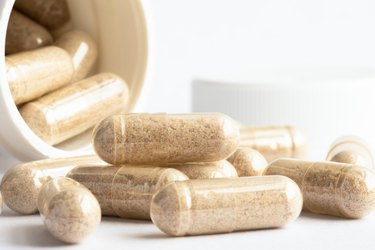
Saw palmetto, or the American dwarf palm, is a type of palm tree native to the West Indies that now grows in the southeast U.S. As a supplement, it's best known as a natural treatment for benign prostatic hyperplasia (BPH), or an enlarged prostate.
Here, we'll dig into the research around saw palmetto for things like prostate health, polycystic ovary syndrome and hair growth, along with what you should know about dosage and side effects.
Video of the Day
Video of the Day
What Are Saw Palmetto Supplements?
Saw palmetto supplements are made from the trademark purple-black berries on the saw palmetto tree. The fruit extracts specifically contain the components that are used to treat BPH.
A January 2019 paper in the Biomedical Journal of Scientific & Technical Research notes that palmetto was withdrawn from the U.S. as a medicine in 1950 due to a lack of research. Since then, it has regained some popularity after a few studies found it may be helpful in treating symptoms of BPH.
So how does saw palmetto work? The berries of the palmetto tree are packed with more than 100 different molecules linked to health perks, including compounds known as fatty acids, long-chain alcohols and sterols. According to July 2020 research in BMC Urology, the berries' phytosterols and fatty acids are most likely responsible for its positive health benefits.
It's also thought that saw palmetto works through mechanisms like relaxing smooth muscle, affecting insulin levels and having an anti-inflammatory effect.
Saw Palmetto Extract vs. the Whole Herb
Dried saw palmetto berries are responsible for the plant's health-supporting properties, per the University of Rochester Medical Center. Accordingly, you can eat the fruit by itself or as an extract in supplement form, such as berry powder, gel caps or tea (though tea may not be as effective as the other options, per Mount Sinai).
However, eating the whole natural saw palmetto herb won't provide you with additional medicinal benefits.
Saw Palmetto for Prostate Health
Saw palmetto is most commonly used as a supplement for prostate health, specifically to help reduce the size of the prostate in cases where it's enlarged. In fact, according to the University of Michigan Health, saw palmetto is still used in Europe as a treatment for BPH.
"Some patients do get some relief from saw palmetto with BPH," says Harland Holman, MD, a family medicine physician with Spectrum Health.
The current research for using saw palmetto for the prostate is promising. For instance, that 2020 double-blind, placebo-controlled, randomized comparative study in BMC Urology found that a supplement of 500 milligrams of β-sitosterol-enriched saw palmetto oil (each tablet had 200 milligrams of the actual saw palmetto supplement) was effective in reducing some of the symptoms of an enlarged prostate, such as weak urine stream or sexual dysfunction.
The study also found that participants who took the saw palmetto supplement could void more effectively than before treatment.
However, another double-blind, placebo-controlled, randomized clinical trial in The New England Journal of Medicine that looked at how saw palmetto affected those with moderate to severe BPH found that it didn't help with urinary obstruction.
The most important thing you can do if you're considering trying saw palmetto for your prostate health is to visit a physician first, Dr. Holman says. That way you can confirm your symptoms are from BPH and not other causes like a bladder infection or prostate cancer.
How Long Does It Take for Saw Palmetto to Work?
Though it's unclear exactly how long it can take to start seeing saw palmetto benefits, the BMC Urology study reported BPH symptoms improved after three months of daily supplements.
Saw Palmetto and Testosterone
Along with reducing inflammation around the prostate, the specific way that saw palmetto can help with BPH is through impacting testosterone levels. It helps block testosterone from breaking down into dihydrotestosterone (DHT), which increases prostate size, says Patrick Fratellone, MD, an integrative physician, cardiologist and herbalist, adjunct professor of naturopathic medicine at the University of Bridgeport and vice president of the American Apitherapy Society.
For example, the BMC Urology study showed that saw palmetto oil helped stabilize testosterone levels. Another August 2014 study in the Journal of the International Society of Sports Nutrition found that men taking a supplement that contained saw palmetto were able to increase their testosterone levels.
Libido
Saw palmetto may help increase libido, especially in people who have had sexual dysfunction because of an enlarged prostate. The primary way saw palmetto seems to help with libido is by helping decrease the size of the enlarged prostate, which then helps remove sexual barriers in the first place. (Enlarged prostate might interfere with the ability to get or maintain an erection, for instance.)
A February 2013 clinical trial in Phytotherapy Research found that saw palmetto helped both decrease symptoms of BPH and sexual dysfunction related to having an enlarged prostate.
An increase in libido may also result from improving testosterone levels in the body for those assigned male at birth (AMAB). Dr. Fratellone adds that he has seen incidences of increased sperm count and sexual potency with saw palmetto supplementation.
Estrogen
The exact effect that saw palmetto has on estrogen isn't clearly known. However, a June 2018 study in the African Journal of Urology found that estrogen plays a role in BPH, so part of the way saw palmetto affects BPH may be due to its role in regulating estrogen levels.
But overall, much more research needs to be done to understand the exact effect — if any — that saw palmetto has on estrogen levels.
PCOS
According to the International Journal of Endocrinology & Metabolism, saw palmetto is considered to be a potential anti-androgen, or something that can decrease sex hormones in the body.
People with polycystic ovary syndrome (PCOS) usually have imbalanced sex hormones, including excess androgen, per the Mayo Clinic. Accordingly, saw palmetto may be able to help balance those levels.
Lowering the levels of androgen hormones in the body could help decrease certain symptoms of PCOS, such as female facial hair or excess hair growth on the body, per the International Journal of Endocrinology & Metabolism research. However, the research isn't conclusive enough to say whether saw palmetto is effective for PCOS.
Hair Growth
According to the January 2019 Biomedical Journal of Scientific & Technical Research paper, saw palmetto may be able to help treat androgenetic alopecia, which is a type of hair loss caused by imbalanced sex hormones and often associated with BPH.
However, if the hair loss is from a different cause, saw palmetto oil may not be effective in helping with hair growth.
Other Hair Loss Treatments
Minoxidil (commonly recognized by it's brand name, Rogaine) is an FDA-approved cream for hair loss, per the U.S. National Library of Medicine (NLM). You typically apply it twice a day to a dry scalp, then wait at least 4 hours before taking a shower to let it soak in, per the Mayo Clinic. Side effects may include itching, skin rash or in rare cases, rapid weight gain.
Propecia is a similar prescription cream that may also help with BPH-related hair loss, according to the Mayo Clinic.
But talk to your doctor before trying hair-loss supplements like Propidren, biotin and saw palmetto. Why? The FDA doesn't require supplements to be proven safe or effective before they are sold, so there’s no guarantee that any supplement you take is safe, contains the ingredients it says it does or produces the results it claims. They may also interfere with your prescribed hair-loss medication, per Mount Sinai.
Acne
High androgen hormone levels from PCOS can cause oily skin in addition to hair growth, according to March 2014 research in the Indian Journal of Dermatology. High amounts of DHT — which can contribute to an enlarged prostate — are also associated with high androgen levels, per January 2019 research in the Pakistan Journal of Medical Sciences. And excess oil can get trapped in your pores and cause acne.
Because saw palmetto is an anti-androgen, it has the potential to lower androgen levels to quell oily skin and improve acne, per the International Journal of Endocrinology & Metabolism research.
That said, there are few studies specifically exploring saw palmetto's impact on your skin. One small, older trial of 20 people with oily or combination skin found that applying a cream containing saw palmetto helped regulate oil and improve their skin, per June 2007 research in the Journal of Cosmetic Dermatology.
However, the cream also included skin-soothing ingredients like sesame seeds and argan oil, so larger studies are needed to establish a better connection between saw palmetto and skin benefits.
How Long Does Saw Palmetto Take to Work for Acne?
The Journal of Cosmetic Dermatology study noted that people's sebum production and visible oily spots reduced after one month of using the cream containing saw palmetto.
However, the effects of any acne treatment vary from person to person, and it remains to be seen whether saw palmetto effectively heals acne.
How Much Saw Palmetto Should You Take?
There's no single saw palmetto dosage that doctors recommend, but the dosages used in clinical trials are typically either 160 milligrams twice a day or 320 milligrams daily, per the NLM and December 2018 research in BJU International, respectively.
However, this research has all focused on people AMAB, so more studies are needed in people assigned female at birth to establish the best doses for a bigger population.
How much saw palmetto is too much? While the answer to that remains unclear, keep in mind that many over-the-counter saw palmetto supplements can come in dosages as high as 1,200 milligrams, which is significantly more than the amounts used in clinical trials. Accordingly, talk to your doctor about how much saw palmetto to take and which supplement brand to try.
Tip
There's no established best time of day to take saw palmetto, so follow your doctor's instructions about when to take it. If the supplement upsets your stomach, eating it with food may help, per University of Michigan Health.
Saw Palmetto Side Effects and Drug Interactions
Saw palmetto is generally safe for most people, Dr. Fratellone says, and Dr. Holman adds that there are no major known side effects from its use.
However, while it's considered a very safe supplement, saw palmetto can interact with certain anti-platelet drugs and anticoagulants such as aspirin or warfarin, per University of Michigan Health. Saw palmetto can also increase the side effects of NSAIDs, including liver damage, per Memorial Sloan Kettering Cancer Center. Pregnant and breastfeeding people should not use saw palmetto.
The Biomedical Journal of Scientific & Technical Research paper lists the rare side effects of saw palmetto as:
- Headaches
- Dizziness
- Nausea
- Vomiting
- Constipation
- Diarrhea
It's also important to note that while saw palmetto might help with some symptoms of an enlarged prostate, it won't help if the cause is prostate cancer. The supplement is only potentially helpful in cases of BPH, which is noncancerous.
Flomax for Prostate Problems
Flomax (sometimes referred to by its generic name, tamsulosin) is a prescription pill used to treat BPH symptoms like difficulty urinating, per the Mayo Clinic. Flomax works by relaxing muscles in the prostate and bladder to increase urine flow.
A typical daily dosage is about 0.4 milligrams, and you can follow your doctor's instructions for how and when to take Flomax pills.
Though there are no reported dangers of taking saw palmetto with Flomax, talk to your doctor to make sure it's safe to add the supplement to your medication regimen.
- Biomedical Journal of Scientific & Technical Research: "The Use of Serenoa Repens (Saw Palmetto) in Hair Care Products"
- University of Michigan Health: "Saw Palmetto"
- The New England Journal of Medicine: "Saw palmetto for benign prostatic hyperplasia"
- Journal of the International Society of Sports Nutrition: "Evaluation of Resettin® on serum hormone levels in sedentary males"
- Phytotherapy Research: "Improving BPH symptoms and sexual dysfunctions with a saw palmetto preparation? Results from a pilot trial"
- African Journal of Urology: "Understanding the role of estrogen in the development of benign prostatic hyperplasia"
- International Journal of Endocrinology & Metabolism: "An Update on Plant Derived Anti-Androgens"
- Journal of Cosmetic Dermatology: "Clinical and instrumental study of the efficacy of a new sebum control cream"
- Indian Journal of Dermatology: "Profiling and Hormonal Therapy for Acne in Women"
- Pakistan Journal of Medical Sciences: "Serum levels of androgens in acne & their role in acne severity"
- Mayo Clinic: "Finasteride (Oral Route)"
- U.S. National Library of Medicine: "Minoxidil Topical"
- FDA: "FDA 101: Dietary Supplements"
- Mayo Clinic: "Minoxidil (Topical Route)"
- U.S. National Library of Medicine: "Saw Palmetto Extract in Benign Prostatic Hyperplasia"
- BMC Urology: "A double blind, placebo-controlled randomized comparative study on the efficacy of phytosterol-enriched and conventional saw palmetto oil in mitigating benign prostate hyperplasia and androgen deficiency"
- University of Michigan Health: "Saw palmetto"
- BJU International: "Efficacy and safety of a hexanic extract of Serenoa repens (Permixon ® ) for the treatment of lower urinary tract symptoms associated with benign prostatic hyperplasia (LUTS/BPH): systematic review and meta-analysis of randomised controlled trials and observational studies"
- University of Rochester Medical Center: "Saw Palmetto"
- Mount Sinai: "Saw palmetto"
- Mayo Clinic: "Tamsulosin (Oral Route)"
- Mayo Clinic: "Polycystic ovary syndrome (PCOS)"
- Memorial Sloan Kettering Cancer Center: "Saw Palmetto"