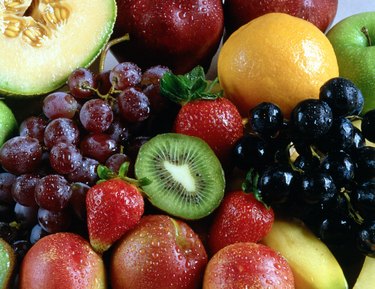
Sugar includes two main types: added sugar and naturally occurring sugar. Sugar is often added to processed foods such as baked goods, desserts, breakfast cereals, condiments, salad dressings and marinades. In contrast, sugar occurs naturally in fruit, vegetables and milk.
Basic Guidelines
Video of the Day
The United States Department of Agriculture makes no specific recommendation about the amount of natural sugar you should consume every day, but does provide guidelines about consuming sources of natural sugar -- how much fruit, vegetables and dairy products you should include in your daily menu. If you need to lose weight or lower your triglycerides, a type of fat that can clog your arteries and make you susceptible to heart attacks and strokes, choose less-sweet fruits and vegetables, such as raspberries and broccoli, over choices such as raisins and corn. Keep your intake of added sugars to a minimum -- about 100 calories a day for women and 150 for men.
Video of the Day
Fruit
Include 1 1/2 to 2 cups of fruit in your daily menu. As a general guideline, 1 cup of 100 percent fruit juice, 1/2 cup of dried fruit or 1 average-size piece of whole fruit equals 1 cup of fruit. Low-sugar choices among fruits includes blueberries, 14.74 g, and pears, 17.44 g per 1 medium. Fruit juices and dried fruits tend to contain more sugar than does fresh fruit. One cup of 100 percent orange juice contains 20.83 g of sugar, and 1/2 cup of raisins contains 42.91 g of sugar.
Vegetables
Women should consume between 2 cups and 2 1/2 cups of vegetables every day, and men should include 2 1/2 cups to 3 cups in their daily menus. Equivalents include 1 cup of raw or cooked vegetables, 1 cup of vegetable juice or 2 cups of raw green leafy vegetables. If you want to limit your intake of natural sugar, keep these examples in mind: 1 cup of chopped raw carrots contains 6.07 g of sugar, 1 cup of cooked broccoli contains 2.16 g of sugar, 1 cup of tomato juice contains 8.65 g of total sugar and 2 cups of raw spinach provides 0.26 g of sugar.
Milk and Dairy
Adult men and women should consume 3 cups of dairy products daily. In general, equivalents to 1 cup of milk or soy milk include 1 cup of yogurt, 1 1/2 oz. of natural cheese or 2 oz. of processed cheese. Consider that 1 cup of 2 percent milk contains approximately 12.18 g of total sugar, 1 cup of non-fat fruit yogurt contains 46.55 g of total sugar, 1 1/2 oz. of low-moisture reduced-fat mozzarella cheese contains 0.25 g of total sugar and 2 oz. of shredded processed American cheese contains 0.16 g of total sugar.
- American Diabetes Association: Food and Fitness – Carbohydrates
- MayoClinic.com; Nutrition and Healthy Eating – Carbohydrates: How Carbs Fit into a Healthy Diet; February 2011
- United States Department of Agriculture Nutrient Database
- United States Department of Agriculture: What Counts as a Cup in the Dairy Group?