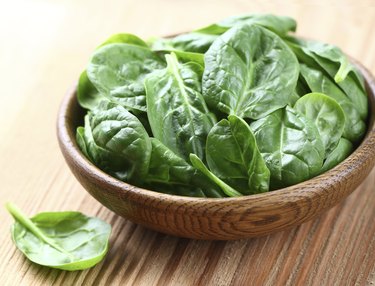
Spinach packs a powerful nutrient punch, whether you eat it fresh or cooked. While it may seem that cooked spinach contains more nutrients if you measure it cup for cup, this isn't really a fair comparison since it takes about 6 cups of fresh spinach to get 1 cup of cooked spinach. Cooking spinach can decrease the amount of some nutrients.
Similar Macronutrient Content
Video of the Day
Fresh and cooked spinach contain about the same amount of macronutrients in a 100-gram serving, which is about 3 1/3 cups of raw or about 1/2 cup of cooked spinach. Each serving provides about 23 calories, 3 grams of protein, 0.3 grams of fat and 3.8 grams of carbohydrates, including 2.4 grams of fiber, or 10 percent of the daily value. Fiber helps fill you up, lowers your risk for high cholesterol, high blood sugar, heart disease and digestive conditions like hemorrhoids and constipation.
Video of the Day
Major Vitamin Differences
The main difference between fresh and cooked spinach is the level of vitamins they contain. Each 100-gram serving of fresh spinach provides 47 percent of the daily value for vitamin C, but the same amount of cooked spinach only contains 16 percent. The same is true when it comes to folate, with fresh spinach providing 49 percent of the DV and cooked spinach only 38 percent. Cooked spinach, however, contains a bit more of vitamins A, B-6, K and riboflavin.
Minimal Mineral Loss
As with macronutrients, the mineral content of both fresh and cooked spinach is very similar. Both provide significant amounts of calcium, iron, magnesium, potassium and manganese, with cooked spinach providing slightly higher amounts of all of these nutrients except for potassium. Calcium and magnesium help you form strong bones, and iron helps form red blood cells. Potassium counteracts the adverse effects of sodium on your blood pressure, and manganese is important for processing cholesterol in your body.
Things to Consider
Spinach is nutrient-dense whether you eat it raw or cooked. While some nutrients are lost during the cooking process, cooked spinach is a lot more compact. so you can eat more of it in one sitting, making it easier to consume more nutrients overall. Using the right cooking methods can help you limit nutrient losses. Nutrients are lost during cooking due to leaching into water, long cooking times or high heat. Steaming and microwaving tend to be among the best cooking methods for maintaining nutrients, since they don't involve immersing the vegetables in water or very long cooking times.