What does fact checked mean?
At Healthfully, we strive to deliver objective content that is accurate and up-to-date. Our team periodically reviews articles in order to ensure content quality. The sources cited below consist of evidence from peer-reviewed journals, prominent medical organizations, academic associations, and government data.
The information contained on this site is for informational purposes only, and should not be used as a substitute for the advice of a professional health care provider. Please check with the appropriate physician regarding health questions and concerns. Although we strive to deliver accurate and up-to-date information, no guarantee to that effect is made.
Liquid Chlorophyll & Wheat Grass
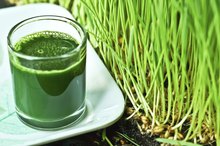
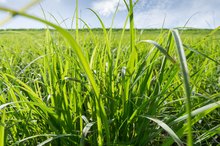
Wheat grass boasts an assortment of nutrients and phytochemicals, and is popular as a juice and dietary supplement. Along with containing calcium, iron, magnesium, vitamin C, vitamin E and vitamin A, wheat grass contains ample amounts of the green plant pigment chlorophyll. Although wheat grass is purported to boost immunity and alleviate some diseases, it's uncertain whether chlorophyll plays a role in these health benefits 3.
Explanation of Chlorophyll
Chlorophyll is a green-pigmented molecule that allows plants to absorb energy from the sun and harness it for photosynthesis, the process of creating carbohydrates from water and carbon dioxide. Found only in green plants, chlorophyll has a molecular structure similar to that of hemoglobin in blood, according to the University of Bristol School of Chemistry 4. Like other grasses, the young, green blades of the wheat grass plant are an abundant source of this molecule.
Wheatgrass Claims
Difference Between Wheat & Wheatgrass
Learn More
Proponents of wheat grass believe this food can boost your immune system and help you heal from diseases such as cancer, diabetes, ulcerative colitis and arthritis, while also improving digestion and fighting harmful bacteria in your body. Many of these healing effects are attributed to the liquid chlorophyll found in wheat grass, which wheat-grass advocates claim can rebuild the bloodstream, revitalize tissues and detoxify the body. Ann Wigmore, a natural health practitioner and one of the earliest modern advocates of wheat grass, is largely responsible for the belief that chlorophyll instills wheat grass with healing properties, according to the National Council Against Health Fraud 2.
Evidence of Benefits
Evidence supporting the role of chlorophyll and wheat grass in human health is limited, and it's uncertain how well the human body can absorb or metabolize this molecule. As the Linus Pauling Institute explains, chlorophyll and its derivative, chlorophyllin, may help destroy cancer cells, can accelerate wound healing by killing bacteria and may help prevent liver cancer in people exposed to carcinogens 5. However, studies showing beneficial effects of chlorophyll on disease typically administer chlorophyll directly onto cancer cells, rather than having subjects ingest chlorophyll orally. As a consequence, the results of these studies may not apply to chlorophyll consumed via wheat grass.
- Evidence supporting the role of chlorophyll and wheat grass in human health is limited, and it's uncertain how well the human body can absorb or metabolize this molecule.
- As the Linus Pauling Institute explains, chlorophyll and its derivative, chlorophyllin, may help destroy cancer cells, can accelerate wound healing by killing bacteria and may help prevent liver cancer in people exposed to carcinogens 5.
Things to Consider
Does Chlorophyll Cleanse the Blood?
Learn More
Although the role of chlorophyll in human health is uncertain, wheat grass may still be a beneficial addition to your diet. Wheat grass contains a spectrum of vitamins and minerals, according to the American Cancer Society 1. It also contains amino acids that may help boost immunity and keep you healthy. In addition, wheat grass can count towards your daily recommended consumption of vegetables. If you have celiac disease or a wheat allergy, consult your physician before consuming wheat grass.
- Although the role of chlorophyll in human health is uncertain, wheat grass may still be a beneficial addition to your diet.
- In addition, wheat grass can count towards your daily recommended consumption of vegetables.
Related Articles
Difference Between Wheat & Wheatgrass
Learn More
Does Chlorophyll Cleanse the Blood?
Learn More

Can You Eat Wheatgrass Raw?
Learn More
Differences Between Wheat Germ & Wheatgrass
Learn More
Wheatgrass & Weight Loss
Learn More

Wheatgrass for Anemia
Learn More
Allergy to Wheat Grass
Learn More
Torula Yeast Allergy
Learn More

Herbs to Shrink Colon Polyps
Learn More

Side Effects of Chlorella Supplements
Learn More
References
- American Cancer Society: Wheatgrass
- National Council Against Health Fraud: Wheatgrass Therapy
- WheatGrassKits.com: 40 Benefits of Wheat Grass
- University of Bristol School of Chemistry: Chlorophyll
- Linus Pauling Institute: Chlorophyll and Chlorophyllin
- BeBeautiful.com. Benefits of Chlorophyll for Your Skin. By Vishwa Khare. April 29, 2018. Mumbai, Maharashtra, India: BeBeautiful lever.care@unilever.com https://www.bebeautiful.in/articles/benefits-of-chlorophyll-for-your-skin
- Vaňková K, Marková I, Jašprová J, et al. Chlorophyll-Mediated Changes in the Redox Status of Pancreatic Cancer Cells Are Associated with Its Anticancer Effects. Oxid Med Cell Longev. 2018;2018:4069167. doi:10.1155/2018/4069167
- McQuistan TJ, Simonich MT, Pratt MM, et al. Cancer chemoprevention by dietary chlorophylls: a 12,000-animal dose-dose matrix biomarker and tumor study. Food Chem Toxicol. 2012;50(2):341–352. doi:10.1016/j.fct.2011.10.065
- MedlinePlus. US National Library of Medicine. Chlorophyll. 10/16/2017. Last updated 23 March 2020. Bethesda, Md.: U.S. National Library of Medicine U.S. Department of Health and Human Services National Institutes of Health 2020 https://medlineplus.gov/ency/article/002893.htm
- Ferruzzi MG, Blakeslee J. Digestion, absorption, and cancer preventative activity of dietary chlorophyll derivatives. Nutrition Research. 2007;27(1):1-12. doi:10.1016/j.nutres.2006.12.003
- Chimploy K, Díaz GD, Li Q, et al. E2F4 and ribonucleotide reductase mediate S-phase arrest in colon cancer cells treated with chlorophyllin. Int J Cancer. 2009;125(9):2086–2094. doi:10.1002/ijc.24559
- Yun CH, Jeong HG, Jhoun JW, Guengerich FP. Non-specific inhibition of cytochrome P450 activities by chlorophyllin in human and rat liver microsomes. Carcinogenesis. 1995;16(6):1437-1440. doi:10.1093/carcin/16.6.1437
- Yun CH, Jeong HG, Jhoun JW, Guengerich FP. Non-specific inhibition of cytochrome P450 activities by chlorophyllin in human and rat liver microsomes. Carcinogenesis. 1995;16(6):1437-1440. doi:10.1093/carcin/16.6.1437
- Xu XF, Hu JP, Cheng X, et al. Effects of sodium ferrous chlorophyll treatment on anemia of hemodialysis patients and relevant biochemical parameters. J Biol Regul Homeost Agents. 2016;30(1):135-140.
- Wangcharoen W, Phimphilai S. Chlorophyll and total phenolic contents, antioxidant activities and consumer acceptance test of processed grass drinks. J Food Sci Technol. 2016;53(12):4135–4140. doi:10.1007/s13197-016-2380-z
- Stenblom EL, Montelius C, Östbring K, et al. Supplementation by thylakoids to a high carbohydrate meal decreases feelings of hunger, elevates CCK levels and prevents postprandial hypoglycaemia in overweight women. Appetite. 2013;68:118-23. doi:10.1016/j.appet.2013.04.022
- Köhnke R, Lindqvist A, Göransson N, et al. Thylakoids suppress appetite by increasing cholecystokinin resulting in lower food intake and body weight in high-fat fed mice. Phytother Res. 2009;23(12):1778-1783. doi:10.1002/ptr.2855
- Linus Pauling Institute. Micronutrient Information Center. Oregon State University. Chlorophyll and Chlorophyllin. Summary. Reviewed June 2009. Corvallis, Oregon: Linus Pauling Institute Oregon State University 2020 https://lpi.oregonstate.edu/mic/dietary-factors/phytochemicals/chlorophyll-chlorophyllin
Writer Bio
Denise Minger, an independent researcher, writer, editor and public speaker, published her first book, "Death by Food Pyramid," in January 2014. Passionate about health, she runs a blog at rawfoodsos.com dedicated to debunking bad nutritional science, and offers health consultations for individuals with special dietary goals.