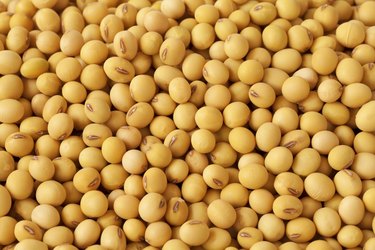
Genetically modified organisms, GMOs, seem to offer the most effective way to feed the 795 million people who don't have enough food. The public, however, has shown resistance to products made using these organisms. Some authors claim that genetic engineering offers no threat, yet reports of negative effects of GMOs like environmental concerns and allergic reactions persist in the media. Understanding these issues will help you make good buying decisions.
Understand Genetic Engineering
Video of the Day
People have used genetic alteration to increase productivity and profit for 30,000 years, but modern genetic engineering began in 1973. That's when Stanley Cohen and Herbert Boyer created the first GMO using gene transfer. This important discovery has led to endless possibilities and many remain controversial. That controversy seems endless as scientists still can't reach a consensus about the safety of GMOs.
Video of the Day
You can educate yourself about these important issues by reading the article Advantages & Disadvantages of Biotechnology on Food Health. The author lists the advantages of GMOs like having an extended shelf life. The article also points out the disadvantages of GMOs like the lack of data on long-term effects. It also describes the current U.S. regulations on genetic engineering.
Recognize the Benefits
Genetic engineering offers many benefits. It can, for example, play a role in combating global warming. The current pesticides used by farmers emit many greenhouse gases. Scientists can alter the genetic makeup of crops so that they need fewer of these harmful chemicals and thereby decrease their carbon footprint.
Using GMOs might also help people living in impoverished conditions. Genetically altered seeds can increase the yield of small-scale farms, generating rural jobs with better wages, according to a 2017 report in the Canadian Journal of Development Studies. These improvements filter down to the average consumer as well. Without GMOs, the average food budget in the U.S. would increase 28.7 percent.
Yet there are more important issues than saving money. Genetic engineering offers a way to feed the world despite global warming. Climate change has led to more drought. Scientists can make GMOs which are more tolerant of high temperatures and dry conditions, according a 2015 paper from Harvard University.
Read more: Benefits You Get From a GMO
Be Wary of the Cost
Unfortunately, the many benefits of GMOs come at a great cost. The main cost is long-term environmental damage. A 2018 report in PNAS describes what can happen when humans try to change ecosystems. It can lead to an uncontrollable chain reaction, which only becomes clear over a long period.
For example, using a herbicide to kill a pest might take away the natural enemy of another pest. As that pest rises in strength, farmers increase their use of pesticides. This increase leads to pesticide resistance, and new pesticide-resistance species appear. This cascade of events has happened several times, and it might represent an unending cycle of environmental damage.
Identify Your Risk
Most GMOs tolerate the pesticide glyphosate, but this genetic alteration remains controversial because this pesticide might cause cancer. From 1995 to 2002, the use of glyphosate went from 2,500 to 30,000 tons a year. This increase shows the dramatic rise of growing GMOs. In fact, 94 percent of soybeans and 89 percent of corn grown in the U.S. are genetically modified.
Glyphosate residue leaches into the genetically modified food grown in treated fields through a process called desiccation__.__ When you eat these foods, you might allow glyphosate into your gastrointestinal tract. This exposure likely has negative consequences. For example, increases in circulating glyphosate correlate with a diagnosis of autism.
You can decrease your exposure to glyphosate in the U.S. by buying products with a special label. That label includes the statement Non-GMO Project Verified. A nonprofit organization known as the Non-GMO Project offers this label in compliance with the USDA's Food Safety and Inspection Service rules. These guidelines cover how companies can make label or labeling claims.
Know the Consumer Backlash
Genetic engineering has actually moved slower than expected because of consumer resistance. In fact, some consumers think that GMOs are Frankenfoods or monster-like creations destined to destroy society. Younger people, especially women, remain skeptical about GMOs despite the safety claims of manufacturers like Monsanto.
A 2015 report in Cell Press describes how this resistance has slowed the progress of genetic engineering. For example, the EU allows only two genetically altered crops. It's important to carefully move forward, but anti-GMO activists should remember that thousands of lives have been lost by blocking GMOs in Africa.
Protect the Macroenvironment
The effects of GMOs on the environment remain one of the biggest concerns. For example, farmers might fail to limit genetically modified crops to a certain area. Bees take pollen from genetically altered corn, and they might transfer it between fields. This possible transfer brings up moral issues such as identifying who's responsible for the potential damage.
A 2017 article in PLoS One showed that this transfer does indeed happen. Starting an experimental field featuring transgenic bentgrass planted in 2002 led to the plant still appearing in nearby areas 13 years later. The authors argued that factors other than pollen transfer explain these disturbing results. Foremost among these factors is wind dispersal, which is nearly impossible to control.
Similar issues arise with genetically modified salmon. A mathematical model suggests that the accidental release of transgenic animals could end the wild population. Fortunately, manufacturers can take steps to prevent this Trojan gene effect from happening. These steps include keeping the transgenic animals isolated and making them sterile.
Protect the Microenvironment
Environmental damage might also happen at a smaller scale. For example, the roots of transgenic plants can release toxic proteins into the soil. Another issue is that some marker genes give the transgenic plant antibiotic resistance, and this quality also leeches into the soil. Most disturbing, few researchers have even bothered to test the impact of GMOs on the soil.
Avoid Allergic Reactions
The GMO side effects on humans also remain a concern. New genetic technologies have the unwanted effect of the added gene possibly entering the host's genome causing a permanent alteration in its basic genetic structure. A 2016 report in Biological and Pharmaceutical Bulletin showed that this result seems unlikely to happen. Yet the new technology created unexpected proteins, and one of these proteins was very similar to a known allergen.
Other evidence also suggests that using GMOs will trigger allergic reactions. More than 20 years ago, a company wanted to add a Brazil nut gene to their soybeans. Brazil nuts cause an allergic reaction in some people, and the transgenic soybean had the same effect in sensitive subjects.
You can avoid these allergic reactions by buying non-GMO products. Buying organic foods gives you an easy way to avoid genetic engineering. Look for products with the USDA Organic label. In the U.S., buying organic products guarantees that they don't feature GMOs.
Save the Animals
Creating GMOs can also create ethical issues about animal treatment. Genetically altered salmon, for example, experience physiological changes which many animal rights activists consider cruel. A 2018 article in the Transactions of the American Fisheries showed that these salmon show alterations in their organs and bones. These changes have a negative impact on their swimming ability.
These genetic changes also bring up darker issues. A 2019 paper in Scientific Reports showed that transgenic salmon have a greater rate of survival in crowded conditions, and that they survive because they better manage cannibalism and starvation.
Prevent Pesticide Resistance
The great use of herbicides like glyphosate has unexpected consequences. Similar to what happens with the overuse of antibiotics, antigens develop resistance by mutating into new strains. At least 34 glyphosate-resistant weeds now exist around the world because of herbicide resistance. This change is part of a disturbing trend with 249 herbicide-resistant weeds currently known.
Farmers have also become more dependent on glyphosate. They now rotate crops less and often fail to pursue alternative forms of pest management. There's also been less conservation tillage. These negative changes do more than just generate weeds, they also decrease soil quality.
Read more: Side Effects of Long-Term Antibiotic Use
Protect the Children
The widespread use of glyphosate also affects human lives. The International Agency for Research on Cancer has classified glyphosate as probably carcinogenic to humans and likely to damage their genetic structure. The herbicide also seems to alter human pregnancy. For example, 90 percent of a sample of pregnant women in Indiana had detectable levels of glyphosate, and these levels correlated with having a shortened pregnancy.
An association between glyphosate exposure and birth defects also exists. A 2017 paper in Birth Defects Research showed that women exposed to the herbicide were more likely to have children with a heart condition. Findings in laboratory animals support this correlation with more direct evidence. Exposing neonatal rats to glyphosate altered the development of their bodies.
A report from the Virginia Cooperative Extension describes ways to lower your exposure to glyphosate. The authors recommend buying organic and using alternative methods of weed control. It's also important to follow the manufacturer's directions. You can wear protective equipment and keep people away from sprayed areas until the herbicide has dried.
Read more: Health Effects of Weed Killers
Save the Butterflies
The Monarch butterfly gives a rallying cry to environmental activists, who claim that glyphosate use has damaged the main food source for Monarch caterpillars: the milkweed. Recently, there has been a 58 percent decrease in milkweed plants and an 81 percent decrease in Monarch butterflies, according to a 2017 article in Insect Conservation and Diversity. These changes might make the Monarch vulnerable to extinction.
It will take participation from all levels of society to reverse this disturbing trend. One Green Planet has an extensive list of things you can do to help save the Monarch butterfly. This list includes not using pesticides and avoiding GMOs. It also features advice like planting milkweed plants and building butterfly way stations.
Adverse Effects of GMO Crops
A large divide exists between the opinions of the manufacturers and the public about GMOs. Manufacturers typically believe that GMOs are safe, and the public typically fears that they are not. A 2016 report in the journal Sustainability describes how important it is to include everyone as genetic engineering inevitably moves forward. In Norway, for example, GMOs can only be used in an ethically justifiable and socially acceptable way.
The large number of side effects and possible risks of GMOs suggests that they don't meet these criteria at the present time. Scientists must do more research, and manufacturers must put more barriers in place to guarantee the safety of both the society and the environment.
- African Journal of Economic and Sustainable Development: Analysis of GMO Food Products Companies: Financial Risks and Opportunities in the Global Agriculture Industry
- Food Aid Foundation: Hunger Statistics
- Journal of Environmental Studies and Sciences: Arguments and Actors in Recent Debates Over US Genetically Modified Organisms
- Tufts University: GMO Foods as Safe as Conventional Choices
- Harvard University: From Corgis to Corn
- Environmental Sciences Europe: No Scientific Consensus on GMO Safety
- Nature: Plants: Essential Need for GM Crops
- Canadian Journal of Development Studies: GMOs and Poverty
- AgBioForum: Cost of a GMO-Free Market Basket of Food in the United States
- Harvard University: Feeding the World One Genetically Modified Tomato at a Time
- PNAS: New Pests for Old as GMOs Bring on Substitute Pests
- Ciencia and Saude: Use of Genetically Modified Crops and Pesticides in Brazil
- Around the World in 80 Species: Ecological Auto Ethnography of a Monarch Butterfly
- Integrative Medicine: Elevated Urinary Glyphosate and Clostridia Metabolites With Altered Dopamine Metabolism in Triplets With Autistic Spectrum Disorder or Suspected Seizure Disorder
- Food and Chemical Toxicology: Impact on Environment, Ecosystem, Diversity and Health From Culturing and Using GMOs as Feed and Food
- Science: How a Horror Story Haunts Science
- International Journal of Agricultural Resources, Governance and Ecology: Examination of Millennials' Attitudes Toward Genetically Modified Organism (GMO) Foods
- University of Cincinnati: Seeds of Consciousness
- Cell Press: Fatal Attraction
- Journal of the Science of Food and Agriculture: Legislation Governing Genetically Modified and Genome-Edited Crops in Europe
- Environmental Sciences Europe: Spread of Volunteer and Feral Maize Plants in Central Europe: Recent Data From Austria
- Science and Engineering Ethics: Gone With the Wind
- PLoS One: Pollen-Mediated Gene Flow From Transgenic Perennial Creeping Bentgrass and Hybridization at the Landscape Level
- Springer Handbook of Marine Biotechnology: Principles and Application of Transgenic Technology in Marine Organisms
- Visions for Sustainability: Impact of Genetically Modified Salmon
- Research in Microbiology: Below Ground Environmental Effects of Transgenic Crops
- Biological and Pharmaceutical Bulletin: Cas9 in Genetically Modified Food Is Unlikely to Cause Food Allergy
- Cloning and Transgenesis: Biosafety Issues of Genetically Modified Crops
- U.S. Department of Agriculture: USDA Organic
- Transactions of the American Fisheries Society: Internal Morphological Effects of Growth Hormone Transgenesis in Coho Salmon
- Scientific Reports: Importance of Experimental Environmental Conditions in Estimating Risks and Associated Uncertainty of Transgenic Fish Prior to Entry Into Nature
- Environmental Sciences Europe: Herbicide Resistance and Biodiversity
- Government of Western Australia: Herbicide Resistance
- Purdue University: What Is Conservation Tillage?
- U.S. Department of Agriculture: APHIS Petition Number 09-233-01p
- International Agency for Research: IARC Monograph on Glyphosate
- Environmental Health: Glyphosate Exposure in Pregnancy and Shortened Gestational Length
- Birth Defects Research: Maternal Residential Exposure to Specific Agricultural Pesticide Active Ingredients and Birth Defects in a 2003-2005 North Carolina Birth Cohort
- Toxicology: Neonatal Exposure to a Glyphosate Based Herbicide Alters the Development of the Rat Uterus
- Virginia Cooperative Extension: Glyphosate Q & A Sheet
- Bioscience: Monarch Butterfly Through Time and Space
- Insect Conservation and Diversity: Milkweed Loss in Agricultural Fields Because of Herbicide Use
- Scientific Reports: Quasi-Extinction Risk and Population Targets for the Eastern, Migratory Population of Monarch Butterflies (Danaus plexippus)
- Conservation Letters: Restoring Monarch Butterfly Habitat in the Midwestern US
- One Green Planet: 8 Ways You Can Help Save Monarch Butterflies
- Sustainability: Inclusion and Implementation of Socio-Economic Considerations in GMO Regulations
- Non-GMO Project: About
- United States Department of Agriculture: Food Safety and Inspection Service
- Natural Resource Defense Council: ATSDR Report Confirms Glyphosate Cancer Risks