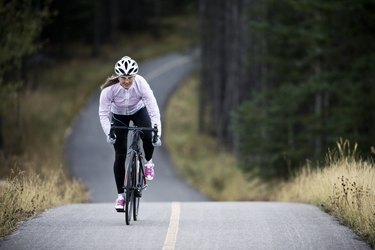
During a spin class or a long bike ride outdoors, you'll probably feel your leg muscles work hard. BetterHealth notes that lots of incredibly complex muscles in all major muscle groups are used during cycling, expanding beyond your legs into your buttocks, abdomen and even into your upper body. The primary muscles used during cycling, however, include the upper leg muscles, the calf muscles and the glutes. To improve the efficacy of these muscles while cycling, it may be a good idea to stretch beforehand as well.
Tip
Cycling activates a variety of complex muscles across all muscle groups in the body, but the main ones include the quadriceps and hamstrings in the thigh, the glutes in the buttocks, and the gastrocnemius and soleus in the calves.
Video of the Day
The Cycling Phases
Cycling is considered a healthy alternative to driving a car because it's less harmful on the joints than some exercises, it provides an aerobic workout and it builds muscle. It also helps improve posture, bones, joint mobility, the cardiovascular system and stress levels.
Video of the Day
Biking is a cyclical exercise, consisting of the two main phases and two transitional phases. The first main phase is the power phase, which involves pushing down on the pedal using mostly the muscles in your buttocks, thighs and calves. The recovery phase consists of using your hamstrings as well as the flexor muscles in your hips, according to Harvard Health Publishing.
Quadriceps, Hamstrings and Calf Muscles
Your quadriceps, or quads, are the big muscles located in the front of your thigh. These muscles are activated when you're pushing down on the bike pedal, contributing to your momentum. Using your quads is necessary to produce power and movement on the bike, according to a July 2016 study published in the European Journal of Applied Physiology, which examined the role of eight thigh muscles used during cycling.
The same 2016 study notes that your hamstrings — the group of muscles and tendons in the back of your thigh — are used alongside the quads when pedaling. A combination of superficial and deeper muscles are also used when cycling, the study found. Deeper muscles include the biceps femoris short head (BFS), which are part of the hamstrings, and the vastus intermedius (Vint), which is part of the quadriceps.
The calf muscles play a lesser role in the pushing motion of pedaling, but they still work together with the hamstrings and quads. The gastrocnemius and soleus are used to stabilize the ankles and legs during the pushing motion.
Read more: Exercise Bike vs. Walking
Work Your Gluteals
Those spin classes or uphill bike rides are likely to be working your buttocks just as much as your thighs and calves. In addition to the hamstrings and quadriceps, the gluteals are another main muscle force used during cycling. The gluteals consist of three muscles that make up the buttocks, including the gluteus maximus, the gluteus medius and the gluteus minimus. The gluteus maximus is the largest muscle in the glutes and also the most important during biking. This is why cyclists often have very toned glutes.
Abdominal and Upper-Body Muscles
Abdominal muscles take charge during cycling to help keep your body upright on the bike, according to Harvard Health Publishing. Aside from keeping your body steady during the ride, your abs and upper muscles will be active during an uphill cycle when you begin pulling on the handlebars, which activates the biceps and triceps.
The cycle of the power and recovery phases in biking, if maintained for even a short time, can work all of these muscles. That's why biking is a good way to fight sedentary lifestyles: Ditch the car or cab for short trips and start building those muscles.
- Department of Health and Human Services, State Government of Victoria, Australia: BetterHealth: "Cycling - Health Benefits"
- Exploratorium: "How Do Your Muscles Work"
- European Journal of Applied Physiology: "Quadriceps and Hamstring Muscle Activity During Cycling as Measured With Intramuscular Electromyography"
- Harvard Health Publishing: "The Top 5 Benefits of Cycling"